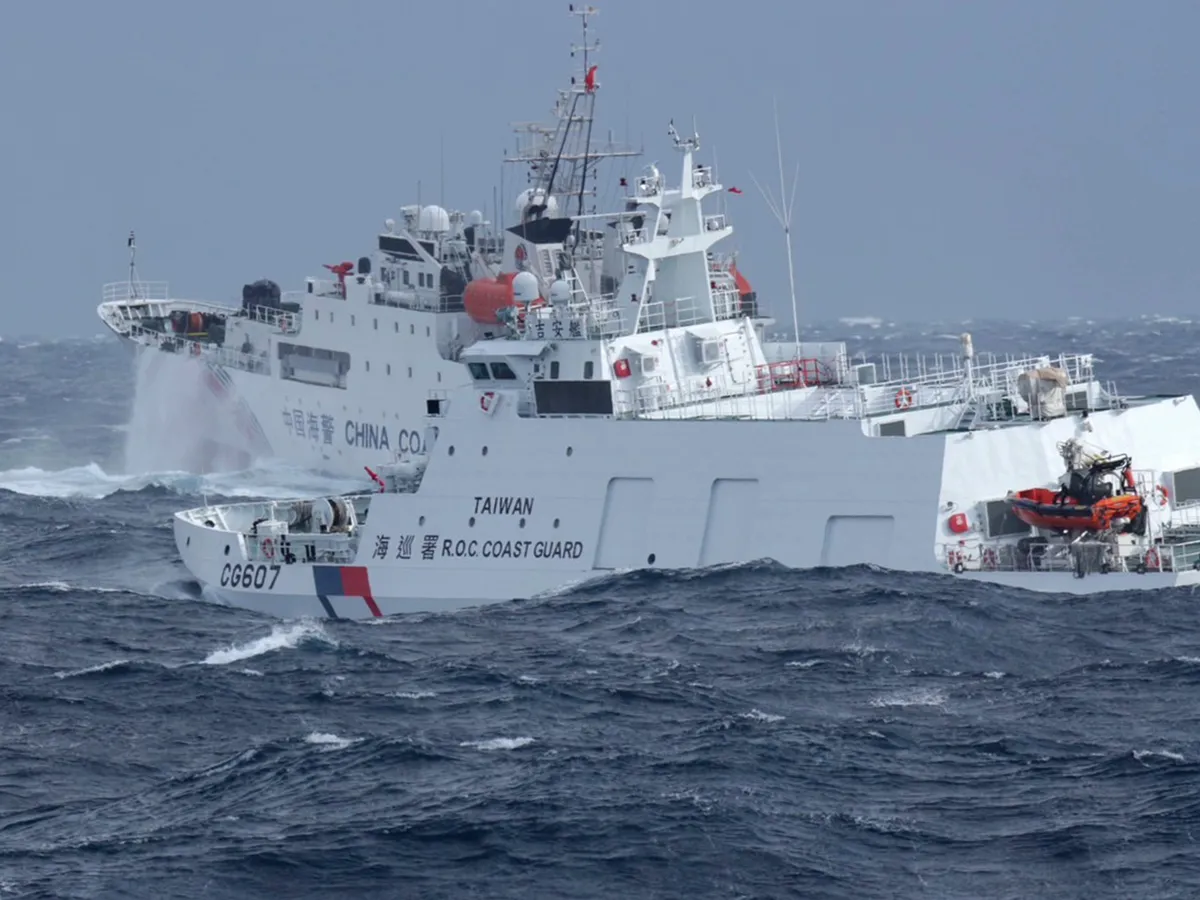
New law enforcement operations could quickly escalate into a blockade of Taiwan, say analysts.Taiwan-coastguard" class="entity-link entity-organization" data-entity-id="173765" data-entity-type="organization">Taiwan coastguard vessel Ji An, right, chases after Chinese coastguard vessel 1302 off the coast of Hualien, eastern Taiwan, on December 12, 2024 [Handout/Taiwan Coast Guard via AP]Published On 29 Jul 2026Taipei, Taiwan – China’s coastguard and civilian fleet are expanding their presence in the waters east of Taiwan, raising fears that Beijing may be rehearsing a containment strategy that would cut off the self-ruled island from outside trade and assistance.Through June and July, China’s Maritime Safety Administration and coastguard staged multiple patrols and “special maritime law enforcement operations”, according to official government announcements.Recommended Stories list of 4 itemslist 1 of 4England vs Norway: Key talking points ahead of World Cup quarterfinallist 2 of 4Bayeux Tapestry smuggled into Britain for first visit in 1,000 yearslist 3 of 4Administration without sovereignty will not free Palestinelist 4 of 4Bodies found in cars as deadly Spain wildfire kills at least 12end of listWhile China regularly patrols the Taiwan-strait" class="entity-link entity-location" data-entity-id="5508" data-entity-type="location">Taiwan Strait – the waterway with an average width of about 180km (112 miles) separating coastal China from the main island of Taiwan – this marks the first time the patrols have moved east of Taiwan in such quick succession, according to analysts.K Tristan Tang, a nonresident fellow at the United States-based National Bureau of Asian Research, said the shift carries both strategic and symbolic weight for Taiwan.“Beijing is signalling that it wants to extend its claimed administrative jurisdiction to Taiwan’s eastern waters, effectively surrounding Taiwan rather than only eroding Taiwan’s space in the strait,” Tang told Al Jazeera.“Law enforcement operations” have included patrolling the area and requesting information from commercial vessels about their origin and destination, according to Taipei.The shift east has also occurred amid a greater uptick in Chinese maritime activity around Taiwan and its outlying islands. Taiwan reported 55 sightings of Chinese coastguard and research vessel activity in June, up from 30 sightings in May.These sightings included Chinese activity near the uninhabited Taiwan-controlled Dongsha Islands, also known as the Pratas Islands, in the China-sea" class="entity-link entity-location" data-entity-id="8346" data-entity-type="location">South China Sea.Beijing has said the operations are a response to talks between Japan and the Philippines to set their maritime boundaries, which infringe on “territorial sovereignty as well as its maritime rights and interests”, according to Chinese state media.Some of the waters around southern Japan and the northern Philippines overlap with Taiwan’s Exclusive Economic Zone (EEZ), which extends 200 nautical miles (370km) from its coastline.On July 4, China’s coastguard announced that law enforcement activities to the east of Taiwan would continue to “firmly safeguard China’s territorial sovereignty and maritime rights and interests”.China claims Taiwan as a province – which means it also views Taiwan’s EEZ as under its jurisdiction. It also claims large swaths of the nearby China-sea" class="entity-link entity-location" data-entity-id="8346" data-entity-type="location">South China Sea and East China Sea, some of which are disputed by Japan, the Philippines, Vietnam, Malaysia, Indonesia and Brunei.China’s Ministry of Foreign Affairs has previously told reporters that its activities near Taiwan are “legitimate actions to exercise China’s jurisdiction, safeguard regional stability and uphold order at sea in accordance with the law”.The Chinese embassy in Washington, DC did not immediately respond to Al Jazeera’s request for comment.‘Grey zone’ tacticsRay Powell, founder and director of Sea Light, a maritime transparency project based at Stanford University, said he views the uptick in patrols as part of China’s “boa constrictor strategy that intends to squeeze Taiwan one coil at a time”.China has pledged to annex Taiwan by peace or by force, and it employs a variety of pressure tactics, from cutting off access to international spaces such as the World Health Organization, drone and fighter jet incursions, to alleged cyberattacks, according to Taiwan’s National Security Bureau.Known as “grey zone” tactics, these manoeuvres are designed to strain Taiwan’s limited resources and damage morale in order to convince its 23 million people that annexation is inevitable, according to Taiwanese officials.Security analysts like Powell have warned that “law enforcement” activities could quickly escalate into a blockade or quarantine. Taiwan is particularly vulnerable to this type of pressure as an island that imports nearly all its energy supplies.“One day we could look back at this and say this was in some ways the start of the quarantine,” he told Al Jazeera.“Today it’s radio challenges; what is the next stage after that? When do we start to see them stop and inspect ships or reroute them? It’s not a very big step to start squeezing Taiwan on things it needs, like LNG,” Powell said.China has already signalled that a blockade could be on the table in the future. Since 2022, Beijing has regularly staged large-scale military exercises in the Taiwan-strait" class="entity-link entity-location" data-entity-id="5508" data-entity-type="location">Taiwan Strait, including a simulated blockade of the island during its last round of exercises in December.While coastguard activity is more low-profile than a naval patrol, Chauluen Lin, an expert in asymmetric warfare at Taipei’s Institute for National Defense and Security Research, told Al Jazeera the fleet could be considered a “second navy”.China’s coastguard is not a civilian police force, as it falls under the jurisdiction of the Central Military Commission as a division of the People’s Armed Police.An aerial view of the outlying Atoll National Park of the Dongsha Islands, also known as the Pratas Islands, 236km (147 miles) southwest of the southern Taiwanese port of Kaohsiung, Taiwan, on September 15, 2010 [Peter Enav/AP Photo]China’s coastguard patrols have been unusual enough to elicit a rare joint response from the United Kingdom, Germany and France, who said in late June that the “actions threaten regional stability and the freedom of navigation and safety of international shipping”.“We reiterate our opposition to any unilateral change to the status quo, particularly by threat or use of force or coercion,” the statement said.US Secretary of State Marco Rubio said last week that Washington disagrees with the expanded patrols and that they undermine regional stability.A distracted USWilliam Yang, the Crisis Group’s senior analyst for Northeast Asia, told Al Jazeera that Beijing may be taking advantage of a US distracted by the war in Iran and a president who appears ambivalent towards Taiwan.Although the US does not recognise Taiwan as a country, it has pledged to help the island defend itself. Much of this assistance has come in the form of weapons sales, training and intelligence sharing.US President Donald Trump also cast doubt on these commitments when he said US weapons sales could be a “negotiating chip” with China following a meeting with Chinese leader Xi Jinping in May.“The external environment has fundamentally changed in the Indo-Pacific region, at least from their perspective, with Washington very focused and tangled up in the Middle East,” Yang said.“At the same time, the US has no bandwidth to really look at or respond to such an expansion of Chinese maritime operations in these sensitive waters,” he added.
SRCAl Jazeera
LANGEN
LEANCenter
WORDS1 132
ENT12
WED · 2026-07-29 · 05:22 GMTBRIEF NSR-2026-0729-97027
NSR-2026-0729-97027News Report·EN·Political Strategy
China puts the ‘squeeze’ on Taiwan with new maritime patrols
China's coastguard and civilian fleet have expanded patrols east of Taiwan in June and July, a shift from their usual operations in the Taiwan Strait. Analysts suggest these "special maritime law enforcement operations" could be a rehearsal for a containment strategy to cut off Taiwan's trade and assistance.
Erin HaleAl JazeeraFiled 2026-07-29 · 05:22 GMTLean · CenterRead · 5 min
Al JazeeraFIG 01
Reading time
5min
Word count
1 132words
Sources cited
2cited
Entities identified
12entities
Quality score
100%
§ 01
Briefing Summary
AI-generatedNEWSAR · AI
China's coastguard and civilian fleet have expanded patrols east of Taiwan in June and July, a shift from their usual operations in the Taiwan Strait. Analysts suggest these "special maritime law enforcement operations" could be a rehearsal for a containment strategy to cut off Taiwan's trade and assistance. These patrols involve monitoring commercial vessels and requesting information about their origin and destination. This increased maritime activity around Taiwan, including near the Dongsha Islands, is occurring amid broader Chinese claims over disputed maritime areas. Beijing states these actions are legitimate exercises of jurisdiction to safeguard territorial sovereignty and maritime rights. Security analysts warn these "grey zone" tactics could escalate into a blockade, potentially impacting Taiwan's essential imports.
Confidence 0.90Sources 2Claims 5Entities 12
§ 02
Article analysis
Model · rule-basedFraming
Political Strategy
Conflict
Tone
Mixed Tone
AI-assessed
CalmNeutralAlarmist
Factuality
0.70 / 1.00
Factual
LowHigh
Sources cited
2
Limited
FewMany
§ 03
Key claims
5 extracted01
China claims Taiwan as a province.
factual
Confidence
0.95
02
Taiwan reported 55 sightings of Chinese coastguard and research vessel activity in June, up from 30 sightings in May.
statisticTaiwan
Confidence
0.90
03
China's coastguard and civilian fleet are expanding their presence in waters east of Taiwan.
factual
Confidence
0.90
04
Beijing is signalling that it wants to extend its claimed administrative jurisdiction to Taiwan’s eastern waters, effectively surrounding Taiwan.
quoteK Tristan Tang
Confidence
0.80
05
New law enforcement operations could quickly escalate into a blockade of Taiwan, say analysts.
predictionanalysts
Confidence
0.70
§ 04
Full report
5 min read · 1 132 words§ 05
Entities
12 identifiedKey playerOppositionContextPositiveNeutralNegative
People1
Organizations4
§ 06
Keywords & salience
9 termsmaritime patrols
0.90
taiwan strait
0.90
china
0.80
taiwan
0.80
blockade strategy
0.70
law enforcement operations
0.60
administrative jurisdiction
0.50
south china sea
0.40
territorial sovereignty
0.40
§ 07
Topic connections
Interactive graph Network visualization showing 51 related topics
View Full Graph Person Organization Location Event|Click node to navigate|Edge numbers = shared articles