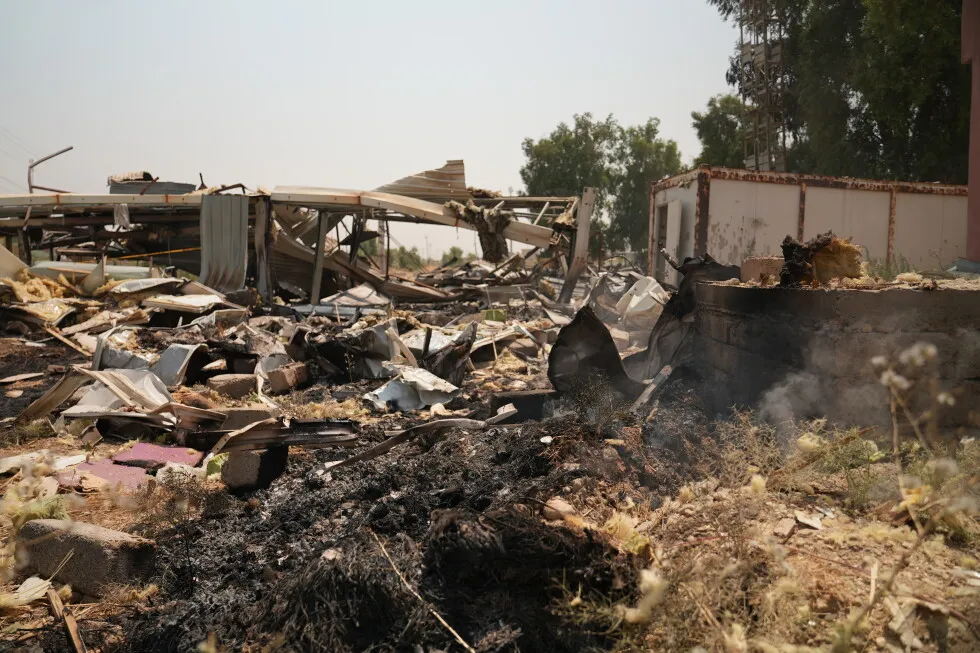
Iraq’s balancing act is only getting harder as the war between the US and Iran widens 1 of 3 | Damaged structures at the site of an airstrike on a Popular Mobilization Forces base in Mosul, Iraq, Wednesday, July 29, 2026. (AP Photo/Farid Abdulwahed) 2 of 3 | A damaged vehicle at the site of an airstrike on a Popular Mobilization Forces base in Mosul, Iraq, Wednesday, July 29, 2026. (AP Photo/Farid Abdulwahed) 3 of 3 | Iraqis inspect damaged structures at the site of an airstrike on a Popular Mobilization Forces base in Mosul, Iraq, Wednesday, July 29, 2026. (AP Photo/Farid Abdulwahed) By ABBY SEWELL Updated 4:51 PM MESZ, July 29, 2026 Add AP News on Google Add AP News as your preferred source to see more of our stories on Google. Share Share Facebook Copy Link copied Print Email X LinkedIn Bluesky Flipboard Pinterest Reddit BEIRUT (AP) — Strikes launched by the U.S. and Saudi Arabia against Iran-allied fighters in Iraq have put Iraq’s government in a delicate position — and not for the first time. Since the 2003 U.S.-led invasion, Iraq has walked a tightrope between Washington and Tehran, seeking to avoid becoming a battleground for rival powers. The balancing act has only grown more fraught since the U.S. and Israel went to war with Iran in February. Saudi Arabia had accused Iraqi armed groups of using drones to attack its oil facilities. The retaliatory strikes in Iraq hit bases of the Popular Mobilization Forces, a collection of armed groups close to Iran that are officially part of Iraq’s security forces but often operate outside of state control. The groups have also attacked U.S. forces who are in Iraq at the invitation of the government. The Iraqi government has given non-state armed groups until the end of September to disarm, but some of the most powerful — and the closest to Iran — have said they have no intention of doing so. U.S. President Donald Trump has been effusive in his praise of Iraq’s new Prime Minister Ali al-Zaidi, a political outsider and fellow businessman. But the Iraqi leader is likely to face mounting U.S. pressure to rein in the PMF, and confronting them directly could lead to internal unrest. The Iran-backed groups have fought Islamic State extremists and the US The PMF is a coalition of primarily Shiite, Iran-backed armed groups that joined in the fight against the Islamic State group after it seized large sections of Iraq in 2014. Some have roots in the Shiite insurgency that erupted after the 2003 invasion. During the war against IS, the PMF were allies of convenience with a U.S.-led international coalition battling the Sunni extremists. In 2016, Iraq designated the PMF as an “independent military formation” within the armed forces, but many of the factions remain largely autonomous. Iran resumes missile attacks as US and Saudis strike Tehran-backed militias in Iraq 2 MIN READ US thwarts an Iranian missile attack and launches strikes with Saudi Arabia against militias in Iraq 4 MIN READ US military launches new strikes on Iran as clashes escalate over shipping routes 4 MIN READ Lahib Higel, an expert at the International Crisis Group, an international think tank, said that despite officially reporting to the Iraqi military command, most of the PMF brigades “have kind of retained the same command structure as they had when they were their individual groups.” Since the U.S. and Israel attacked Iran on Feb. 28, Iraqi militias have launched regular attacks on U.S. military bases and diplomatic facilities as well as other sites, including energy infrastructure. Saudi Arabia blamed the Iraqi groups for drone attacks Saudi Arabia blamed Iran-backed Iraqi militias for launching drone attacks on Monday and Tuesday, some of which targeted petroleum facilities. The Iraqi armed groups have denied any role in the attacks. The Islamic Resistance in Iraq, an umbrella group of Iran-backed armed factions, described the Saudi claims as “fabrications” and an “attempt to justify their inability to respond to the painful Yemeni strikes that have targeted the heart of their infrastructure.” It implied that the attacks were carried out by Yemen’s Iran-backed Houthi rebels, who had themselves claimed to have attacked Saudi oil facilities. Iraq’s National Security Council condemned the U.S.-Saudi strikes, saying they had killed and injured “a number of innocent people” and undermined the Iraqi state. It said the strikes came while the Iraqi government was actively investigating and trying to address the Saudi and American concerns. It said Iraq remains committed to ensuring the withdrawal of U.S. forces and consolidating arms under state control. The PMF said the strikes killed at least 20 of its members and wounded 32. Al-Zaidi had been slated to visit Saudi Arabia on Thursday, but the trip was postponed indefinitely after the hostilities. Disarmament poses a dilemma for the Iraqi government Al-Zaidi came to power as a consensus candidate in Iraq earlier this year after months of deadlock following last year’s parliamentary elections. He was backed by a coalition of Shiite parties allied with Iran, but also received the blessing of Trump, who welcomed him at the White House this month. The prime minister has vowed to disarm non-state groups, saying they will have no justification to retain their weapons after Sept. 30 — the deadline for U.S. troops stationed in Iraq to complete their withdrawal. But Iraq faces a similar dilemma to Lebanon, where another U.S.-backed government is under mounting pressure to disarm the Iran-backed Hezbollah. If they move too aggressively, it could spark fighting in countries with bitter histories of civil conflict. If they move too slowly, they risk U.S. anger — and in Lebanon’s case, a prolonged Israeli occupation. Iraq’s predicament is in some ways easier, as some of the PMF factions could be integrated into the armed forces and brought fully under the military’s command. But others, like the powerful Kataib Hezbollah — which is especially close to Iran — have refused. “Everyone knows that this is a process that is going to take months if not years,” Higel said of the disarmament effort. “And you only have a handful that have agreed to it, while those that are the sort of self-described resistance groups have rejected it.” As long as the U.S.-Iran war continues, she said, it’s unlikely that the holdouts will yield. They “view themselves as a part of Iran’s regional network. And this is their moment to fight.” ABBY SEWELL Sewell is the Associated Press news director for Lebanon, Syria and Iraq. She joined the AP in 2022 but has been based in the region since 2016, reporting and guiding coverage on some of its most significant news stories. twitter mailto
SRCAssociated Press (AP)
LANGEN
LEANCenter
WORDS1 112
ENT12
WED · 2026-07-29 · 14:53 GMTBRIEF NSR-2026-0729-97205
NSR-2026-0729-97205News Report·EN·Conflict
Iraq’s balancing act is only getting harder as the war between the US and Iran widens
Recent U.S. and Saudi Arabian airstrikes in Iraq targeting Iran-allied Popular Mobilization Forces (PMF) have intensified Iraq's difficult balancing act between Washington and Tehran.
Associated Press (AP)Filed 2026-07-29 · 14:53 GMTLean · CenterRead · 5 min
Associated Press (AP)FIG 01
Reading time
5min
Word count
1 112words
Sources cited
1cited
Entities identified
12entities
Quality score
100%
§ 01
Briefing Summary
AI-generatedNEWSAR · AI
Recent U.S. and Saudi Arabian airstrikes in Iraq targeting Iran-allied Popular Mobilization Forces (PMF) have intensified Iraq's difficult balancing act between Washington and Tehran. These strikes, a response to Saudi accusations of drone attacks by Iraqi militias on oil facilities, hit bases of the PMF, a group officially part of Iraq's security forces but often operating autonomously and with close ties to Iran. The PMF has also attacked U.S. forces in Iraq. Iraq's government has set a September deadline for non-state armed groups to disarm, but powerful factions close to Iran have refused. Prime Minister Ali al-Zaidi faces pressure from the U.S. to control the PMF, but confronting them could lead to internal unrest. The PMF reported casualties from the strikes, and a planned visit by al-Zaidi to Saudi Arabia was postponed.
Confidence 0.90Sources 1Claims 5Entities 12
§ 02
Article analysis
Model · rule-basedFraming
Conflict
Political Strategy
Tone
Measured
AI-assessed
CalmNeutralAlarmist
Factuality
0.70 / 1.00
Factual
LowHigh
Sources cited
1
Limited
FewMany
§ 03
Key claims
5 extracted01
U.S. President Donald Trump has been effusive in his praise of Iraq’s new Prime Minister Ali al-Zaidi.
factual
Confidence
0.90
02
The Iraqi government has given non-state armed groups until the end of September to disarm.
factual
Confidence
0.90
03
The Popular Mobilization Forces (PMF) are a collection of armed groups close to Iran that are officially part of Iraq’s security forces but often operate outside of state control.
factual
Confidence
0.90
04
Saudi Arabia accused Iraqi armed groups of using drones to attack its oil facilities.
factual
Confidence
0.90
05
Strikes launched by the U.S. and Saudi Arabia against Iran-allied fighters in Iraq have put Iraq’s government in a delicate position.
factual
Confidence
0.90
§ 04
Full report
5 min read · 1 112 words§ 05
Entities
12 identifiedKey playerOppositionContextPositiveNeutralNegative
Organizations2
Locations6
§ 06
Keywords & salience
9 termsus-iran war
1.00
iraq
1.00
balancing act
0.90
popular mobilization forces
0.90
iran-allied fighters
0.80
state control
0.70
internal unrest
0.60
2003 invasion
0.50
islamic state
0.40
§ 07
Topic connections
Interactive graph Network visualization showing 51 related topics
View Full Graph Person Organization Location Event|Click node to navigate|Edge numbers = shared articles