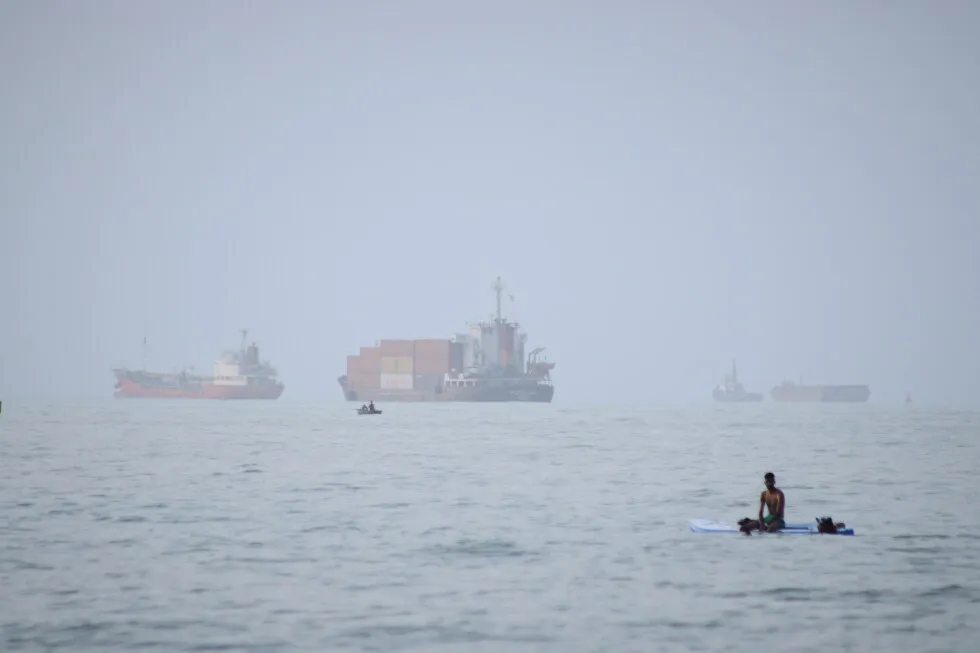
A man sits on a surfboard as a container ship and other commercial vessels appear anchored in the Strait of Hormuz off Bandar Abbas, Iran, Monday, July 27, 2026. (Razieh Poudat/ISNA via AP, File) By SAMY MAGDY and ELENA BECATOROS Updated 8:09 AM MESZ, July 30, 2026 Leer en español Add AP News on Google Add AP News as your preferred source to see more of our stories on Google. Share Share Facebook Copy Link copied Print Email X LinkedIn Bluesky Flipboard Pinterest Reddit CAIRO (AP) — Jordan’s air defenses shot down five missiles launched from Iran Thursday morning, the country’s state-run Petra news agency said, hours after the U.S. military announced it had completed “a heavy wave of strikes against Iran” in response to an earlier Iranian missile attack on a U.S. base in Jordan. No casualties were reported from Jordan’s interception of the missiles, the news agency quoted the spokesman for the country’s armed forces as saying. The U.S. Central Command said in a social media post that for over two hours the United States had struck “dozens” of targets belonging to Iran’s Revolutionary Guard Corps, including military command centers as well as missile and drone facilities, and coastal surveillance and defense sites. The new strikes came hours after U.S. President Donald Trump vowed to hit Iran “very hard” after it targeted a base in Jordan that hosts U.S. troops. Iran’s official IRNA news agency said three people were killed and two were wounded in a strike on the island of Qeshm, which lies just off the Iranian mainland in the Strait of Hormuz. The latest barrage came after the U.S. partnered with Saudi Arabia to strike Iran-backed-militias" class="entity-link entity-organization" data-entity-id="119659" data-entity-type="organization">Iran-backed militias in neighboring Iraq, killing at least 20 fighters and six Iranian advisers on Wednesday. The flare-ups on multiple fronts after several days of relative calm raised the risk of a return to all-out war. It also underscored the difficulty of winding down a five-month conflict that has jolted the world economy and is unpopular among Americans. The fighting was likely to add to concerns that the U.S. is further drawing down already diminished stockpiles of sophisticated munitions needed to defend its bases and allies. US launches strikes on Iranian targets a day after it foiled missile attack on American forces 7 MIN READ 116 US launches more airstrikes against Iran after announcing another death of a service member 4 MIN READ Recent fighting with Iran further draws down key US air defense stockpiles, analysis says 4 MIN READ Fires reported on two natural gas vessels in Egyptian port Elsewhere, British maritime security firm Ambrey said drone strikes ignited fires on two natural gas vessels at the Egyptian port of Damietta. It was not immediately clear who was responsible for the strikes on a U.S.-owned floating storage facility and a Greek-owned tanker. No injuries were reported. Egypt, a close U.S. ally and regional mediator, is one of the only countries in the Middle East to have been spared direct military action during the war. A strike by Iran or its allies, if confirmed, would mark a significant widening of the conflict. Asked during an Oval Office event if Iran was responsible for the strikes on the natural gas vessels, Trump responded: “It’s a little more of the same.” “In the meantime, we’re going to be hitting them very hard because it’s our turn to hit them,” he added. Saudi Arabia accuses Iraq militias of targeting its oil facilities Saudi Arabia had accused the Iraqi militias of firing drones against its oil facilities over the past days. An umbrella group of Iraqi militias initially denied the allegations, while another Iran-backed group — the Houthi rebels in Yemen — said they had attacked Saudi energy facilities as part of a separate but related conflict. Saudi Defense Minister Khalid bin Salman met separately on Wednesday with Trump and Vice President JD Vance, according to two people familiar with the matter who were not authorized to comment publicly about the private meetings. They said the Saudi decision to join the U.S. attacks against the Iraqi militias was meant to send a message to Iran that it wouldn’t tolerate Iran or its proxies targeting the Saudi oil industry and other critical infrastructure. At the same time, the defense minister underscored to Trump and Vance that the Saudis want to see a de-escalation in the war and for Washington and Tehran to return to negotiations. Before the latest eruption, mediators had expressed optimism about bringing the U.S. and Iran back to the negotiating table. An interim agreement collapsed in recent weeks over renewed fighting in the Strait of Hormuz, a crucial waterway for global energy supplies that Iranian attacks have again effectively closed. A regional official said mediators are “still trying with both sides” to restore calm and get the ceasefire back on track. He gave no details on whether progress was being made and spoke on condition of anonymity to discuss the closed-door diplomacy. Attacks on Saudi oil facilities could worsen global energy crisis Saudi Arabia is also locked in a renewed conflict with the Houthis. The rebels have declared a blockade of Saudi shipping that could choke off another crucial Middle East trade route, the Bab el-Mandeb strait from the Red Sea into the Gulf of Aden. On Monday, the Houthis said they had launched drones targeting oil facilities used to transport oil across Saudi Arabia to the Red Sea port city of Yanbu, a key bypass for Saudi exports blocked by Iran’s chokehold on the Strait of Hormuz. The rebels said the attack was in response to a Saudi drone they said had breached Yemen’s airspace. Planet Labs satellite imagery from Monday analyzed by The Associated Press showed damage to Saudi Aramco’s Abqaiq oil-processing facility. The massive facility is capable of processing approximately 7 million barrels of crude oil per day. Becatoros reported from Athens, Greece. Konstantin Toropin in Washington and Qassim Abdul-Zahra in Baghdad, Iraq, contributed. SAMY MAGDY Magdy is a Middle East reporter for The Associated Press, based in Cairo. He focuses on conflict, migration and human rights abuses. twitter facebook mailto ELENA BECATOROS Becatoros oversees coverage of southeast Europe for The Associated Press, with frequent assignments to the Middle East and Afghanistan. Based in Athens, Greece, she has worked around the world, including covering war in the Balkans, Iraq, Afghanistan and Ukraine. twitter instagram mailto
SRCAssociated Press (AP)
LANGEN
LEANCenter
WORDS1 065
ENT12
THU · 2026-07-30 · 05:23 GMTBRIEF NSR-2026-0730-97392
NSR-2026-0730-97392News Report·EN·Conflict
Jordanian air defenses shoot down 5 missiles launched from Iran, state-run news agency says
Jordan's air defenses intercepted five missiles launched from Iran on Thursday morning, according to Jordan's state-run Petra news agency. This occurred hours after the U.S.
Associated Press (AP)Filed 2026-07-30 · 05:23 GMTLean · CenterRead · 5 min
Associated Press (AP)FIG 01
Reading time
5min
Word count
1 065words
Sources cited
5cited
Entities identified
12entities
Quality score
100%
§ 01
Briefing Summary
AI-generatedNEWSAR · AI
Jordan's air defenses intercepted five missiles launched from Iran on Thursday morning, according to Jordan's state-run Petra news agency. This occurred hours after the U.S. military reported completing a significant wave of strikes against Iran in retaliation for an earlier Iranian missile attack on a U.S. base in Jordan. No casualties were reported in Jordan from the missile interception. The U.S. Central Command stated their strikes targeted dozens of Iranian Revolutionary Guard Corps sites, including command centers and missile facilities. Iran's state media reported casualties from strikes on Qeshm island. These events follow joint U.S.-Saudi strikes on Iran-backed militias in Iraq and separate drone strikes that caused fires on two natural gas vessels in Egypt.
Confidence 0.90Sources 5Claims 5Entities 12
§ 02
Article analysis
Model · rule-basedFraming
Conflict
National Security
Tone
Measured
AI-assessed
CalmNeutralAlarmist
Factuality
0.80 / 1.00
Factual
LowHigh
Sources cited
5
Well sourced
FewMany
§ 03
Key claims
5 extracted01
The U.S. military announced it had completed a heavy wave of strikes against Iran.
factualU.S. Central Command
Confidence
0.95
02
Jordan's air defenses shot down five missiles launched from Iran.
factualJordan's state-run Petra news agency
Confidence
0.90
03
Three people were killed and two were wounded in a strike on the island of Qeshm.
factualIran's official IRNA news agency
Confidence
0.85
04
The U.S. partnered with Saudi Arabia to strike Iran-backed militias in Iraq, killing at least 20 fighters and six Iranian advisers.
factualAP reporting
Confidence
0.80
05
Drone strikes ignited fires on two natural gas vessels at the Egyptian port of Damietta.
factualAmbrey
Confidence
0.75
§ 04
Full report
5 min read · 1 065 words§ 05
Entities
12 identifiedKey playerOppositionContextPositiveNeutralNegative
Organizations2
Locations8
§ 06
Keywords & salience
10 termsjordan air defenses
1.00
iran
1.00
missile attack
1.00
us strikes
0.90
revolutionary guard corps
0.70
strait of hormuz
0.60
drone facilities
0.50
iran-backed militias
0.50
military command centers
0.50
all-out war
0.40
§ 07
Topic connections
Interactive graph Network visualization showing 51 related topics
View Full Graph Person Organization Location Event|Click node to navigate|Edge numbers = shared articles