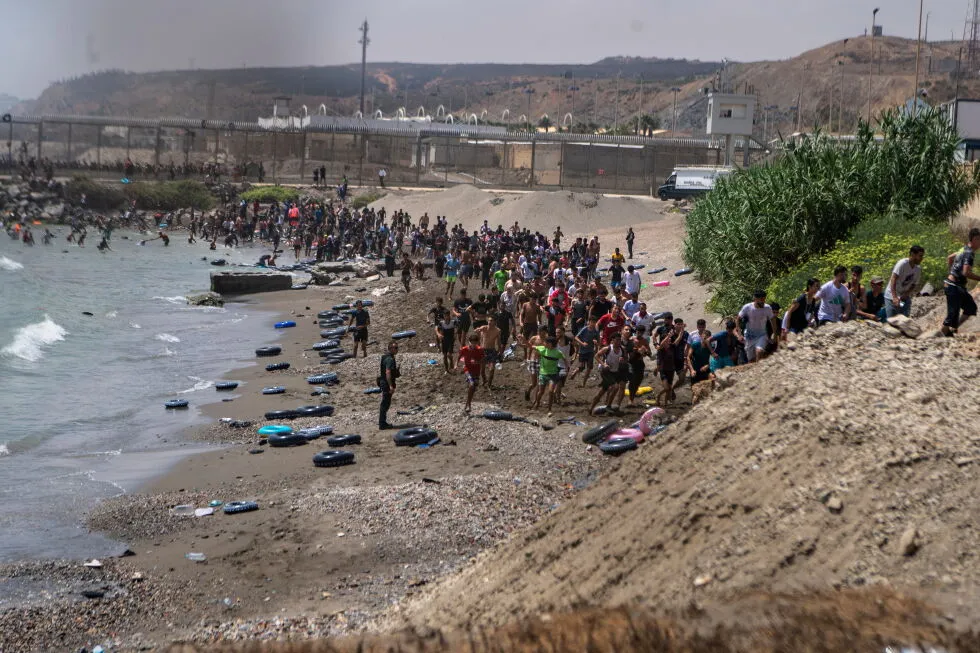
What to know about the Spanish enclave of Ceuta as migrant arrivals from Morocco spike 1 of 4 | Migrants cross from Morocco into the Spanish enclave of Ceuta, Thursday, July 30, 2026. (AP Photo/Antonio Sempere) 2 of 4 | Migrants cross from Morocco into the Spanish enclave of Ceuta, Thursday, July 30, 2026. (AP Photo/Antonio Sempere) 3 of 4 | Migrants cross from Morocco into the Spanish enclave of Ceuta, Thursday, July 30, 2026. (AP Photo/Antonio Sempere) 4 of 4 | Migrants cross from Morocco into the Spanish enclave of Ceuta, Thursday, July 30, 2026. (AP Photo/Antonio Sempere) By Suman Naishadham Updated 8:04 PM MESZ, July 30, 2026 Leer en español Add AP News on Google Add AP News as your preferred source to see more of our stories on Google. Share Share Facebook Copy Link copied Print Email X LinkedIn Bluesky Flipboard Pinterest Reddit Madrid (AP) — Thousands of migrants have streamed into the tiny Spanish territory of Ceuta in North Africa from Morocco, prompting local officials to call for help from Spain’s national government in Madrid to restore the border. Videos and images from the frontier showed crowds of people, mainly Moroccans, walking around the breakwaters at an urban beach near a border checkpoint with Morocco onto local roads. The majority looked to be young men, though there were also families with women and children. Spain’s Interior Ministry said it would guarantee its citizens’ safety and border integrity, but that the government could not declare a national emergency over migration concerns. The escalation at the frontier comes after a surge in migrants attempting to reach the small exclave, mainly by swimming, a day before. It was not immediately clear what prompted so many migrants to cross to Ceuta. Ceuta and the larger Spanish territory of Melilla that is some 400 kilometers (250 miles) further south, are located on the northern shores of the Mediterranean coast at the tip of Africa. Both autonomous cities belong to Spain and share the European Union’s only land borders with Africa. In Spanish possession since 1580, Ceuta is home to a mixed population of Christians and Muslims, and Spanish and Moroccan residents and day workers who live in relative harmony. Morocco does not officially recognize Ceuta and Melilla as Spanish territory, and often refers to them as occupied lands. Hundreds of migrants are swimming from Morocco to the Spanish territory of Ceuta 4 MIN READ 29 ‘Absolute chaos’ as thousands of people breach Morocco’s border with Spain’s Ceuta 5 MIN READ By the numbers: Spain’s mass legalization for immigrants 5 MIN READ A migration and diplomatic flashpoint between Spain and Morocco The city of 85,000 has been a flashpoint in major diplomatic crises in recent memory between Madrid and Rabat. In May 2021, the Moroccan government dropped its border controls and let some 8,000 people from Morocco and sub-Saharan countries pour into Ceuta in just two days. The move was broadly interpreted as retaliation from Morocco for Spain’s decision to allow a pro-independence leader from the disputed Western Sahara region to be treated for COVID-19 at a Spanish hospital. Tensions were defused and the border restored only after Spain’s prime minister shifted Spain’s long-standing position on Western Sahara, and met with Moroccan King Mohammed VI the following year. Spain is a main point of arrival into Europe for migrants seeking better economic opportunities or an escape from violence in their home countries. Ceuta and its sister city Melilla are heavily fortified, as the territories are seen as a destination for those trying to reach Spain from Morocco and other parts of Africa. Many migrants who reach Ceuta or Melilla are immediately turned back, while others held in migrant shelters are processed and can apply for asylum in Spain. To reach Ceuta, migrants often swim from the Moroccan town of Castillejos, covering about 5 kilometers (3.1 miles) to reach Spanish territory. Others attempt the crossing from the nearby town of Belyounech, where the distance is shorter. Still, migrant arrivals to Ceuta and Melilla are generally much lower than those reaching Spain through the Canary and Balearic Islands. Spain’s overall immigrant population has grown considerably in recent decades, with around 10 million people in the country of 50 million having been born elsewhere. Many are from Colombia, Venezuela and Morocco, and work in key sectors of the Spanish economy, including agriculture, tourism and the service sector. Suman Naishadham Naishadham is an Associated Press reporter covering Spain and Portugal. She is based in Madrid. twitter mailto
SRCAssociated Press (AP)
LANGEN
LEANCenter
WORDS751
ENT10
THU · 2026-07-30 · 17:23 GMTBRIEF NSR-2026-0730-97592
NSR-2026-0730-97592News Report·EN·Human Interest
What to know about the Spanish enclave of Ceuta as migrant arrivals from Morocco spike
Thousands of migrants, primarily Moroccans, have entered the Spanish enclave of Ceuta from Morocco, prompting local officials to request assistance from Spain's national government. The surge in arrivals, mainly by swimming, occurred on July 30, 2026, with videos showing large groups reaching urban beaches and roads.
Associated Press (AP)Filed 2026-07-30 · 17:23 GMTLean · CenterRead · 4 min
Associated Press (AP)FIG 01
Reading time
4min
Word count
751words
Sources cited
1cited
Entities identified
10entities
Quality score
100%
§ 01
Briefing Summary
AI-generatedNEWSAR · AI
Thousands of migrants, primarily Moroccans, have entered the Spanish enclave of Ceuta from Morocco, prompting local officials to request assistance from Spain's national government. The surge in arrivals, mainly by swimming, occurred on July 30, 2026, with videos showing large groups reaching urban beaches and roads. Ceuta, an autonomous Spanish city in North Africa, shares the EU's only land borders with Africa and has been a site of diplomatic tension between Spain and Morocco. In May 2021, Morocco temporarily eased border controls, leading to a significant influx of migrants. Spain's Interior Ministry stated it would ensure citizen safety and border integrity but would not declare a national emergency. Migrants often attempt to reach Ceuta by swimming from nearby Moroccan towns, seeking better economic opportunities or refuge.
Confidence 0.90Sources 1Claims 5Entities 10
§ 02
Article analysis
Model · rule-basedFraming
Human Interest
Diplomatic
Tone
Mixed Tone
AI-assessed
CalmNeutralAlarmist
Factuality
0.80 / 1.00
Factual
LowHigh
Sources cited
1
Limited
FewMany
§ 03
Key claims
5 extracted01
The government could not declare a national emergency over migration concerns.
quoteSpain’s Interior Ministry
Confidence
1.00
02
Morocco does not officially recognize Ceuta and Melilla as Spanish territory.
factual
Confidence
1.00
03
Spain’s Interior Ministry said it would guarantee its citizens’ safety and border integrity.
quoteSpain’s Interior Ministry
Confidence
1.00
04
In May 2021, the Moroccan government dropped its border controls and let some 8,000 people pour into Ceuta in two days.
factual
Confidence
0.90
05
Thousands of migrants have streamed into the Spanish territory of Ceuta from Morocco.
factual
Confidence
0.90
§ 04
Full report
4 min read · 751 words§ 05
Entities
10 identifiedKey playerOppositionContextPositiveNeutralNegative
Locations5
§ 06
Keywords & salience
9 termsspanish enclave
1.00
ceuta
1.00
morocco
1.00
migrant arrivals
1.00
border integrity
0.80
migration concerns
0.70
european union
0.60
land borders
0.50
occupied lands
0.40
§ 07
Topic connections
Interactive graph Network visualization showing 51 related topics
View Full Graph Person Organization Location Event|Click node to navigate|Edge numbers = shared articles