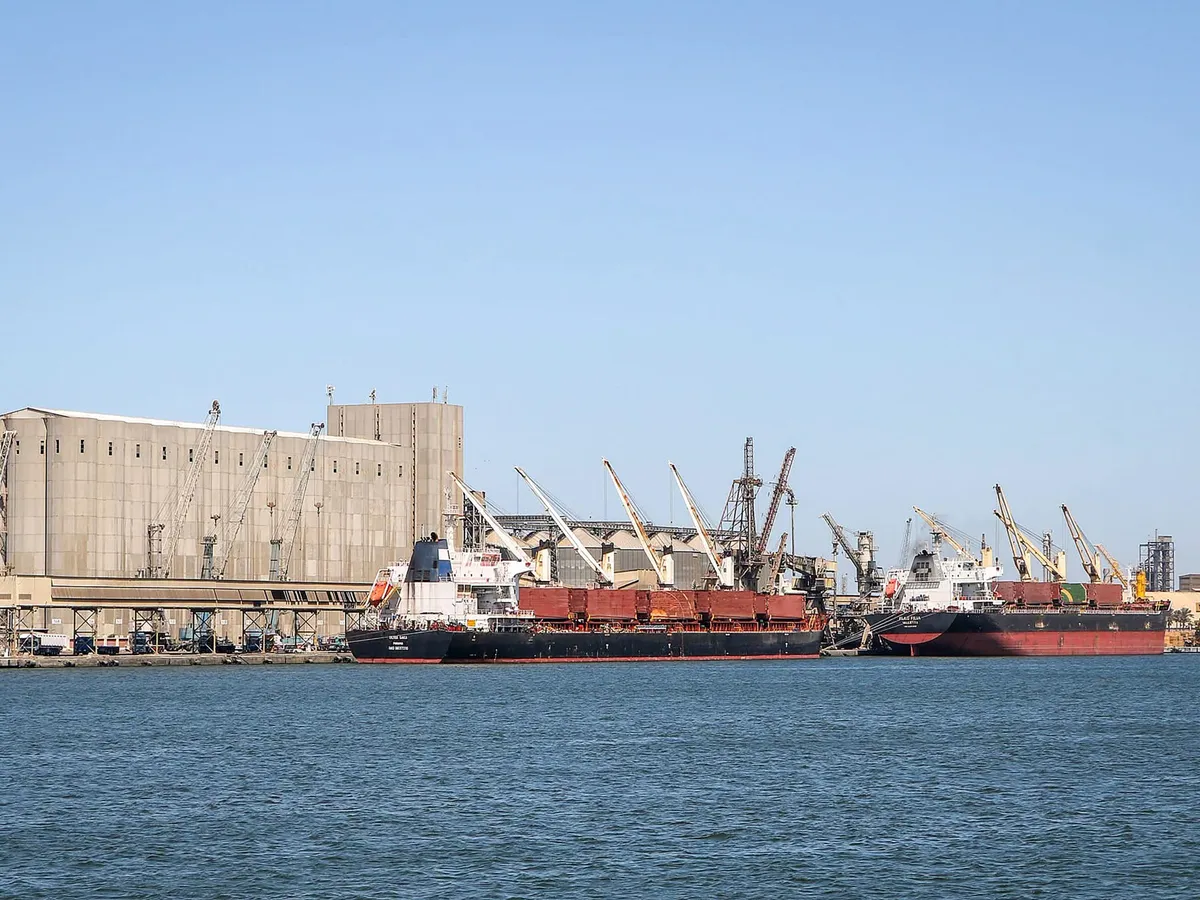
EXPLAINERIran says it struck Kuwait in retaliation for US strikes on multiple locations in Iran, including Qeshm island.This handout photograph taken and released by the Damietta Port Authority in Egypt on July 30, 2026 shows ships docked on the wharf of the Mediterranean port of Damietta [AFP]Published On 31 Jul 2026Iran announced on Friday that it had targeted United States military assets at Kuwait’s Ahmad Al-Jaber airbase, describing the attack as retaliation for US strikes a day earlier.Here is a recap of the latest developments in the US-Israeli war on Iran over the past 24 hours and a look at how the war could be expanding within the region.Where has Iran attacked?The Iranian army said on Friday that its forces had targeted strategic US military facilities at Kuwait’s Ahmad Al-Jaber airbase in a drone attack, describing the operation as retaliation for recent US strikes.In a statement reported by Iran’s semiofficial Tasnim news agency, the army said it had targeted hangars, satellite communication systems and equipment warehouses using drones.The strike, according to the statement, was carried out in response to a US attack on a residential home on Qeshm island, adding that the Kuwait facility serves as a vital hub for US aerial surveillance and operational support in the region.The US has not responded to Iran’s attack yet, and specific details about the damage and casualties are not known.Citing Iran’s recent claimed attack on a US military base in Jordan, Ali Akbar Dareini, a Tehran-based researcher at the Center for Strategic Studies, told Al Jazeera that Tehran believes Washington is amassing equipment there in preparation for a major attack.He said Iran is likely trying to preempt any future attacks by the US in its current targeting in the region.Iran does not want to “allow the US to decide when to start the war, when to pause temporarily and when to restart the war”, he added. “Iran is now targeting the staging grounds of future operations.”Dareini explained that while Washington has been pursuing “vertical escalation” by ramping up military attacks against Iran, Tehran has sought “horizontal escalation” by expanding the conflict’s “geographical scope”.“Iran wants a complete, permanent end to war, or it’s going to be a wide-scale regional war,” he said.Where did the US attack Iran on Thursday?The United States Central Command (CENTCOM) said that it struck dozens of Islamic Revolutionary Guard Corps (IRGC) targets in Iran overnight on Wednesday.Three people were killed on Qeshm island when a residential building was hit.Explosions were also heard in Fars province, Kish island, Bushehr province, Khuzestan province and Hormozgan province.The IRGC promised it would retaliate.The IRGC said that “with the help of God Almighty, the aggressor will be punished today,” according to Iran’s Fars news agency.Early on Thursday morning, the Jordanian Armed Forces said their air defence systems intercepted and shot down five missiles launched from Iran targeting the kingdom’s territory.Kuwait’s Defence Ministry announced on Thursday that one worker had been killed in an Iranian attack that targeted a building belonging to a Chinese company in the country’s north.On Friday, Chinese Foreign Ministry spokesperson Mao Ning said Beijing had concluded the attack had not affected any Chinese citizens. She said China had asked Kuwait to take the necessary measures to protect Chinese nationals and institutions.Is the war expanding?Recent attacks in Jordan, Egypt and Iraq, as well as strikes on shipping in the Red Sea and the Caspian Sea, have sparked fears of the war expanding geographically – and may even have overlapped with the war in Ukraine.Attacks on shippingOn July 20, Yemen’s Iran-backed Houthis announced a maritime blockade against Saudi Arabia and have since attacked shipping in the Red Sea. The Houthis have accused Saudi leaders of imposing “an unjust and oppressive siege” on them in Yemen for nearly 12 years, “plundering our resources and imposing a comprehensive blockade on our ports and airports by land, sea and air”.On Thursday, Saudi Arabia revealed plans for a multinational maritime defence coalition to safeguard international shipping and energy supply routes in the Red Sea.A Ukrainian drone strike on an Iranian commercial ship in the Caspian Sea prompted Iran’s Ministry of Foreign Affairs to summon Ukraine’s charge d’affaires in Tehran over what it described as a “hostile and criminal” attack on Saturday, state news agency IRNA reported.Ukraine said it was targeting a Russian warship and vessels used for transporting Iranian-linked military cargo in the Caspian Sea.Strike in EgyptEgypt has confirmed that a fire which damaged two ships at the Mediterranean port of Damietta on Wednesday was caused by a drone attack.In a statement, the Egyptian Cabinet said initial investigations had determined the fire was caused by a drone, but that no party had claimed responsibility. It said authorities were investigating the circumstances of the strike to protect Egypt’s interests and national security.Reuters news agency reported on Thursday, quoting people familiar with the incident, that the drone had hit the US-owned gas storage tanker Energos Winter, causing a fire that spread to a second vessel.Iran has denied involvement in the Egypt attack.“Egypt is an important friend and partner in the region, and its security is of utmost importance to us,” Iranian Foreign Minister Abbas Araghchi wrote on social media.“We must all be vigilant against Israeli plots and false-flag operations designed to undermine regional peace.”Strikes in Iraq and JordanAl Jazeera Arabic reported on Thursday that a drone attack targeted a camp belonging to an Iranian Kurdish opposition group located east of Iraq’s Erbil, according to local security sources. More information about this attack is not known yet.On Wednesday morning, the US and Saudi Arabia launched attacks on Iran-backed groups in Iraq.The US and Saudi Arabia justified the attacks by claiming Iran was responsible for recent drone attacks on Saudi oil facilities apparently launched from Iraqi territory.They claimed Iran-aligned groups in Iraq had carried out “30 IRGC-directed” drone attacks in 72 hours.On Friday, the state-run IRNA news agency reported that the bodies of five IRGC members killed in US-Saudi strikes had been returned to Iran.Also on Wednesday, Iran fired several ballistic missiles at US military installations in Jordan, which the US confirmed and said were intercepted.Burcu Ozcelik, a senior research fellow for Middle East security at the United Kingdom-based think tank the Royal United Services Institute (RUSI), told Al Jazeera that the most likely scenario is a continuation of tit-for-tat military strikes between Iran and the US while diplomatic efforts, with the engagement of Gulf states, continue in parallel.“The moment to watch for is a direct attack that prompts a collective Gulf military response against Iran, as well as the threat that the Houthis escalate in the Bab al-Mandeb.”
SRCAl Jazeera
LANGEN
LEANCenter
WORDS1 098
ENT12
FRI · 2026-07-31 · 09:09 GMTBRIEF NSR-2026-0731-97821
NSR-2026-0731-97821News Report·EN·Conflict
IRGC strikes US targets in Kuwait a day after US hits Iran: Latest events
Iran announced it struck US military assets at Kuwait's Ahmad Al-Jaber airbase in retaliation for US strikes on multiple locations in Iran, including Qeshm island, a day prior. The Iranian army stated the drone attack targeted hangars, satellite communication systems, and equipment warehouses, describing the Kuwait facility as a hub for US aerial surveillance.
Sarah ShamimAl JazeeraFiled 2026-07-31 · 09:09 GMTLean · CenterRead · 5 min
Al JazeeraFIG 01
Reading time
5min
Word count
1 098words
Sources cited
2cited
Entities identified
12entities
Quality score
100%
§ 01
Briefing Summary
AI-generatedNEWSAR · AI
Iran announced it struck US military assets at Kuwait's Ahmad Al-Jaber airbase in retaliation for US strikes on multiple locations in Iran, including Qeshm island, a day prior. The Iranian army stated the drone attack targeted hangars, satellite communication systems, and equipment warehouses, describing the Kuwait facility as a hub for US aerial surveillance. The US has not yet responded, and details on damage and casualties are unknown. This action follows US Central Command's strikes on dozens of IRGC targets in Iran, which resulted in three deaths on Qeshm island. Recent attacks in Jordan, Egypt, and Iraq, along with shipping incidents in the Red Sea and Caspian Sea, indicate a potential geographical expansion of the conflict.
Confidence 0.90Sources 2Claims 5Entities 12
§ 02
Article analysis
Model · rule-basedFraming
Conflict
Political Strategy
Tone
Mixed Tone
AI-assessed
CalmNeutralAlarmist
Factuality
0.60 / 1.00
Mixed
LowHigh
Sources cited
2
Limited
FewMany
§ 03
Key claims
5 extracted01
CENTCOM stated it struck dozens of IRGC targets in Iran overnight on Wednesday.
factualCENTCOM
Confidence
0.90
02
Iran claims the strike was retaliation for US strikes on a residential home on Qeshm island.
factualIran
Confidence
0.90
03
Iran announced it targeted US military assets at Kuwait’s Ahmad Al-Jaber airbase in a drone attack.
factualIran
Confidence
0.90
04
Three people were killed on Qeshm island when a residential building was hit.
factual
Confidence
0.80
05
The US has not responded to Iran’s attack yet, and specific details about damage and casualties are not known.
factual
Confidence
0.80
§ 04
Full report
5 min read · 1 098 words§ 05
Entities
12 identifiedKey playerOppositionContextPositiveNeutralNegative
Organizations5
§ 06
Keywords & salience
10 termsus strikes
1.00
irgc strikes
1.00
retaliation
0.90
kuwait
0.80
iran
0.80
ahmad al-jaber airbase
0.70
drone attack
0.60
qeshm island
0.60
regional war
0.50
escalation
0.50
§ 07
Topic connections
Interactive graph Network visualization showing 51 related topics
View Full Graph Person Organization Location Event|Click node to navigate|Edge numbers = shared articles