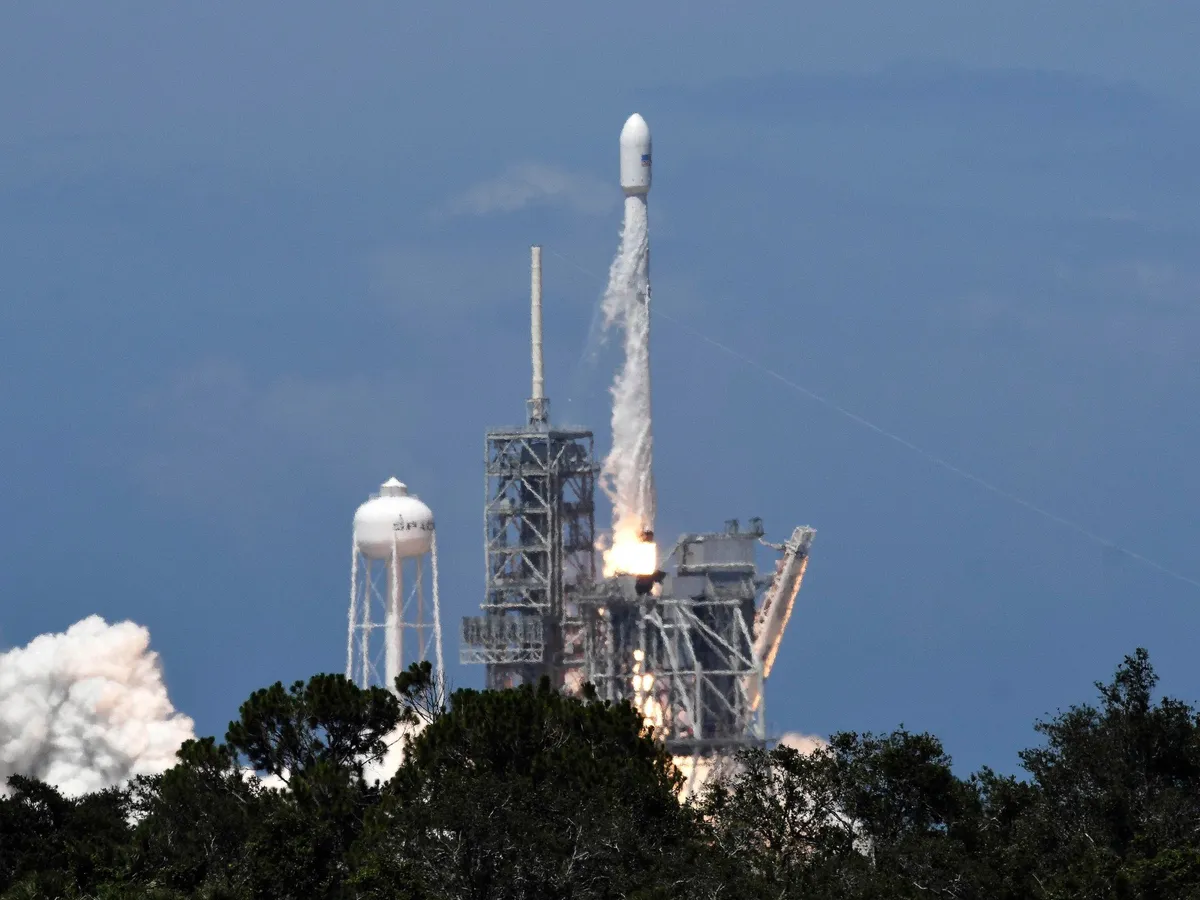
EXPLAINERA piece of the SpaceX Falcon 9 rocket is believed to have crashed into the Moon after floating in space since last year.A SpaceX Falcon 9 rocket lifts off from Kennedy Space Center, Florida, US [File: Craig Bailey/Florida Today/USA Today Network via Reuters]Published On 5 Aug 2026A piece of a SpaceX rocket which has been floating in space since last year was believed to have crashed into the Moon at high speed on Wednesday.The event, not visible to the naked eye, is expected to be confirmed by experts monitoring it with a telescope.This event posed no danger to Earth but was also expected to create a new lunar crater, experts said.Here’s what we know so far.Has the rocket hit the Moon yet?It is believed to have hit the Moon already, but this has not yet been confirmed as it takes time for signals to return from the Moon to the Earth. The rocket segment was expected to hit the Moon around 2:35am ET (06:35 GMT) on Wednesday, crashing into the surface at 5,400mph (8,690km/h).The rocket piece is believed to have hit Einstein Crater on the Moon’s western limb, which is often difficult to see from Earth.Weighing 4 metric tonnes (4,000kg), it was expected to kick up a plume of lunar dust that would likely be illuminated by sunlight but would be difficult to spot with the naked eye from Earth.The crash landing is unintentional, SpaceX has said.Which rocket did this piece of space debris come from?It comes from a SpaceX Falcon 9, which is a reusable model and has been used for several space missions.It is made of two parts: upper and lower. The lower part can detach from the upper part and return to Earth. It is the upper part of the rocket which likely crashed into the Moon.Is this dangerous for the Earth?“There is no danger to Earth,” NASA spokesperson Jimi Russell said in a statement on Tuesday.“NASA will continue to track the booster for training purposes, as well as later observe the impact site for scientific purposes.”What was the Falcon 9 doing near the Moon?The Falcon 9 rocket took off last January from Florida, United States, carrying two lunar landers. The booster returned to Earth, but the upper segment remained in space to push the landers onwards.After pushing the lunar landers onwards, the upper segment of the rocket typically falls back into Earth’s atmosphere and burns up or plunges into the ocean.But, because the January lunar lander mission required more thrust than missions closer to Earth, the rocket’s second stage remained in space, floating aimlessly among thousands of other pieces of space junk that active satellites have to steer clear of as a matter of course.According to the United Kingdom’s Natural History Museum, humans have launched thousands of objects into space since the 1950s. “When these spacecraft, rockets, and satellites stop working or break apart, they stay in orbit instead of falling back down right away,” it says.Why was this rocket section heading to the Moon?It was not until earlier this year that astronomers determined that the rocket section, which had dumped its remaining fuel and could no longer be controlled, was on an orbital trajectory which would end at the Moon.Generally, for such “high-energy missions”, SpaceX performs a manoeuvre to make sure the second stage “is safe per the appropriate rules and regulations”, said Julianna Scheiman, director of NASA science missions at SpaceX, at a Monday news conference.“We did that,” she continued, but “what has happened is essentially a mixture of solar activity and gravity forces have put it on a path towards the Moon”.Does it matter if part of a rocket crashes into the Moon?This collision raises concerns about human-made debris in space generally. The rocket section was just one of many pieces of “space junk” already orbiting Earth.There are more than 46,000 pieces of space debris weighing a total of 17,000 tonnes currently in orbit, the European Space Agency reported in late July.“The environmental impacts that we’re most concerned about include climate and the ozone hole,” Eloise Marais, atmospheric chemist in the geography department at University College London, told Al Jazeera last year.“Depletion of the protective ozone layer results from chemicals released by rockets during launch that can undergo reactions that deplete ozone,” Marais added, explaining that air pollutants such as particles of soot, which can absorb sunlight and warm the atmosphere, are released during rocket launches.NASA and SpaceX are discussing ways to prevent future lunar impacts, NASA’s Scheiman said. The US space agency plans to build a lunar base and send routine astronaut missions to the lunar surface beginning later this decade under its multibillion-dollar Artemis programme. It would not want errant pieces of space junk impacting those assets.Not very. The Moon routinely weathers impacts from space debris, including meteoroids. Collisions with artificial objects are less common.A Chinese rocket segment crashed into the Moon in March 2022 after completing a lunar test mission.In 2009, NASA intentionally crashed a rocket segment into the Moon to study the plume of lunar material kicked up by the impact.In the 1970s, NASA also intentionally crashed stages from its Saturn V Moon rocket into the Moon to study the impact’s seismic effects.Several spacecraft intending to land softly on the Moon in recent years have crashed instead.Like many scientists, Scheiman said, “I also am very excited to see the observation.”“This may be of some – probably minor – scientific interest, and we may learn some things from it,” said Bill Gray, creator of widely used astronomy software who published a report on the stage’s impact in April.“It doesn’t present any danger to anyone, though it does highlight a certain carelessness about how leftover space hardware [junk] is disposed of.”NASA hopes to soon establish a sustained human presence on the Moon, making it critical to better understand space debris in lunar orbit.
SRCAl Jazeera
LANGEN
LEANCenter
WORDS972
ENT10
WED · 2026-08-05 · 12:36 GMTBRIEF NSR-2026-0805-99404
NSR-2026-0805-99404News Report·EN·Technology
SpaceX rocket segment to crash into the moon: What happened?
A piece of a SpaceX Falcon 9 rocket, which had been in space since last year, is believed to have intentionally crashed into the moon on Wednesday. The four-metric-ton upper segment was launched in January carrying lunar landers and, unlike typical missions, its trajectory did not result in its return to Earth.
Al Jazeera StaffAl JazeeraFiled 2026-08-05 · 12:36 GMTLean · CenterRead · 4 min
Al JazeeraFIG 01
Reading time
4min
Word count
972words
Sources cited
2cited
Entities identified
10entities
Quality score
100%
§ 01
Briefing Summary
AI-generatedNEWSAR · AI
A piece of a SpaceX Falcon 9 rocket, which had been in space since last year, is believed to have intentionally crashed into the moon on Wednesday. The four-metric-ton upper segment was launched in January carrying lunar landers and, unlike typical missions, its trajectory did not result in its return to Earth. Instead, a combination of solar activity and gravity forces sent it on a path towards the moon, where it was expected to impact Einstein Crater at high speed. This unintentional crash poses no danger to Earth, though it is expected to create a new lunar crater. NASA and SpaceX are collaborating to prevent future lunar impacts, especially with NASA's Artemis program planning future lunar missions.
Confidence 0.90Sources 2Claims 5Entities 10
§ 02
Article analysis
Model · rule-basedFraming
Technology
Human Interest
Tone
Mixed Tone
AI-assessed
CalmNeutralAlarmist
Factuality
0.80 / 1.00
Factual
LowHigh
Sources cited
2
Limited
FewMany
§ 03
Key claims
5 extracted01
NASA spokesperson Jimi Russell stated that there is no danger to Earth from this event.
quoteJimi Russell (NASA spokesperson)
Confidence
1.00
02
The crash landing is unintentional, SpaceX has said.
factualSpaceX
Confidence
0.95
03
The rocket segment was expected to hit the moon around 2:35am ET (06:35 GMT) on Wednesday, crashing into the surface at 5,400mph (8,690km/h).
factual
Confidence
0.90
04
A piece of a SpaceX Falcon 9 rocket is believed to have crashed into the moon.
factual
Confidence
0.90
05
The rocket piece is believed to have hit Einstein Crater on the moon’s western limb.
factual
Confidence
0.85
§ 04
Full report
4 min read · 972 words§ 05
Entities
10 identifiedKey playerOppositionContextPositiveNeutralNegative
Organizations3
§ 06
Keywords & salience
9 termsmoon impact
1.00
spacex rocket
1.00
falcon 9
0.90
space debris
0.80
lunar crater
0.70
rocket segment
0.60
einstein crater
0.50
lunar landers
0.50
nasa
0.40
§ 07
Topic connections
Interactive graph Network visualization showing 51 related topics
View Full Graph Person Organization Location Event|Click node to navigate|Edge numbers = shared articles