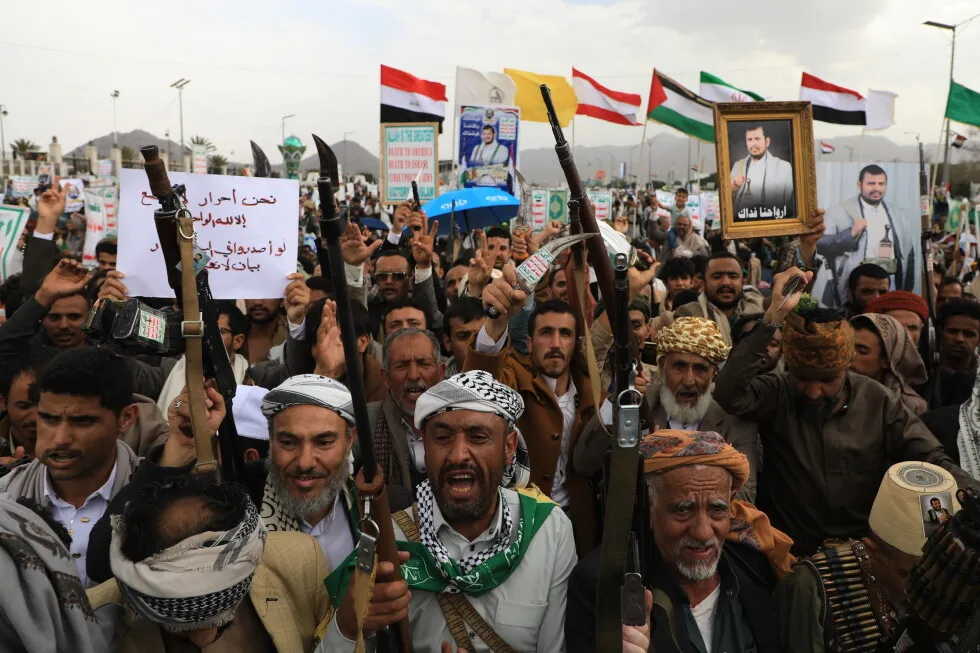
How the Iran-backed Houthis’ claims of deadly attacks are stoking fears of a wider regional conflict 1 of 4 | Houthi supporters chant slogans during a rally against the Saudi-led coalition in Sanaa, Yemen, Friday, July 31, 2026. (AP Photo/Osamah Abdulrahman) 2 of 4 | Fireworks burst as Houthi supporters rally against the Saudi-led coalition in Sanaa, Yemen, Monday, July 20, 2026. (AP Photo/Osamah Abdulrahman) 3 of 4 | This is a locator map for Yemen with its capital, Sanaa. (AP Photo) 4 of 4 | Demonstrators attend a rally against the Saudi-led coalition in Sanaa, Yemen, Wednesday, July 22, 2026. (AP Photo/Osamah Abdulrahman) By FATMA KHALED and AHMED AL-HAJ Updated 3:01 PM MESZ, August 7, 2026 Add AP News on Google Add AP News as your preferred source to see more of our stories on Google. Share Share Facebook Copy Link copied Print Email X LinkedIn Bluesky Flipboard Pinterest Reddit CAIRO (AP) — Yemen’s Iran-backed Houthi rebels claimed responsibility for a series of deadly attacks this week, escalating the conflict between them and Saudi-backed Yemeni forces and raising fears of a wider regional conflagration. The attacks have killed dozens of civilians and troops and also targeted Saudi tankers in transit from Red Sea ports through the Bab el-Mandeb Strait out to the Gulf of Aden and the rest of the world. Though less significant than the Strait of Hormuz, around 12% of the world’s trade, including a fourth of global container traffic, once passed through Bab el-Mandeb, moving between Europe and Asia via Egypt’s Suez Canal. Fewer tankers have passed through the strait since this week’s attacks, according to shipping data published by the analytics firm Kpler this week. Weeks of Houthi escalation reflected how Iran “is scaling up pressure on the United States in Yemen through its close ally,” according to Yemen researcher Afrah Nasser. “The escalation is directly connected to regional developments,” she wrote in an analysis for the nonprofit DAWN on Friday. The Houthi attacks — including one in northeastern Yemen on Friday morning — come weeks after the rebels declared a blockade on Saudi-linked ships leaving the strait in retaliation for a yearslong Saudi siege on Yemen and recent attacks on the Houthi-controlled capital. One Houthi attack on Thursday injured 11 civilians, including a 4-year-old child, according to the Saudi military. Others on Saudi-backed military camps in eastern Yemen killed at least 17 soldiers, according to SABA news agency, which is affiliated with Yemen’s internationally recognized government. Houthi spokesman Nasruddin Amer said on X on Friday that the group will continue to target any Saudi buildups in an effort to lift the kingdom’s blockade on Yemen. A new threat by Yemen’s Houthis could widen the Iran war and put another trade chokepoint at risk 4 MIN READ A new threat by Yemen’s Houthis could widen the Iran war and put another trade chokepoint at risk 2 MIN READ Yemen’s Iranian-backed Houthis say they will block Saudi shipping at Red Sea gateway 2 MIN READ Sporadic attacks risk largely blocking the waterway In the Strait of Hormuz, Iran has shown that even sporadic attacks on ships can be enough to effectively close a critical waterway by driving up risks and insurance premiums. Experts have warned that if ships fear traversing Bab el-Mandeb so much that they do not attempt passage, it means two of the world’s most important maritime routes will effectively be disrupted, compounding the crisis facing commercial shipping and the global oil supply. Bab el-Mandeb has worked as a pressure release valve since the start of the Iran war, with more tankers transiting through it with the Strait of Hormuz under threat. Exports flowing from Saudi ports have blunted some of the impact of the Strait of Hormuz closure. Three Houthi officials told The Associated Press in July that the group has planned for months how to disrupt shipping in the strait. The group doesn’t control the part of Yemen’s coastline along Bab el-Mandeb but holds territory less than 100 kilometers (60 miles) away. The officials spoke on condition of anonymity to be able to speak to the media. Outside Bab el-Mandeb and the Strait of Hormuz, the options for exporting Gulf oil and gas to the broader world are limited, but include piping supply across the Arabian Peninsula and routing it through Egypt’s Suez Canal or rerouting ships toward a costly and lengthy journey around South Africa’s Cape of Good Hope. Attacks could draw retaliation and reignite Yemen’s war Yemen’s civil war began in 2014 when the rebels seized the capital, Sanaa, and much of northern Yemen, forcing the government into exile. Saudi Arabia has led an international coalition fighting the rebels and also imposed an air and sea blockade on Houthi-held parts of Yemen, which had eased in recent years. The Houthis say closing Bab el-Mandeb to Saudi traffic aims to break the coalition’s blockade. Ahmed Nagi, a senior Yemen analyst at the International Crisis Group, said the blockade also benefits the Houthis’ ally, Iran, at a time when the U.S. has resumed daily airstrikes. ″From Iran’s perspective, opening additional pressure points across the region gives it more leverage,” Ahmed Nagi, a senior Yemen analyst at the International Crisis Group, told the AP last month. “The Houthis provide Tehran with influence over one of the world’s most important maritime choke-points.” Al-Haj reported from Aden, Yemen. Associated Press writer Sam Metz in Jerusalem contributed to this report. FATMA KHALED Khaled is based in the Middle East region. She covers humanitarian crises, conflict, among other news beats for The Associated Press. twitter mailto
SRCAssociated Press (AP)
LANGEN
LEANCenter
WORDS929
ENT12
FRI · 2026-08-07 · 13:23 GMTBRIEF NSR-2026-0807-100129
NSR-2026-0807-100129News Report·EN·Conflict
How the Iran-backed Houthis’ claims of deadly attacks are stoking fears of a wider regional conflict
Yemen's Iran-backed Houthi rebels have claimed responsibility for recent deadly attacks that killed dozens of civilians and troops and targeted Saudi tankers. These attacks, occurring in northeastern Yemen and on Saudi-backed military camps, aim to lift the Saudi blockade on Yemen.
Associated Press (AP)Filed 2026-08-07 · 13:23 GMTLean · CenterRead · 4 min
Associated Press (AP)FIG 01
Reading time
4min
Word count
929words
Sources cited
3cited
Entities identified
12entities
Quality score
100%
§ 01
Briefing Summary
AI-generatedNEWSAR · AI
Yemen's Iran-backed Houthi rebels have claimed responsibility for recent deadly attacks that killed dozens of civilians and troops and targeted Saudi tankers. These attacks, occurring in northeastern Yemen and on Saudi-backed military camps, aim to lift the Saudi blockade on Yemen. The Houthis have also declared a blockade on Saudi-linked ships leaving the Bab el-Mandeb Strait, a critical waterway for global trade. This escalation, linked to regional developments, is stoking fears of a wider conflict, as disruptions to Bab el-Mandeb could significantly impact commercial shipping and oil supply, similar to past incidents in the Strait of Hormuz. The Houthis state their actions are in retaliation for the Saudi siege and recent attacks on their capital.
Confidence 0.90Sources 3Claims 5Entities 12
§ 02
Article analysis
Model · rule-basedFraming
Conflict
Economic Impact
Tone
Mixed Tone
AI-assessed
CalmNeutralAlarmist
Factuality
0.70 / 1.00
Factual
LowHigh
Sources cited
3
Well sourced
FewMany
§ 03
Key claims
5 extracted01
Around 12% of the world’s trade passed through Bab el-Mandeb, including a fourth of global container traffic.
statisticKpler (analytics firm)
Confidence
0.90
02
Yemen's Iran-backed Houthi rebels claimed responsibility for a series of deadly attacks this week, escalating conflict and raising fears of a wider regional conflagration.
factualAP
Confidence
0.90
03
One Houthi attack on Thursday injured 11 civilians, including a 4-year-old child.
factualSaudi military
Confidence
0.80
04
The attacks have killed dozens of civilians and troops and also targeted Saudi tankers in transit through the Bab el-Mandeb Strait.
factualAP
Confidence
0.80
05
Iran is scaling up pressure on the United States in Yemen through its close ally, the Houthis.
factualAfrah Nasser (Yemen researcher)
Confidence
0.70
§ 04
Full report
4 min read · 929 words§ 05
Entities
12 identifiedKey playerOppositionContextPositiveNeutralNegative
Organizations1
Locations10
§ 06
Keywords & salience
10 termshouthi rebels
1.00
regional conflict
1.00
iran-backed
0.90
deadly attacks
0.80
bab el-mandeb strait
0.70
saudi-led coalition
0.70
global trade
0.60
yemen
0.50
escalation
0.50
shipping data
0.40
§ 07
Topic connections
Interactive graph Network visualization showing 51 related topics
View Full Graph Person Organization Location Event|Click node to navigate|Edge numbers = shared articles