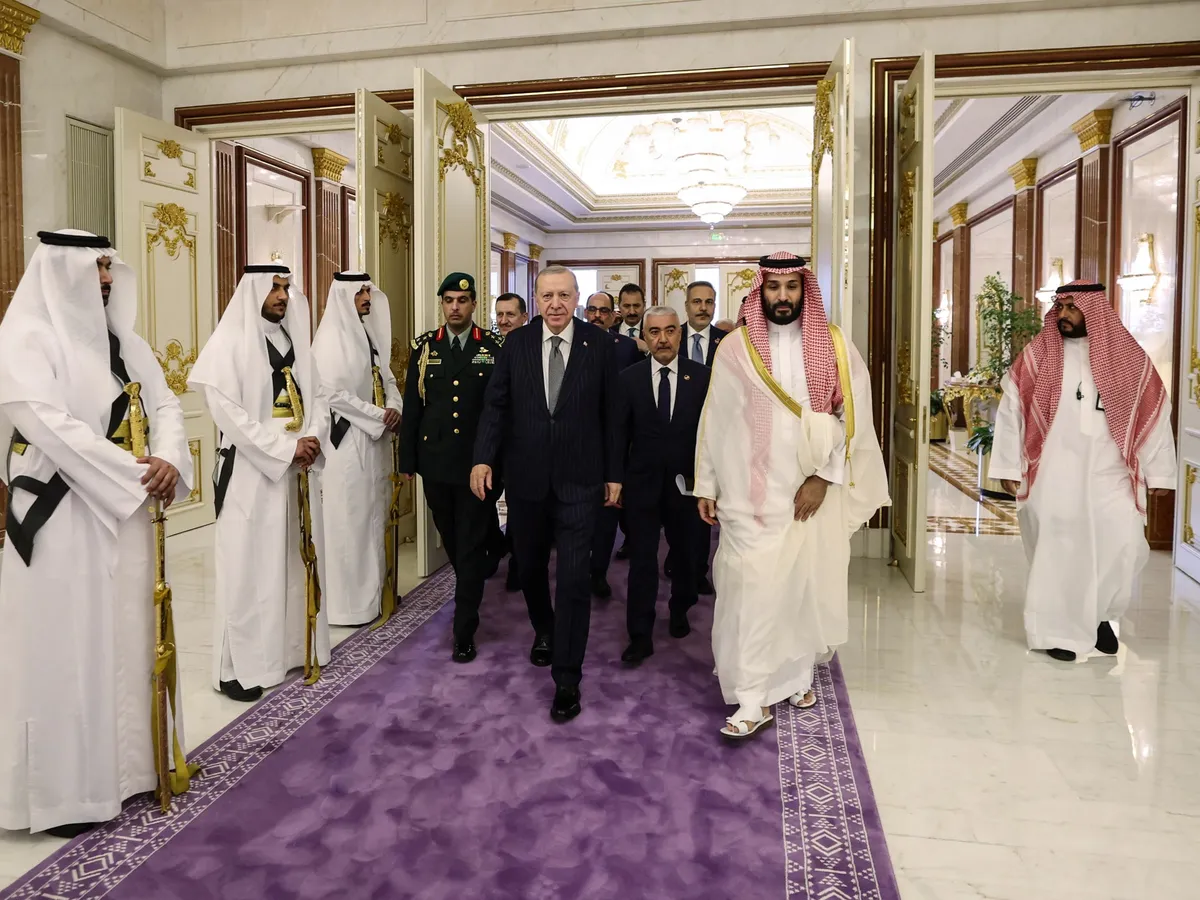
Analysts say regional partners are seeking alternatives to supplement their security without discarding US support.Saudi Arabia's Crown Prince Mohammed bin Salman walks alongside Turkish President Recep Tayyip Erdogan during their meeting in Mecca on August 7 [Handout via AFP]Published On 8 Aug 2026A new mutual defence pact between Saudi Arabia, Turkiye and Pakistan has raised questions about the shifting geopolitical landscape of the Middle East, where fallout from the Iran" class="entity-link entity-event" data-entity-id="38678" data-entity-type="event">US-Israel war on Iran has prompted some countries to seek new arrangements to safeguard their security.The pact, termed the Mecca-joint-defence-agreement" class="entity-link entity-event" data-entity-id="180845" data-entity-type="event">Mecca Joint Defence Agreement, was signed in the Saudi city of Mecca on Friday.Recommended Stories list of 3 itemslist 1 of 3Turkiye, Saudi Arabia, Pakistan sign joint defence agreement: What’s in it?list 2 of 3Houthi attacks on gov’t forces hint that a major battle in Yemen is brewinglist 3 of 3Saudi Arabia, Pakistan and Turkiye sign defence deal amid regional turmoilend of list“The agreement is intended to strengthen collective deterrence against any act of aggression, and stipulates that any armed attack against any one of the three states shall be regarded as an attack against them all,” a statement from the meeting reads.“It further provides for the enhancement of all aspects of defence cooperation among the three states.”While it is not yet clear what such an agreement might look like in practice, analysts say the pact points to growing questions about the durability of US security guarantees.“Regional states have harbored growing doubts about the reliability of the US security partnership for more than a decade,” Kristian Coates Ulrichsen, a Middle East fellow at Rice University’s Baker Institute for Public Policy, told Al Jazeera over email.“Both the decision to begin military operations against Iran and the subsequent conduct of the war and the on-off attempts to resolve it have only intensified those concerns and accelerated efforts to diversify security and defence relations.”But, Ulrichsen added, building new defence pacts is likely not intended “to replace or supplant the US, but to provide additional strategic and policy options”.Uncertainty over US roleWhile the administration of US President Donald Trump has yet to weigh in on the pact, analysts say the agreement is an effort by the three countries to reorient themselves after the turmoil of the Iran war.“This is one of the first major geopolitical signs that the regional order is being reshaped by the US-Israeli war on Iran,” Sina Toossi, an analyst at the Center for International Policy, told Al Jazeera.“The significance is less about a formal military alliance than about what it says regarding how regional states are reassessing security.”Toossi pointed to the long-running alliance between the US and Saudi Arabia. For decades, the two countries have enjoyed a strong relationship, hinged on shared security interests. But the pact could be a sign that Saudi Arabia is looking to expand its security alliances.“Rather than relying primarily on Washington, Saudi Arabia appears to be broadening its security partnerships and laying the groundwork for more intra-regional security arrangements,” Toossi explained. “That is arguably the most important takeaway.”Media reports have also indicated that US partners in the Middle East were frustrated that the Trump administration had launched February’s war against Iran with little apparent thought to the impact on allies in the region.Iranian forces have launched waves of missile and drone strikes against US military facilities in the Middle East, causing bystander casualties. Iran has also targeted civilian infrastructure, including energy and desalination plants.Tehran’s decision to close the Strait of Hormuz, a key conduit for the region’s energy exports, has also imposed a steep cost on local economies.Despite heavy strikes by the US and Israel, Iran has largely maintained its ability to restrict traffic through the strait, and Washington has struggled to provide partners with sufficient air defence munitions, many of which went to Israel.‘Normative deterrence’Under the circumstances created by the war, the longstanding reliance on Washington for security in the region has become more strained.“It’s a fluid, tabula rasa era in the Middle East,” Brett McGurk, a key architect of Middle East policy under former US President Joe Biden, wrote in a social media post.But analysts note that Friday’s security pact is best understood as an effort to supplement regional security cooperation with other countries and deter Iran.“These countries are all US partners, and they recognise that there is no framework that can replace the United States,” Yasmine Farouk, an analyst at the International Crisis Group, told Al Jazeera.Farouk added that it would also be a mistake to see the pact as a step towards greater confrontation with Iran.She noted that all three countries involved have generally called for mediation and de-escalation since the US and Israel first launched their attacks on Iran in late February.“What these countries have in common is that they are not seeking regional escalation,” she said, underscoring that the importance of the agreement might be something closer to “normative deterrence”.Iran, she explained, has emerged from the war hardened and more confident in its ability to use force to advance its goals.“There is a long-term perspective here on strategic cooperation, not just a deterrent effect.”
SRCAl Jazeera
LANGEN
LEANCenter
WORDS843
ENT12
SAT · 2026-08-08 · 01:29 GMTBRIEF NSR-2026-0808-100263
NSR-2026-0808-100263Analysis·EN·National Security
What could the Mecca defence pact mean for the US role in the Middle East?
Saudi Arabia, Turkiye, and Pakistan have signed the Mecca Joint Defence Agreement, a mutual defense pact aimed at strengthening collective deterrence and enhancing defense cooperation. This agreement, signed in Mecca on Friday, comes amid regional turmoil following the US-Israel war on Iran.
Brian OsgoodAl JazeeraFiled 2026-08-08 · 01:29 GMTLean · CenterRead · 4 min
Al JazeeraFIG 01
Reading time
4min
Word count
843words
Sources cited
2cited
Entities identified
12entities
Quality score
100%
§ 01
Briefing Summary
AI-generatedNEWSAR · AI
Saudi Arabia, Turkiye, and Pakistan have signed the Mecca Joint Defence Agreement, a mutual defense pact aimed at strengthening collective deterrence and enhancing defense cooperation. This agreement, signed in Mecca on Friday, comes amid regional turmoil following the US-Israel war on Iran. Analysts suggest the pact reflects growing doubts among regional partners about the reliability of US security guarantees and their desire to supplement security without discarding US support. The agreement is seen as a geopolitical sign of a reshaping regional order, with Saudi Arabia broadening its security partnerships beyond Washington. While the pact is not intended to replace the US, it provides additional strategic options for the participating nations.
Confidence 0.90Sources 2Claims 5Entities 12
§ 02
Article analysis
Model · rule-basedFraming
National Security
Diplomatic
Tone
Measured
AI-assessed
CalmNeutralAlarmist
Factuality
0.40 / 1.00
Mixed
LowHigh
Sources cited
2
Limited
FewMany
§ 03
Key claims
5 extracted01
Regional states have harbored growing doubts about the reliability of the US security partnership for more than a decade.
quoteKristian Coates Ulrichsen
Confidence
1.00
02
The pact is intended to strengthen collective deterrence against any act of aggression.
quotestatement from the meeting
Confidence
1.00
03
A new mutual defence pact between Saudi Arabia, Turkiye and Pakistan has been signed.
factual
Confidence
1.00
04
Building new defence pacts is likely not intended to replace or supplant the US, but to provide additional strategic and policy options.
quoteKristian Coates Ulrichsen
Confidence
0.90
05
The agreement is an effort by the three countries to reorient themselves after the turmoil of the Iran war.
quoteSina Toossi
Confidence
0.90
§ 04
Full report
4 min read · 843 words§ 05
Entities
12 identifiedKey playerOppositionContextPositiveNeutralNegative
People3
Locations6
§ 06
Keywords & salience
10 termsmecca joint defence agreement
1.00
us security guarantees
0.90
geopolitical landscape
0.80
regional security
0.80
collective deterrence
0.70
middle east
0.60
us role
0.50
saudi arabia
0.40
turkiye
0.40
pakistan
0.40
§ 07
Topic connections
Interactive graph Network visualization showing 51 related topics
View Full Graph Person Organization Location Event|Click node to navigate|Edge numbers = shared articles