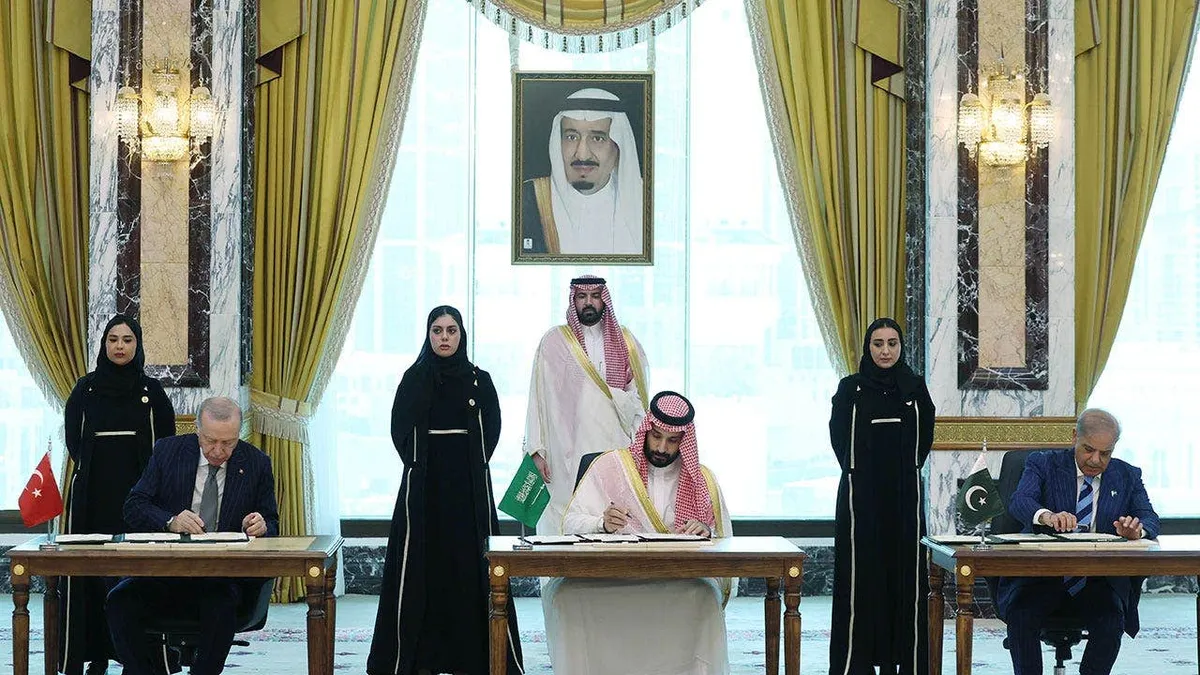
close Video Saudi-Turkey-Pakistan pact signals new regional security model, Saudi expert says Saudi analyst Aziz Alghashian says the alliance complements US interests by increasing burden-sharing rather than challenging the Abraham Accords. NEWYou can now listen to Fox News articles! Hören Sie sich diesen Artikel an 8 Min A new defense pact linking Saudi Arabia, Turkey and Pakistan is fueling debate over whether the three countries are laying the groundwork for a competing regional bloc — potentially challenging the U.S.-backed architecture built around Israel and the Abraham Accords — or simply creating a new model of burden-sharing among American partners. The three countries, all with longstanding security ties to the United States, enter the pact with different interests — but together they could begin shifting the region’s balance of power. Saudi Arabia signed a Strategic Defense Agreement with the United States in November 2025 and was designated a major non-NATO ally, but Riyadh did not secure the treaty-level, Article 5-style U.S. defense guarantee it had long sought, making the new pact a potential hedge against uncertainty over Washington’s future security commitments. Pakistan, a nuclear-armed state, gains greater energy security, Saudi investment and regional influence, while offering significant military capabilities — although whether its nuclear deterrent extends to its partners remains unconfirmed. Turkey, already a NATO member, gains a larger market for its growing defense industry and additional strategic weight as tensions with Israel rise. WHO IS Turkey'S Recep Tayyip Erdoğan? HOW NATO'S MOST UNPREDICTABLE LEADER KEEPS REINVENTING HIMSELF Turkish President Recep Tayyip Erdogan (L), Saudi Crown Prince Mohammed bin Salman (C) and Pakistani Prime Minister Shehbaz Sharif (R) sign a trilateral joint defense agreement in Mecca, Saudi Arabia, on August 7, 2026. (TUR Presidency /Murat Cetinmuhurdar / Handout/Anadolu via Getty Images)) Taken together, the arrangement gives three U.S. partners greater ability to build deterrence on their own — potentially easing Washington’s security burden while also giving them more independence from it. Saudi Crown Prince Mohammed bin Salman, Turkish President Recep Tayyip Erdoğan and Pakistani Prime Minister Shehbaz Sharif signed the Mecca Joint Defence Agreement on Aug. 7 . A joint statement said the pact was intended to "strengthen collective deterrence against any act of aggression" and stipulated that an armed attack against one country would be regarded as an attack against all three. Turkish Foreign Minister Hakan Fidan went further the following day, telling Turkey’s state-run Anadolu news agency that the agreement was "technically the same" as NATO’s Article 5 mutual-defense provision, which treats an attack on one member as an attack on all. Fidan said, however, that the countries would consult on the degree and form of assistance provided following an attack, with operational details still to be determined by a new ministerial committee. The alliance will also establish a general secretariat based in Saudi Arabia , Reuters reported Aug. 8 . Fidan said President Recep Tayyip Erdoğan wants the alliance to eventually expand beyond its three founding members and identified Egypt as a potential participant. He said negotiations over the pact had been underway for two years and eight months. Saudi Deputy Minister for Public Diplomacy Rayed Krimly has pushed back on suggestions that the agreement represents the creation of a new sectarian or military bloc, saying it is not connected to nuclear ambitions or an arms race. Turkish officials have similarly said the pact is defensive and not directed against Iran or any other country. Iran, meanwhile, played down the pact as a threat to Tehran. Foreign Ministry spokesman Esmaeil Baghaei said Aug. 10 that Iran saw no reason to be concerned that the agreement was directed against it, telling Reuters that the pact reflected a regional shift toward countries relying more heavily on their own security capabilities rather than outside powers. "Any plan that is based on the geopolitical and historical realities of the region, is comprehensive and inclusive, and correctly identifies the enemy and the threat, has a chance of helping to strengthen security and prevent instability and abuses by the Zionist enemy and its allies," Baghaei said, referring to Israel. Fox News Digital reached out to the Turkish Embassy in Washington, D.C., and the Pakistani government for comment but did not receive responses in time for publication. Sinan Ciddi, a senior fellow at the Foundation for Defense of Democracies and director of its Turkey program, told Fox News Digital that he remains skeptical that the pact currently amounts to a NATO-style alliance. AMERICANS ARE NOT GIVING UP ON NATO, BUT THEY EXPECT EUROPE TO DO ITS SHARE Video "Does it have teeth? Is it a serious deterrent? Is that a serious collective defense pact? Is it a Muslim NATO? We're not actually sure yet," Ciddi said. Ciddi said each of the three countries enters the pact with different incentives. For Saudi Arabia, he sees it as a hedge against doubts over the reliability of U.S. security guarantees; for Pakistan, it offers greater energy security, Saudi investment and added regional prestige; and for Turkey, it creates new opportunities for defense cooperation and a larger market for its arms industry. Ankara also gains additional deterrent weight as its tensions with Israel grow, he argued. "I would say that this pact is much more targeted towards closer economic and commercial ties rather than substantive NATO-like security ties," Ciddi added. Saudi Arabia rejects the suggestion that the agreement represents a turn away from Washington. WATCH: DEMOCRATS BLAST TRUMP SAUDI NUCLEAR DEAL AS GOP TOUTS REGIONAL ALLIANCE Pakistan's Prime Minister Shehbaz Sharif is received by Deputy Governor of Mecca region, Prince Saud bin Mishaal bin Abdulaziz upon his arrival in Jeddah, Saudi Arabia, August 6, 2026. (SPA Saudi Pess Agancey via Reuters) "The United States remains to be our primary strategic partner," a Saudi source told Fox News Digital on background, saying the kingdom’s expanding ties with Pakistan and Turkey should not be viewed as coming at the expense of its relationship with Washington. The Saudi source also rejected descriptions of the agreement as a "Muslim NATO" or Sunni alliance and said it was not directed against Israel, Iran or any other particular country. Asked whether the pact represented a Saudi move away from normalization with Israel, the source said, "It's not related in any way." Aziz Alghashian, a senior non-resident fellow at the Gulf International Forum, offered a similar interpretation. "I don't think it's a counterweight to the Abraham Accords," Alghashian told Fox News Digital. WHY NATO’S DEFENSE SPENDING IMBALANCE LASTED FOR DECADES Turkish President Tayyip Erdogan meets Saudi Crown Prince Mohammed bin Salman, ahead of the expected signing of a defence deal between Saudi Arabia, Pakistan and Turkey, in Mecca, Saudi Arabia, August 7, 2026. (Murat Cetinmuhurdar/Turkish Presidential Press Office/Handout via Reuters) Instead, Alghashian described the agreement as part of Saudi Arabia’s longer-term diversification of strategic relationships. "I think it's actually a supplementation. It's complementary to the United States," he said, arguing that greater cooperation among regional partners could provide increased burden-sharing for Washington. From Pakistan’s perspective, the agreement offers both military and political advantages, Raza Rumi, distinguished lecturer at the Roosevelt House Public Policy Institute at CUNY, told Fox News Digital. "Pakistan gains strategic depth, greater leverage in the Gulf and a more formal place in an emerging regional security architecture," Rumi said, pointing to potential cooperation on defense production, technology transfers, intelligence, training and air and missile defense. But he cautioned against interpreting the pact’s mutual-defense language too literally. "Seriously, but not literally as an Article 5-style guarantee, at least not yet," Rumi said. Its credibility, he added, will depend on whether the countries develop joint planning, command structures and procedures for responding to crises. Rumi also warned against assuming the Middle East is already dividing into two fixed camps. India, however, is watching the new alignment closely. India’s Ministry of External Affairs said Aug. 11 that it was examining the pact’s implications for national security and regional peace and stability, adding that New Delhi would take "whatever necessary steps are required" to safeguard its interests. "These states are hedging, not choosing permanent blocs," he said. TRUMP SQUEEZED BETWEEN Israel AND Turkey AS NETANYAHU, ERDOGAN ESCALATE FEUD Turkish President Recep Tayyip Erdogan (L), Saudi Crown Prince Mohammed bin Salman (C), and Pakistani Prime Minister Shehbaz Sharif (R) sign a trilateral defense agreement in Mecca, Saudi Arabia, on August 7, 2026. (Turkish Presidency / Murat Cetinmuhurdar / Handout/Anadolu via Getty Images) Ciddi, on the other hand, argued that the agreement reflects "serious reservations" among regional countries about U.S. security guarantees. His greater concern is that even a militarily weak pact could encourage opposing alignments to harden. "Security pacts beget more security pacts," Ciddi said, arguing that Israel, Greece, Cyprus and potentially India could deepen their own cooperation in response. "You're buying security, but you're also creating tension," he said. "That's where I think the harm comes in." U.S. President Donald Trump meets with Crown Prince and Prime Minister Mohammed bin Salman of Saudi Arabia during a bilateral meeting in the Oval Office of the White House on November 18, 2025 in Washington, DC. (Win McNamee/Getty Images) Calling the pact a direct counterweight to the Abraham Accords or the India-Middle East-Europe Economic Corridor would therefore be "premature," Rumi argued. But he said a broader competition is emerging over the region’s future — between U.S.-backed economic integration involving India, Israel and the Gulf and efforts by Saudi Arabia, Turkey and Pakistan to develop greater strategic autonomy. Efrat (Effie) Lachter is a reporter for Fox News Digital with more than 15 years of experience covering conflict, global affairs, human rights and political accountability. She has directed and produced more than 200 documentary segments across more than 40 countries, documenting conflicts, humanitarian crises, corruption, human trafficking, gender-based violence and the human stories behind major world events. Lachter’s reporting has taken her into conflict zones and crisis areas across the Middle East, Europe, Asia and Africa. Her work has included uncovering human trafficking networks, revealing an ISIS underground torture prison in Syria, documenting the war in Ukraine and interviewing senior political figures and world leaders. She was also among the Western journalists who entered Russia after the war began to bring testimonies from Putin’s opposition. Lachter is the recipient of the 2022 Peres Center for Peace Award and was a 2023–2024 Knight-Wallace Journalism Fellow at the University of Michigan. She also won two Rockower Awards for Excellence in Reporting. She holds a bachelor's degree in communication and a master's degree in political science.
SRCFox News - World
LANGEN
LEANCenter-Right
WORDS1 741
ENT12
WED · 2026-08-12 · 13:53 GMTBRIEF NSR-2026-0812-101588
NSR-2026-0812-101588Analysis·EN·Political Strategy
New power axis in the making? Three military heavyweights lock arms, complicating Abraham Accords strategy
Saudi Arabia, Turkey, and Pakistan have signed a new Joint Defence Agreement in Mecca, establishing a mutual defense pact where an attack on one is considered an attack on all. This alliance, negotiated over two years, aims to strengthen collective deterrence and could potentially shift regional power dynamics.
Fox News - WorldFiled 2026-08-12 · 13:53 GMTLean · Center-RightRead · 7 min
Fox News - WorldFIG 01
Reading time
7min
Word count
1 741words
Sources cited
2cited
Entities identified
12entities
Quality score
100%
§ 01
Briefing Summary
AI-generatedNEWSAR · AI
Saudi Arabia, Turkey, and Pakistan have signed a new Joint Defence Agreement in Mecca, establishing a mutual defense pact where an attack on one is considered an attack on all. This alliance, negotiated over two years, aims to strengthen collective deterrence and could potentially shift regional power dynamics. While Turkish officials describe it as technically similar to NATO's Article 5, operational details are still to be determined. The pact is seen by some as a hedge against uncertainty in U.S. security commitments, offering benefits like energy security for Pakistan and a larger market for Turkey's defense industry. Saudi Arabia and Turkey emphasize the pact's defensive nature and deny it's directed against any specific country or a challenge to the Abraham Accords.
Confidence 0.90Sources 2Claims 5Entities 12
§ 02
Article analysis
Model · rule-basedFraming
Political Strategy
National Security
Tone
Mixed Tone
AI-assessed
CalmNeutralAlarmist
Factuality
0.60 / 1.00
Mixed
LowHigh
Sources cited
2
Limited
FewMany
§ 03
Key claims
5 extracted01
The pact aims to 'strengthen collective deterrence against any act of aggression'.
quoteJoint statement
Confidence
1.00
02
The agreement is 'technically the same' as NATO's Article 5 mutual-defense provision, according to Turkish Foreign Minister Hakan Fidan.
quoteHakan Fidan
Confidence
1.00
03
An armed attack against one country would be regarded as an attack against all three under the new pact.
factualJoint statement
Confidence
0.90
04
A new defense pact links Saudi Arabia, Turkey, and Pakistan, potentially shifting regional power balance.
factual
Confidence
0.90
05
The pact could be a hedge against uncertainty over Washington's future security commitments for Saudi Arabia.
factual
Confidence
0.80
§ 04
Full report
7 min read · 1 741 words§ 05
Entities
12 identifiedKey playerOppositionContextPositiveNeutralNegative
People4
Organizations1
Locations5
§ 06
Keywords & salience
10 termsregional security
1.00
abraham accords
0.90
defense pact
0.90
turkey
0.80
saudi arabia
0.80
pakistan
0.80
balance of power
0.70
burden-sharing
0.60
us security commitments
0.50
collective deterrence
0.40
§ 07
Topic connections
Interactive graph Network visualization showing 51 related topics
View Full Graph Person Organization Location Event|Click node to navigate|Edge numbers = shared articles