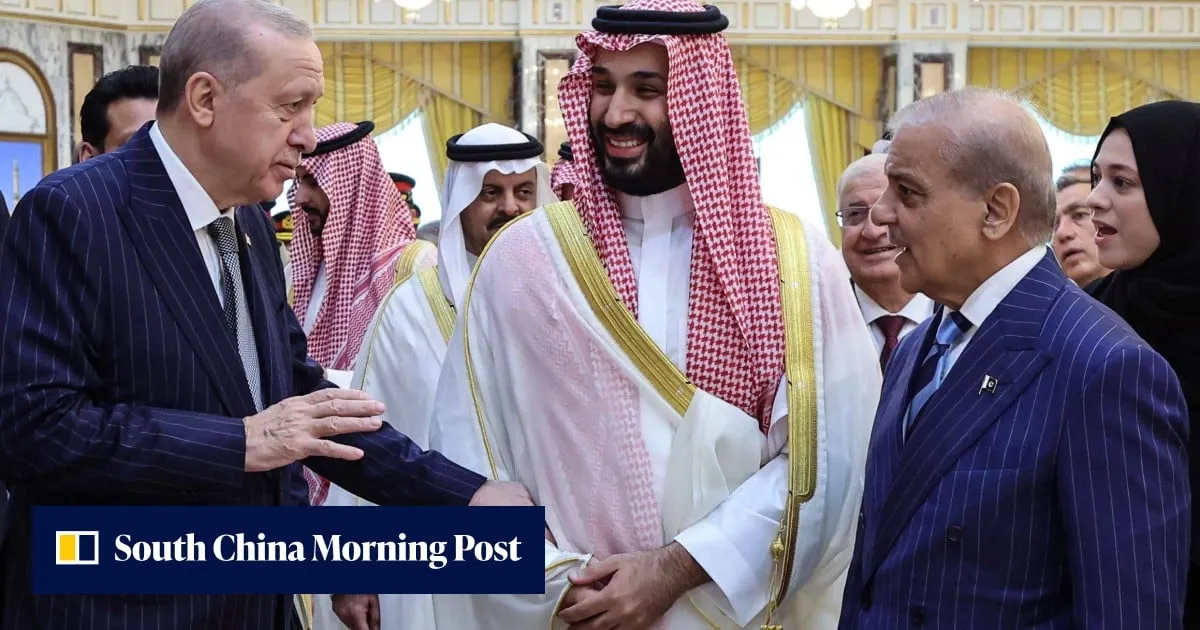
The security pact signed on Friday by three of the world’s most powerful Muslim nations with a vow to enhance collective deterrence remains far from what many are calling an Islamic Nato, according to experts.The Mecca Joint Defence Agreement between Saudi Arabia, the Persian Gulf’s top oil exporter, Nato member Turkey and Pakistan, a nuclear-armed South Asian state, would be challenged by diverging strategic interests and weak mutual defence capacity, they said.The Mecca pact’s statement that an armed attack on any of the three would be viewed as an attack on all was technically similar to the defence principle outlined in Article 5 of the transatlantic security alliance, Turkey’s top diplomat Hakan Fidan said on Saturday.
SRCSouth China Morning Post
LANGEN
LEANCenter-Right
WORDS116
ENT8
THU · 2026-08-13 · 10:22 GMTBRIEF NSR-2026-0813-101908
NSR-2026-0813-101908News Report·EN·Political Strategy
Saudi-Turkey-Pakistan Mecca pact ‘far from’ Nato-style defence alliance
Saudi Arabia, Turkey, and Pakistan have signed the Mecca Joint Defence Agreement, a security pact aimed at enhancing collective deterrence. While the agreement states that an attack on one will be considered an attack on all, experts believe it is unlikely to become an "Islamic Nato." According to these experts, the pact faces significant challenges due to diverging strategic interests among the three nations and their weak mutual defense capacity.
Fan ChenSouth China Morning PostFiled 2026-08-13 · 10:22 GMTLean · Center-RightRead · 1 min
South China Morning PostFIG 01
Reading time
1min
Word count
116words
Sources cited
2cited
Entities identified
8entities
Quality score
100%
§ 01
Briefing Summary
AI-generatedNEWSAR · AI
Saudi Arabia, Turkey, and Pakistan have signed the Mecca Joint Defence Agreement, a security pact aimed at enhancing collective deterrence. While the agreement states that an attack on one will be considered an attack on all, experts believe it is unlikely to become an "Islamic Nato." According to these experts, the pact faces significant challenges due to diverging strategic interests among the three nations and their weak mutual defense capacity. Turkey's top diplomat, Hakan Fidan, noted the technical similarity of the pact's defense principle to NATO's Article 5.
Confidence 0.85Sources 2Claims 5Entities 8
§ 02
Article analysis
Model · rule-basedFraming
Political Strategy
Diplomatic
Tone
Measured
AI-assessed
CalmNeutralAlarmist
Factuality
0.60 / 1.00
Mixed
LowHigh
Sources cited
2
Limited
FewMany
§ 03
Key claims
5 extracted01
Pakistan is a nuclear-armed South Asian state.
factual
Confidence
1.00
02
Saudi Arabia is the Persian Gulf's top oil exporter.
factual
Confidence
1.00
03
The pact's statement that an armed attack on any of the three would be viewed as an attack on all is technically similar to Article 5 of Nato.
quoteHakan Fidan
Confidence
0.95
04
A security pact signed by Saudi Arabia, Turkey, and Pakistan is far from an Islamic Nato, according to experts.
factualexperts
Confidence
0.90
05
The Mecca Joint Defence Agreement would be challenged by diverging strategic interests and weak mutual defence capacity.
factualexperts
Confidence
0.85
§ 04
Full report
1 min read · 116 words§ 05
Entities
8 identifiedKey playerOppositionContextPositiveNeutralNegative
People1
Locations5
§ 06
Keywords & salience
10 termsmecca joint defence agreement
1.00
collective deterrence
0.90
islamic nato
0.80
defence alliance
0.70
strategic interests
0.60
mutual defence capacity
0.50
turkey
0.40
pakistan
0.40
article 5
0.40
saudi arabia
0.40
§ 07
Topic connections
Interactive graph Network visualization showing 51 related topics
View Full Graph Person Organization Location Event|Click node to navigate|Edge numbers = shared articles