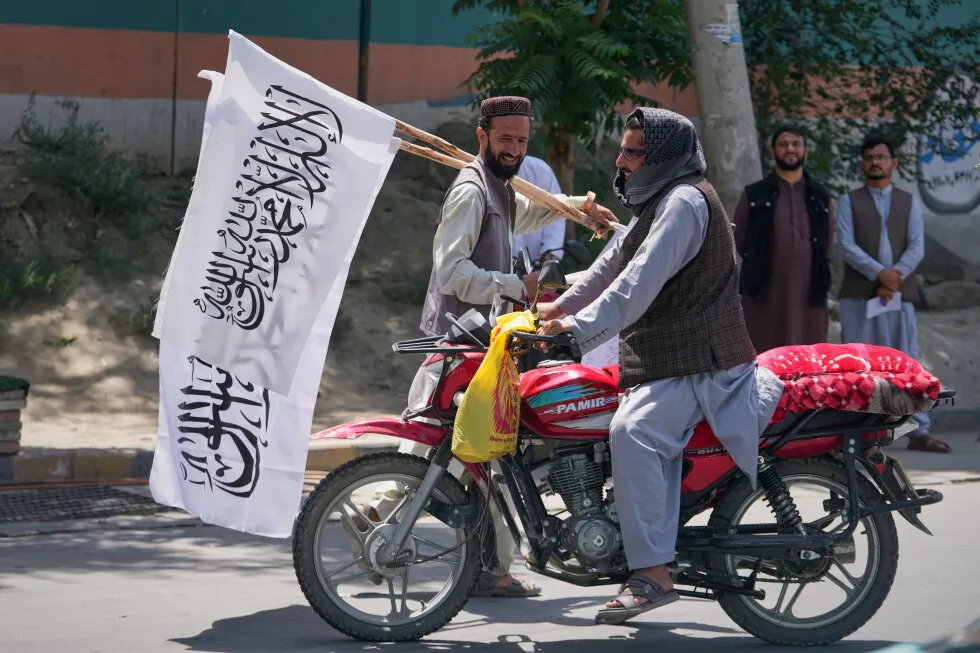
Afghanistan marks 5 years under the Taliban with safer streets but pleas for jobs and education 1 of 5 | A man offers Taliban flags for sale ahead of celebrations marking the fifth anniversary of the U.S. withdrawal from Afghanistan and the start of Taliban-rule" class="entity-link entity-topic" data-entity-id="185342" data-entity-type="topic">Taliban rule, in Kabul, Afghanistan, Thursday, Aug. 13, 2026. (AP Photo/Siddiqullah Alizai) 2 of 5 | A Taliban security officer checks a driver’s identification at a checkpoint ahead of celebrations marking the fifth anniversary of the U.S. withdrawal from Afghanistan and the start of Taliban-rule" class="entity-link entity-topic" data-entity-id="185342" data-entity-type="topic">Taliban rule, in Kabul, Afghanistan, Thursday, Aug. 13, 2026. (AP Photo/Siddiqullah Alizai) 3 of 5 | Workers paint a mural celebrating the Taliban’s victory and the defeat of the U.S.-led occupation ahead of celebrations marking five years of Taliban-rule" class="entity-link entity-topic" data-entity-id="185342" data-entity-type="topic">Taliban rule, in Kabul, Afghanistan, Thursday, Aug. 13, 2026. (AP Photo/Siddiqullah Alizai) 4 of 5 | A Taliban security officer searches a man at a checkpoint ahead of celebrations marking the fifth anniversary of the U.S. withdrawal from Afghanistan and the start of Taliban-rule" class="entity-link entity-topic" data-entity-id="185342" data-entity-type="topic">Taliban rule, in Kabul, Afghanistan, Thursday, Aug. 13, 2026. (AP Photo/Siddiqullah Alizai) 5 of 5 | A Taliban security officer searches a man at a checkpoint ahead of celebrations marking the fifth anniversary of the U.S. withdrawal from Afghanistan and the start of Taliban-rule" class="entity-link entity-topic" data-entity-id="185342" data-entity-type="topic">Taliban rule, in Kabul, Afghanistan, Thursday, Aug. 13, 2026. (AP Photo/Siddiqullah Alizai) By Abdul Qahar Afghan and Suzan Fraser Updated 12:08 PM MESZ, August 14, 2026 Add AP News on Google Add AP News as your preferred source to see more of our stories on Google. Share Share Facebook Copy Link copied Print Email X LinkedIn Bluesky Flipboard Pinterest Reddit Kabul, Afghanistan (AP) — As Afghanistan’s Taliban rulers mark five years since sweeping back to power, some Kabul residents say they feel safer after decades of conflict and upheaval but stress the leaders should now focus on creating jobs and expanding access to schools in the country where girls above the age of 12 are banned from education. The Taliban regained control of Afghanistan on Aug. 15, 2021, after it launched an offensive as the U.S. and other NATO troops withdrew from the country after two decades of war. The withdrawal led to chaotic scenes at and around Kabul’s airport with thousands wanting to leave. “Thank God, the past five years have passed in safety,” said Mohammad Qasim, 30, reflecting on the anniversary that comes against a backdrop of economic hardship in a conflict-stricken country. “Our wish and hope from the government is to create job opportunities for the youth.” “We, along with the entire nation, call upon the government to create employment opportunities for the youth and to encourage them to pursue education,” he added. The group initially pledged to protect women’s rights but soon banned girls and women from attending secondary school and higher education, citing its interpretations of Islamic laws. It later also imposed restrictions on women’s employment and traveling without a male guardian. While the U.N. has acknowledged that the country has become more stable since the takeover, it has warned that lasting stability cannot be possible unless the Taliban rulers — who remain isolated internationally — lift restrictions on women and girls, protect basic rights and address terrorism concerns. “A reduction in conflict has brought tangible benefits for many Afghans and created opportunities to focus on recovery, development and regional economic cooperation,” the United Nations Assistance Mission in Afghanistan, or UNAMA, said in a statement ahead of the anniversary. It added, however, that the restrictions on women and girls impede Afghanistan’s recovery and its reintegration with the international community. 2.4 million Afghan girls shut out of secondary school 5 years after Taliban takeover, UN says 2 MIN READ Human Rights Watch says the Taliban detained 6 staff of a women’s and children’s rights group 1 MIN READ Months of fighting between Afghanistan and Pakistan have killed nearly 500 Afghan civilians, UN says 1 MIN READ UN says Afghanistan in world’s most severe women’s rights crisis In a statement this week, the U.N.'s agency on women’s rights, said Afghan women and girls are living under the world’s most severe restrictions, which not only violate their rights but also threaten the country’s social and economic future. “Half a decade after the Taliban takeover in August 2021, Afghanistan has systematically dismantled the rights of half its population, making it a global outlier with no parallel in the modern world,” U.N. Women said. “In the past year alone, this exclusion of women and girls from education, employment, public life, justice systems and healthcare has only intensified, entrenching what remains the world’s most severe women’s rights crisis,” it said. Fazila Soroush, a 39-year-old Kabul-based entrepreneur and an advocate for women’s rights, said the government had “demonstrated its worth to the people through its actions in every area.” “We consider it essential that the officials of the Islamic Emirate who had announced the closure of schools and universities until further notice, now make a clear and practical decision regarding this matter,” she said. In the streets of Kabul, preparations for the anniversary celebrations were underway. Vendors sold the Taliban’s white with black scripted flags while painters were busy writing slogans in praise of Islamic laws on walls, including: “The Islamic system has been achieved at the cost of the martyrs’ blood” and “Our commitment stands firm: Consolidation and implementation of Islamic Sharia.” Molvi Hayatullah Mahajar Farahi, deputy minister in the Taliban government for broadcasting at the Ministry of Information and culture, said in the five years the administration has delivered security, stabilized the currency, improved infrastructure and formed industrial parks that have created jobs. “Naturally, challenges and difficulties exist, yet we can highlight several accomplishments,” Farahi told The Associated Press. Farahi, when asked, did not address the issue of the education of girls and women but said “the level of investment made in universities surpasses anything seen in the past. “The Emirate continues its efforts to further organize and improve services for our citizens in the fields of education and other sectors,” he stated. The deputy minister rejected a U.N. report that documented terrorist networks in Afghanistan, saying “these are merely enemy propaganda, spread to portray the country as unstable.” Asked to comment about its international isolation, Farahi insisted the Taliban government was engaged with some 40 countries. The Taliban government currently is only formally recognized by Russia. “The Islamic Emirate of Afghanistan has fulfilled all the requirements necessary for official recognition. It is now up to the international community and others to step forward and take the appropriate action,” he said. The bans have left an estimated 2.4 million girls excluded from secondary education, UNESCO, the U.N. Educational, Scientific and Cultural Organization, said this week — a 200,000 increase from last year. The restrictions have reversed two decades of progress that Afghanistan had made in education, the agency said. Pointing at a broader educational crisis, the agency said 53% of primary school-aged children are out of school. Schools lack basic infrastructure such as water, sanitation or heating, while natural disasters have also led to hundreds of school closures. Meanwhile, the U.N. World Food Program said child malnutrition has reached critical levels in a third of Afghanistan’s provinces and is expected to worsen as funding shortfalls force cuts in food distributions and other support. In Kabul, Dost Mohammad Khan expressed support for the Taliban administration, saying the past five years have brought stability. He said however, that the country needs trained professionals such as doctors and engineers, urging the authorities to keep “all sectors operational.” “We also call upon the Islamic Emirate to permit women to attend school under the sharia dress code and we urge the public to heed the directives of the Emirate also,” said the 38-year-old.
SRCAssociated Press (AP)
LANGEN
LEANCenter
WORDS1 290
ENT12
FRI · 2026-08-14 · 09:23 GMTBRIEF NSR-2026-0814-102260
NSR-2026-0814-102260News Report·EN·Human Interest
Afghanistan marks 5 years under the Taliban: safer streets but pleas for jobs and education
Afghanistan's Taliban rulers are marking five years in power, a period where some residents report increased safety but also express a strong desire for job creation and expanded educational opportunities. The Taliban regained control in August 2021 following the withdrawal of U.S.
Associated Press (AP)Filed 2026-08-14 · 09:23 GMTLean · CenterRead · 6 min
Associated Press (AP)FIG 01
Reading time
6min
Word count
1 290words
Sources cited
1cited
Entities identified
12entities
Quality score
100%
§ 01
Briefing Summary
AI-generatedNEWSAR · AI
Afghanistan's Taliban rulers are marking five years in power, a period where some residents report increased safety but also express a strong desire for job creation and expanded educational opportunities. The Taliban regained control in August 2021 following the withdrawal of U.S. and NATO troops. While the United Nations acknowledges improved stability, it warns that lasting peace is contingent on lifting restrictions on women and girls, who are banned from secondary and higher education and face limitations on employment and travel. The Taliban government claims to have delivered security, stabilized the currency, and improved infrastructure, creating jobs. However, UN agencies highlight a worsening educational crisis, with millions of girls excluded from school, and a severe women's rights crisis.
Confidence 0.90Sources 1Claims 5Entities 12
§ 02
Article analysis
Model · rule-basedFraming
Human Interest
Economic Impact
Tone
Measured
AI-assessed
CalmNeutralAlarmist
Factuality
0.70 / 1.00
Factual
LowHigh
Sources cited
1
Limited
FewMany
§ 03
Key claims
5 extracted01
The Taliban banned girls and women from secondary and higher education, citing Islamic laws.
factual
Confidence
1.00
02
Girls above the age of 12 are banned from education in Afghanistan.
factual
Confidence
1.00
03
Residents are pleading with the Taliban government to create jobs and expand access to education.
quoteMohammad Qasim
Confidence
1.00
04
Some Kabul residents report feeling safer after five years of Taliban rule.
quoteMohammad Qasim
Confidence
1.00
05
Afghanistan's Taliban rulers are marking five years since regaining power.
factual
Confidence
1.00
§ 04
Full report
6 min read · 1 290 words§ 05
Entities
12 identifiedKey playerOppositionContextPositiveNeutralNegative
People4
§ 06
Keywords & salience
8 termsafghanistan
1.00
taliban rule
1.00
jobs and education
0.90
u.s. withdrawal
0.80
safer streets
0.70
economic hardship
0.60
girls' education
0.50
nato troops
0.40
§ 07
Topic connections
Interactive graph Network visualization showing 41 related topics
View Full Graph Person Organization Location Event|Click node to navigate|Edge numbers = shared articles