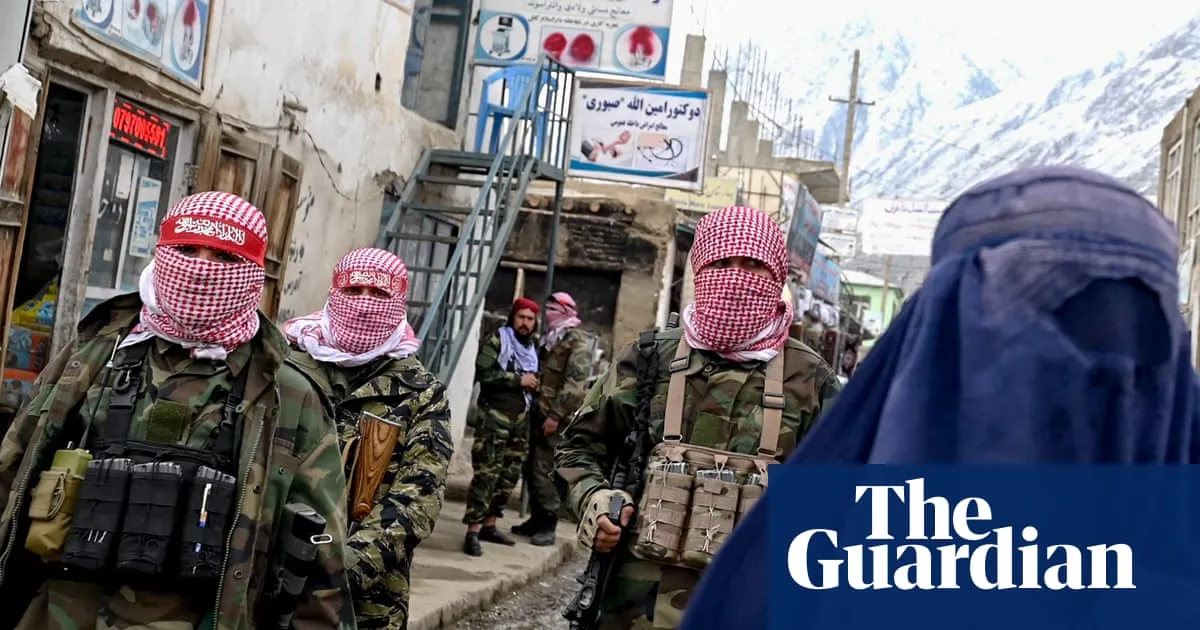
The Taliban in Afghanistan have launched a diplomatic effort to end their isolation as major regional and international powers show a readiness to engage more closely with the repressive regime despite its systematic human rights abuses.Five years after the Taliban took power, an increasing number of countries are renewing ties or scaling up diplomatic contacts with the hardline Islamists, who seized power in Kabul in 2021 after 20 years of brutal insurgent warfare.Campaigners fear that the individual contacts by different countries risk undermining “coherent, consistent” demands for an improvement in human rights in return for any diplomatic concessions.The United Nations described a recent “cascade of [Taliban] edicts and laws” that have banned women from universities and most employment, denied teenage girls education and imposed strict dress codes. Minorities have been persecuted, while activists and journalists face repression. Afghanistan has become a “graveyard for human rights,” the UN said in March.India, Qatar, China, Iran and several central Asian states all recently welcomed Taliban officials or opened new channels of communication. Russia, which recognised the Taliban government in Kabul just over a year ago, signed a military cooperation agreement last month. In June, the European Union held talks with Taliban officials in Brussels about returning failed asylum-seekers to Afghanistan. Individual European countries have also deepened their own contacts with Kabul.“There is no doubt there has been an evolution. The Islamic emirate is now in a confident position. They have realised they are indispensable for regional countries right now and even with Europe and the US they have identified how to engage,” said Shivam Shekhawat, at the Observer Research Foundation in Delhi.“The Taliban see any kind of contact as a diplomatic win and they have been able to capitalise on that as a sign granting legitimacy to the regime.”A strict policy of isolation imposed after the Taliban seized power in 2021 towards informal or “de facto” recognition is now fragmenting. Some western commentators have suggested more countries recognise the regime. Others want intensified “back channel” engagement.“We are not against any engagement … There is a need for engagement even if just for aid agencies to mitigate the ongoing humanitarian crisis but we are worried about the end goal of these contacts and the discussions that are taking place,” said Fereshta Abbasi, Afghanistan researcher at Human Rights Watch.“There should be a consistent and coherent message from the international community to the Taliban that they will not have any friends if they do not show real progress in terms of the women’s rights and human rights situation … and that is not happening.”The new contacts stem from a combination of regional security concerns, pressure in the west to reduce illegal immigration and a general recognition that the Taliban are unlikely to be forced from power in the foreseeable future.A Taliban fighter stands guard as women wait to receive food rations distributed by a humanitarian aid group in Kabul. Photograph: Ebrahim Noroozi/APThe European Commission downplayed its discussions in Brussels with a Taliban delegation, the first such formal encounter since 2021, as merely “technical” and focused on returns, but a Taliban spokesperson claimed it was a historic visit that was a step towards regularising consular relations with EU countries.The meeting prompted outrage.“You cannot condemn Taliban abuses in one breath and then announce talks on immigration in the next … The Taliban are telling their constituency back home that they are now accepted by the international community,” said Abbasi.This year officials from Tajikistan, Turkmenistan, Kyrgyzstan, Uzbekistan and Kazakhstan have all visited Kabul or other Afghan cities, seeking trade routes and pipeline deals that would allow their landlocked countries access to seaports or third countries beyond.India too has moved to reinforce relationships that were frosty after the fall of Kabul to the Taliban in 2021, in part to exploit new tensions between the movement and the Islamist movement’s historic sponsors, Pakistan.New Delhi secured a sanctions waiver last year so that Amir Khan Muttaqi, the Taliban foreign minister and a veteran official who has spent decades at the heart of the movement, could travel there.In June, India’s UN envoy suggested a rethink was necessary on sanctions, such as travel bans, asset freezes and arms embargoes, that target dozens of Taliban members.“The political reality of Afghanistan has changed in the last five years, and the current UN sanctions regime must take that into account,” said Harish Parvathaneni.Afghan authorities’ diplomatic strategy has involved hosting envoys in Kabul, including those from China, Japan, Turkey and Saudi Arabia. Last year, Iran’s foreign minister, Abbas Araghchi, made the first visit by an Iranian foreign minister to Kabul for almost a decade.The Islamic Emirate of Afghanistan “seeks relations with all countries”, Taliban spokesman Zabihullah Mujahid said, though “the countries of the region and our neighbouring states have particular importance, because our economic ties and interests are closely linked”.Anna Borshchevskaya, a senior fellow at The Washington Institute focusing on Russia’s policy towards the Middle East, said Moscow had multiple reasons for recognising the Taliban regime and seeking closer relations.“One likely objective is simply having allies … Afghanistan is also very significant for Russia geographically and Russia just wants influence in that part of the world. There was an opening and they were able to take it,” Borshchevskaya said.“It’s a very cold, cynical calculation. It’s part of a very simple zero-sum view that for Russia to win the US has to lose. From the Kremlin perspective, this is a global battle and whether you are looking at Europe or Afghanistan or wherever, it’s one geopolitical chessboard.”Britain has said it pursues a policy of “limited and pragmatic” engagement with Taliban officials, largely through the UK Mission to Afghanistan based at the British embassy in Qatar. Discreet meetings with the Taliban have also repeatedly been held by other western countries in Qatar. In Germany and at least four other western European capitals, key consulates are now controlled by the Taliban, not representatives of the former Afghan government.Taliban officials have also sought cross-border infrastructure projects to boost the country’s fragile economy and diplomacy. Natural resources are another lure for overseas powers. Kabul has expanded the mining sector, attracting firms from neighbouring China and elsewhere.China, which is worried about Islamic militancy on and around its south-western borders, has welcomed Taliban officials in recent years, and hosted talks when Afghanistan and Pakistan went to war earlier this year.The Taliban are split, with deep disagreements on the ban on women’s education among other issues, but remain dominated by the most conservative factions. Recent laws have further reinforced repression, designating many religious minorities, including Shia Muslims, as heretics and imposing strict punishments to silence dissent.Other new laws recognise only “excessive” beating as domestic violence against women and facilitate the marriage of girls without their consent. Analysts do not believe the Taliban are likely to moderate their position in the near future and point to the continuing authority of Hibatullah Akhundzada, the reclusive and authoritarian cleric leader.Ramin Mansoori, a researcher at the University of Pittsburgh and Carnegie Endowment who studies Afghan politics, said the Taliban’s priority was its domestic agenda.“They are not going to make any significant concessions. Most of them don’t have an international perspective,” Mansoori said.
SRCThe Guardian - World News
LANGEN
LEANCenter-Left
WORDS1 192
ENT12
SAT · 2026-08-15 · 05:00 GMTBRIEF NSR-2026-0815-102520
NSR-2026-0815-102520News Report·EN·Human Rights
Concerns grow over increased global ties with Taliban in Afghanistan
Regional and international powers are increasing diplomatic engagement with the Taliban in Afghanistan, despite the regime's systematic human rights abuses. Countries including India, Qatar, China, Iran, Central Asian states, and Russia are renewing ties or scaling up contacts.
Jason BurkeThe Guardian - World NewsFiled 2026-08-15 · 05:00 GMTLean · Center-LeftRead · 5 min
The Guardian - World NewsFIG 01
Reading time
5min
Word count
1 192words
Sources cited
3cited
Entities identified
12entities
Quality score
100%
§ 01
Briefing Summary
AI-generatedNEWSAR · AI
Regional and international powers are increasing diplomatic engagement with the Taliban in Afghanistan, despite the regime's systematic human rights abuses. Countries including India, Qatar, China, Iran, Central Asian states, and Russia are renewing ties or scaling up contacts. This engagement, driven by regional security concerns and immigration pressures, is feared by campaigners to undermine consistent demands for human rights improvements. The UN has described Afghanistan as a "graveyard for human rights," citing bans on women's education and employment, and repression of minorities, activists, and journalists. While some see engagement as necessary for humanitarian aid and pragmatic reasons, others worry it grants legitimacy to the Taliban without demanding real progress on human rights.
Confidence 0.90Sources 3Claims 5Entities 12
§ 02
Article analysis
Model · rule-basedFraming
Human Rights
Diplomatic
Tone
Mixed Tone
AI-assessed
CalmNeutralAlarmist
Factuality
0.70 / 1.00
Factual
LowHigh
Sources cited
3
Well sourced
FewMany
§ 03
Key claims
5 extracted01
The UN described Afghanistan as a 'graveyard for human rights' due to Taliban edicts banning women from universities and employment.
quoteUnited Nations
Confidence
0.95
02
India, Qatar, China, Iran, and central Asian states have welcomed Taliban officials or opened new communication channels.
factual
Confidence
0.90
03
An increasing number of countries are renewing ties or scaling up diplomatic contacts with the Taliban regime.
factual
Confidence
0.90
04
Shivam Shekhawat states the Taliban realize they are indispensable for regional countries and have identified how to engage with Europe and the US.
quoteShivam Shekhawat
Confidence
0.85
05
Campaigners fear that individual country contacts risk undermining coherent demands for human rights improvements.
quoteCampaigners
Confidence
0.80
§ 04
Full report
5 min read · 1 192 words§ 05
Entities
12 identifiedKey playerOppositionContextPositiveNeutralNegative
Organizations3
§ 06
Keywords & salience
10 termsafghanistan
1.00
taliban
1.00
human rights abuses
0.90
international relations
0.80
diplomatic engagement
0.80
regime legitimacy
0.70
women's rights
0.60
humanitarian crisis
0.50
regional powers
0.40
united nations
0.40
§ 07
Topic connections
Interactive graph Network visualization showing 51 related topics
View Full Graph Person Organization Location Event|Click node to navigate|Edge numbers = shared articles