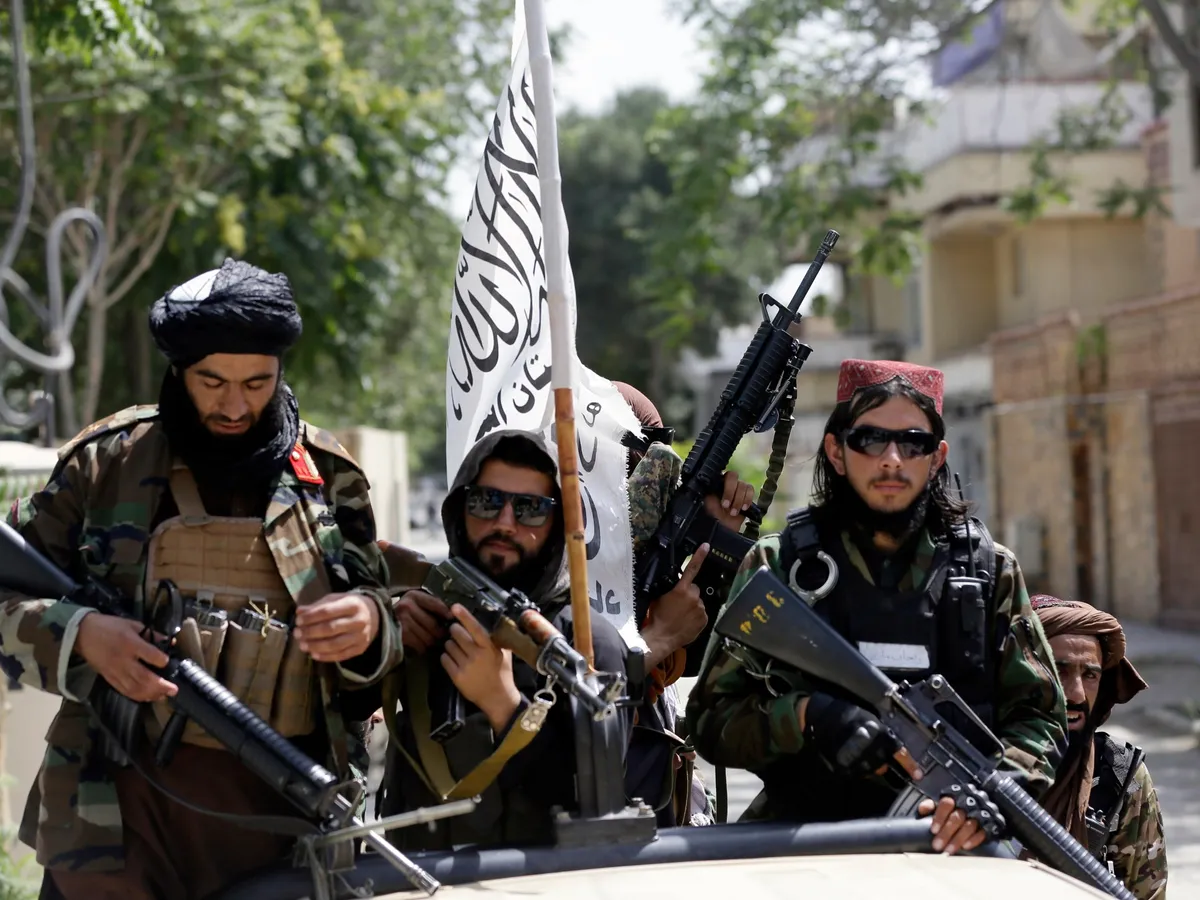
The Taliban-government" class="entity-link entity-organization" data-entity-id="121300" data-entity-type="organization">Taliban government brought security and stability but is facing increasing alienation of the general population.Lecturer of Transitional Justice at the Afghanistan" class="entity-link entity-organization" data-entity-id="186047" data-entity-type="organization">American University in Afghanistan.Published On 15 Aug 2026Taliban fighters display their flag on patrol in Kabul, Afghanistan on August 19, 2021 [Rahmat Gul/AP]Five years ago, the Taliban entered Kabul triumphant, almost 20 years after the collapse of its first government, triggered by the invasion of Afghanistan led by the United States. As US and other troops scrambled to leave, chaos and a bombing attack took the lives of nearly 200 Afghans.Today, Kabul is no longer a chaotic city dotted with reinforced walls to protect from bombings or roamed by armed personal convoys blocking the traffic. It is a cleaner, calmer city that is learning to live again.On this anniversary, it is worth looking back at what the Taliban has accomplished, where it has failed, and what the coming years may hold.What the Taliban got rightOne of the Taliban’s major failures during its first reign between 1996 and 2001 was its inability to capture all of Afghanistan. The provinces that resisted its rule eventually became the bases from which the US and its allies fought it.The Taliban appears determined not to repeat that mistake. It now controls all of Afghanistan and is able to maintain relative security and safety. This is quite remarkable considering the threat posed by the Islamic State – Khorasan Province (ISKP) during the final years of the pro-US government.The Taliban has significantly weakened the group and, for now, faces no major insurgent challenges. Afghans can travel to parts of the country that were once effectively inaccessible without fearing for their lives. For a country where even movement within the capital was dangerous, this is a significant achievement.The economic picture is more complicated. For two decades before the return of the Taliban, economic activity in the country was largely sustained by international aid, while corruption and insecurity undermined it. An economy so dependent on foreign assistance was bound to suffer when much of outside support disappeared overnight.But the Taliban has managed to keep the Afghan economy afloat despite the enormous shock of 2021. Afghanistan appears to have reached a low equilibrium. Improved security has allowed greater economic activity, including natural resource extraction. Refugees returning to the country have brought in capital and, in some cases, business investment. Improved taxation and customs collection have increased domestic revenues, while Afghans abroad continue to send billions of dollars home in remittances.Better relations and greater trade with neighbouring countries, particularly in Central Asia, have also helped. The Taliban-government" class="entity-link entity-organization" data-entity-id="121300" data-entity-type="organization">Taliban government is working on large infrastructure and development projects, such as the Qosh Tepa Canal, the Turkmenistan–Afghanistan–Pakistan–India (TAPI) gas pipeline and extensions of electricity transmission networks with Uzbekistan. In addition, there are many roadwork and construction projects completed and under way across the country which offer hope to ordinary Afghans.And yet, the Taliban-government" class="entity-link entity-organization" data-entity-id="121300" data-entity-type="organization">Taliban government remains untransparent about public finances and unwilling to consolidate state institutions. That, to a certain extent, curtails its ability to cope with deep structural problems such as accountability and corruption.What went wrongThe Taliban’s greatest failure has been its social policies.The past five years have brought a succession of decrees restricting women and girls, reinforcing Afghanistan’s reputation as the world’s most extreme example of gender exclusion. It is a shame to society and a loss to the economy that Afghan girls and women cannot receive formal modern education beyond the sixth grade.The consequences are becoming increasingly difficult to ignore. Afghanistan is running low on female doctors, teachers and other professionals. The contradiction is obvious: the Taliban leadership argues that schools are not sufficiently safe or appropriate for girls, while the country increasingly needs women to fill in essential jobs for which they cannot receive training.The quality of education more broadly has also suffered, with too little attention paid to retaining qualified teachers and lecturers. Meanwhile, religious schools have multiplied and appear to have become the government’s preferred model of education. Religious education has a legitimate place in Afghan society, but it cannot substitute for a modern education system.At the centre of these policies is the growing reach of moral policing, the idea that the state should regulate areas of life that citizens once considered private. This has not simply changed how Afghans live; it has deepened the distance between the government and large sections of its own population.The Taliban has also failed to make its government more inclusive of other groups in Afghan society. Even within the movement, Supreme Leader Hibatullah Akhundzada has sidelined prominent figures. Many of those who negotiated and signed the Doha agreement have since been removed from influential positions or pushed aside.The resulting centralisation of power has slowed governance and allowed the vision of a relatively small group around the supreme leader to dominate.Internationally, the Taliban has also failed to secure the recognition it hoped for. There have been moments of engagement, and neighbouring and European countries have maintained practical relations with Kabul, but formal recognition remains elusive. As long as the restrictions on women’s education and rights remain, Afghanistan is likely to remain isolated from much of the international community.What comes nextFor now, the Taliban appears to have a firm grip on power. There is no viable military threat, the political opposition remains deeply divided, and the international community has neither the appetite nor the resources for another attempt at regime change in Afghanistan.The greater danger to the Taliban may therefore come from something less immediate: the slow accumulation of public grievance.A government can survive opposition for a long time. But it can become vulnerable when ordinary people begin to feel so alienated from it that they become indifferent to the forces seeking to undermine it, whether foreign powers or domestic insurgents.The Taliban’s current stability should therefore not be mistaken for a permanent political settlement. Five years after its return, the movement has secured control of Afghanistan but is yet to resolve the fundamental question of what kind of state it intends to build.International isolation and growing public alienation are recipes for a looming disaster. Some within the Taliban can see it. The question is whether those who recognise the need for change will eventually be willing to stand against the concentration of power that has brought the movement to this point.Something will have to give.The views expressed in this article are the author’s own and do not necessarily reflect Al Jazeera’s editorial stance.
SRCAl Jazeera
LANGEN
LEANCenter
WORDS1 069
ENT12
SAT · 2026-08-15 · 11:07 GMTBRIEF NSR-2026-0815-102575
NSR-2026-0815-102575Analysis·EN·Political Strategy
What the Taliban achieved and failed to achieve in five years
In the five years since the Taliban regained control of Afghanistan, they have achieved relative security and stability, a significant improvement from the chaos of the previous government. The country is now calmer, and travel across regions is safer, with the Taliban having weakened the ISKP threat.
Obaidullah BaheerAl JazeeraFiled 2026-08-15 · 11:07 GMTLean · CenterRead · 5 min
Al JazeeraFIG 01
Reading time
5min
Word count
1 069words
Sources cited
1cited
Entities identified
12entities
Quality score
100%
§ 01
Briefing Summary
AI-generatedNEWSAR · AI
In the five years since the Taliban regained control of Afghanistan, they have achieved relative security and stability, a significant improvement from the chaos of the previous government. The country is now calmer, and travel across regions is safer, with the Taliban having weakened the ISKP threat. Economically, Afghanistan has remained afloat despite the withdrawal of international aid, with increased economic activity, remittances, and improved relations with neighboring countries contributing to domestic revenue and infrastructure projects. However, the Taliban's social policies, particularly the severe restrictions on women and girls' education and employment, have led to increasing alienation of the population and a shortage of essential female professionals. The government's focus on religious education over modern schooling and the expansion of moral policing have further widened the gap between the Taliban and its citizens.
Confidence 0.90Sources 1Claims 5Entities 12
§ 02
Article analysis
Model · rule-basedFraming
Political Strategy
Economic Impact
Tone
Measured
AI-assessed
CalmNeutralAlarmist
Factuality
0.60 / 1.00
Mixed
LowHigh
Sources cited
1
Limited
FewMany
§ 03
Key claims
5 extracted01
The Taliban now controls all of Afghanistan and has significantly weakened the Islamic State – Khorasan Province (ISKP).
factual
Confidence
0.90
02
Afghans abroad continue to send billions of dollars home in remittances.
factual
Confidence
0.80
03
Improved taxation and customs collection have increased domestic revenues.
factual
Confidence
0.80
04
The Taliban government has brought security and stability to Kabul, making it a calmer city.
factual
Confidence
0.80
05
The Afghan economy has been kept afloat despite the shock of 2021, with improved security allowing greater economic activity.
factual
Confidence
0.70
§ 04
Full report
5 min read · 1 069 words§ 05
Entities
12 identifiedKey playerOppositionContextPositiveNeutralNegative
Organizations4
§ 06
Keywords & salience
8 termstaliban government
1.00
security and stability
0.90
afghanistan
0.80
economic activity
0.70
international aid
0.60
general population
0.50
us invasion
0.40
islamic state – khorasan province
0.40
§ 07
Topic connections
Interactive graph Network visualization showing 41 related topics
View Full Graph Person Organization Location Event|Click node to navigate|Edge numbers = shared articles