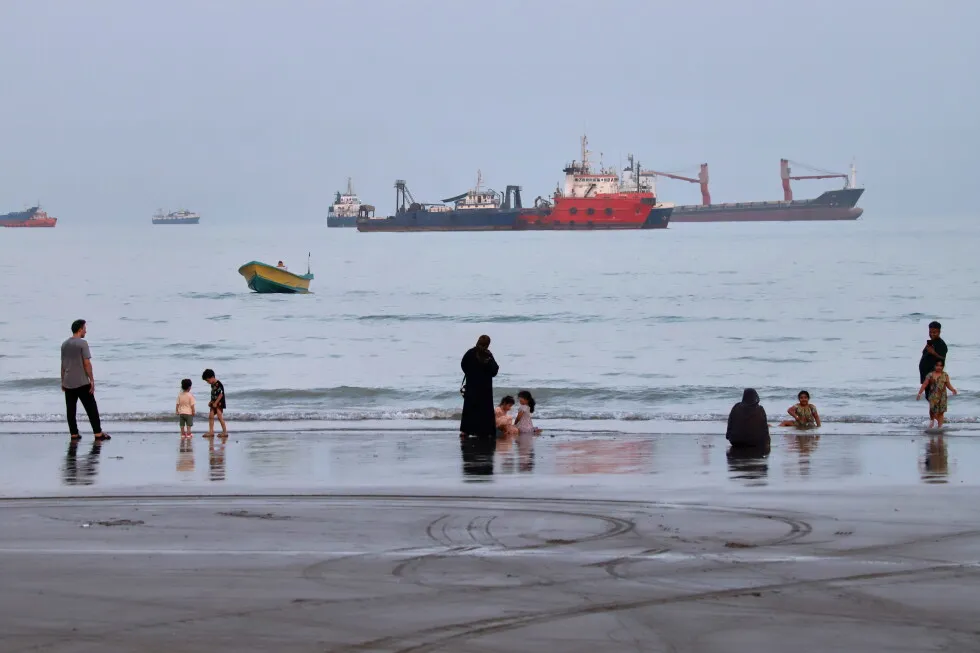
United Arab Emirates suspends trade with Iran after coming under renewed missile fire 1 of 2 | People spend time at a beach as commercial vessels are anchored in the Strait of Hormuz off Bandar Abbas, Iran, Wednesday, Aug. 5, 2026. (Amirhosein Khorgooi/ISNA via AP) 2 of 2 | Oil residue lines the shore near fishing boats on Qeshm Island, Iran, Thursday, Aug. 13, 2026, amid ongoing wartime attacks on vessels and infrastructure in and around the Strait of Hormuz, though the spill’s source has not been independently determined.(Amirhosein Khorgooi/ISNA via AP) By David Rising Updated 1:53 PM MESZ, August 19, 2026 Add AP News on Google Add AP News as your preferred source to see more of our stories on Google. Share Share Facebook Copy Link copied Print Email X LinkedIn Bluesky Flipboard Pinterest Reddit DUBAI, United Arab Emirates (AP) — The United Arab Emirates suspended all trade with Iran on Wednesday after it said it had come under renewed fire from the country — a move that will further isolate the Islamic Republic, which is suffering under U.S. Sanctions and a blockade. Incoming ballistic missile fire triggered nationwide warnings Tuesday night for UAE residents to seek shelter, the first time in weeks such an alarm had sounded. Early in the conflict, the UAE regularly came under intense fire from Iran, and most trade between the countries, which had once been important trading partners, ground to a halt. In late June, as hostilities eased, some maritime trade resumed, Iran’s state-run IRNA news agency reported. More time and data are needed to evaluate the full effect of the war on Iran-UAE trade, but the UAE is clearly a critical partner for Iran, said Mohammad Farzanegan, a professor of Middle Eastern economics at Germany’s University of Marburg. Beyond the trade in domestically produced goods, “the UAE has been very important for Iran as a re-export hub and has helped the country absorb some of the shocks caused by Sanctions,” he told The Associated Press. “Iran therefore depends heavily on the UAE not because the UAE itself produces one-third of Iran’s imports, but because it serves as a major gateway for Iran to access third-country goods and commercial infrastructure.” The UAE accuses Iran of firing missiles. Tehran denies that Following the news that two ballistic missiles had been fired toward the UAE, both of which splashed down in the Persian Gulf late Tuesday, the Foreign Ministry said that while it remained committed to “dialogue, cooperation and regional integration,” it had decided to impose the punitive measures. “In light of regional escalations that undermine regional and international peace and security, all trade, commercial exchanges and financial transactions with Iran have been halted until further notice,” the ministry said in a statement. Iran makes new strait demands, the UAE says a ship was targeted and other Middle East news 3 MIN READ Iran and UAE ties sour, and other major developments in the Middle East 5 MIN READ 17 Trump threatens Oman as it works with Iran on a Strait of Hormuz deal, and other Middle East news 5 MIN READ 17 The UAE’s Defense Ministry said assessments showed that the missiles targeted maritime traffic. It was not clear whether they targeted Emirati ships or the country’s territorial waters. Iranian Foreign Ministry spokesperson Esmail Baghaei denied that Iran had launched any missiles toward the UAE. As part of Iran’s efforts to maintain a stranglehold over the Strait of Hormuz, it has regularly attacked ships attempting to use the waterway, including four tankers owned by Abu Dhabi’s state-owned ADNOC oil and gas company over the past two weeks. None of the attacks caused injuries, but they brought harsh condemnation from the UAE and others in the region, including Kuwait and Bahrain. Since the beginning of the conflict nearly 20 ADNOC vessels have been attacked by missiles and drones in the Strait of Hormuz, killing one person and wounding another 20. Iran’s ability to control traffic through the Strait of Hormuz, through which a fifth of traded oil and natural gas passed during peacetime, has proved its biggest strategic advantage in the war. While the U.S. and Israel — which launched the war on Feb. 28 — have given various aims, including toppling Tehran’s government and ending its nuclear program, the conflict has devolved into a fight over the strait. During the war, Iran has launched hundreds of ballistic missiles and thousands of drones in strikes that Tehran said were targeting U.S. assets but hit buildings in Dubai and Abu Dhabi, Dubai’s commercial airport, ports and energy infrastructure. Iran has accused the UAE and other U.S. allies in the Gulf of facilitating American military attacks on Iran, and Iran’s Chief of Staff Gen. Ali Abdollahi on Wednesday issued a new warning to “countries on the southern shores of the Persian Gulf.” “Any assistance or facilitation provided to the aggressor U.S. military amounts to participation alongside U.S. military forces,” he said in a statement distributed by Iran’s semiofficial Fars news agency. Before the war, the UAE was one of Iran’s biggest trade partners, providing more than 30% of its imports valued at some $21 billion, according to the World Trade Organization’s latest figures from 2024. It was the destination for nearly 13% of its exports worth some $7 billion. The embargo carries its own risks, however, Farzanegan said. “As a relatively small country seeking to remain a regional hub for business and finance while attracting tourists and investors, the UAE depends heavily on regional stability,” he said. “Any major conflict with Iran can therefore cause substantial damage to its economy.” The Emirati announcement comes as the U.S. prepares to apply new economic pressure on Iran. Speaking last week, Treasury Secretary Scott Bessent said the measures would be a combination of economic isolation and the continued blockade of Iranian ports. The economic pressure follows the intense bombing campaign that targeted industrial and civilian infrastructure in addition to military targets. Already the International Monetary Fund forecasts inflation of nearly 70% this year in Iran and an economic contraction of 5.4%. Meanwhile, its rial currency has hit record lows. David Rising Rising covers regional Asia-Pacific stories for The Associated Press. He has worked around the world, including covering the wars in Iraq, Afghanistan and Ukraine, and was based for nearly 20 years in Berlin before moving to Bangkok. twitter mailto
SRCAssociated Press (AP)
LANGEN
LeanCenter
WORDS1,060
ENT11
WED · 2026-08-19 · 11:23 GMTBRIEF NSR-2026-0819-103784
NSR-2026-0819-103784News Report·EN·Conflict
United Arab Emirates suspends trade with Iran after coming under renewed missile fire
The United Arab Emirates has suspended all trade with Iran after reporting renewed ballistic missile fire originating from Iran. The UAE's Foreign Ministry announced the punitive measures, citing regional escalations that undermine peace and security.
Associated Press (AP)Filed 2026-08-19 · 11:23 GMTLean · CenterRead · 5 min
Associated Press (AP)FIG 01
Reading time
5min
Word count
1,060words
Sources cited
2cited
Entities identified
11entities
NEWSAR · AI
The United Arab Emirates has suspended all trade with Iran after reporting renewed ballistic missile fire originating from Iran. The UAE's Foreign Ministry announced the punitive measures, citing regional escalations that undermine peace and security. The UAE's Defense Ministry stated that assessments indicated the missiles targeted maritime traffic. Iran's Foreign Ministry spokesperson denied launching any missiles toward the UAE. This trade suspension further isolates Iran, which is already under U.S. sanctions and a blockade. Prior to this, Iran had been attacking ships in the Strait of Hormuz, including UAE-owned tankers. The UAE was a significant trade partner for Iran, serving as a re-export hub.
Confidence 0.90Sources 2Claims 5Entities 11
Framing
Conflict
Diplomatic
Tone
Measured
AI-assessed
CalmNeutralAlarmist
Factuality
0.70 / 1.00
Factual
LowHigh
Sources cited
2
Limited
FewMany
01
Iran therefore depends heavily on the UAE not because the UAE itself produces one-third of Iran’s imports, but because it serves as a major gateway for Iran to access third-country goods and commercial infrastructure.
quoteMohammad Farzanegan
Confidence
0.90
02
The UAE has been very important for Iran as a re-export hub and has helped the country absorb some of the shocks caused by sanctions.
quoteMohammad Farzanegan
Confidence
0.90
03
The United Arab Emirates suspended all trade with Iran on Wednesday after it said it had come under renewed fire from the country.
factualUnited Arab Emirates
Confidence
0.90
04
Iran denies that two ballistic missiles had been fired toward the UAE.
factualIran
Confidence
0.80
05
Incoming ballistic missile fire triggered nationwide warnings Tuesday night for UAE residents to seek shelter.
factualAP News
Confidence
0.80
§ 04
Full report
5 min read · 1,060 wordsKey playerOppositionContextPositiveNeutralNegative
Locations5
iran
1.00
united arab emirates
1.00
missile fire
0.90
trade suspension
0.90
strait of hormuz
0.70
us sanctions
0.60
re-export hub
0.50
ballistic missiles
0.50
persian gulf
0.40
§ 07
Connections
Who appears together in the newsIn this articleWider coverageLine weight = articles in common
Laying out network…
Strongest ties articles in common
- 12,267
- 3,992
- 3,563
- 811
- 745
- 355
Recurring context not named in this article
- LTehranlinks 7
- PDonald Trumplinks 7
- PBenjamin Netanyahulinks 7
- LIsraellinks 7
- OIslamic Revolutionary Guard Corpslinks 7
- LLebanonlinks 7
- LPakistanlinks 7
- LSaudi Arabialinks 7