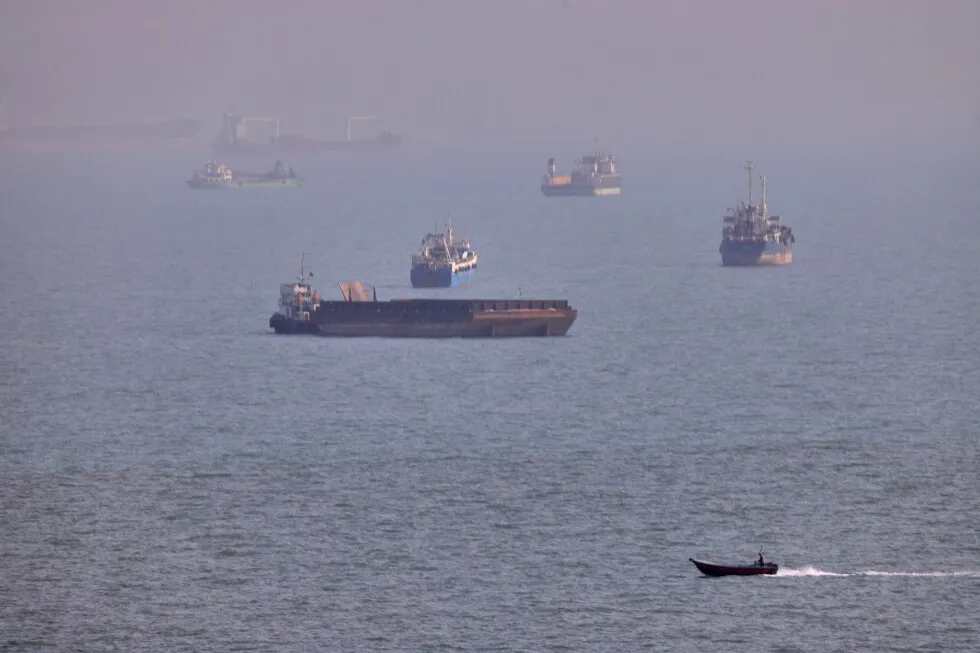
A small boat sails past cargo ships and other commercial vessels anchored in the Strait of Hormuz off Bandar Abbas, Iran, Wednesday, Aug. 5, 2026. (Amirhosein Khorgooi/ISNA via AP, File) By DAVID RISING Updated 9:22 AM MESZ, August 31, 2026 Leer en español Add AP News on Google Add AP News as your preferred source to see more of our stories on Google. Share Share Facebook Copy Link copied Print Email X LinkedIn Bluesky Flipboard Pinterest Reddit DUBAI, United Arab Emirates (AP) — The United Arab Emirates’ air force intercepted an Iranian drone over its territorial waters Monday, the Defense Ministry said, an attack that comes after the U.S. and Iran exchanged fire on the weekend, the first significant military action in a month. In a short statement, the Defense Ministry said it “dealt with” an Iranian drone that was detected over its waters approaching from Iran. There were no immediate claims of responsibility from Tehran nor any reports of damage. The UAE Defense Ministry later issued a second statement denying the Al Menhad Air Base in Dubai had been targeted by Iranian missiles, as had been reported by Iranian media outlets. The incident came after U.S. forces on Sunday struck Iranian rocket launchers on an Iranian island, breaking a lull in fighting in the war that has lasted more than six months. Iran responded by launching missiles at U.S. sites in Jordan, which were intercepted. Early Monday, Iran’s Foreign Ministry said that Iran would “not hesitate to exercise the inherent right of legitimate defense and will respond decisively to any military aggression.” Before heading to attend the Shanghai Cooperation Organization’s summit in Kyrgyzstan with Foreign Minister Abbas Araghchi, Iranian President Masoud Pezeshkian, who has favored a negotiated end to the conflict, stressed that Iran was not seeking war. Iran official says support for new sanctions would be an ‘act of war,’ and other Middle East news 2 MIN READ 11 Trump scoffs at Iran’s demand for war reparations and other Mideast developments 2 MIN READ United Arab Emirates suspends trade with Iran after coming under renewed missile fire 2 MIN READ “But,” he said, “we will respond decisively to aggressors.” The summit brings together a group billed as a counterweight to U.S. global influence, and includes Chinese President Xi Jinping, Russian President Vladimir Putin and Indian Prime Minister Narendra Modi. Pezeshkian was scheduled to meet with Putin on the sidelines on Tuesday. Meantime, U.S. Treasury Secretary Scott Bessent was set to host meetings of the Group of 20 finance ministers in North Carolina on Monday and Tuesday, which come as Washington pressures other countries to help the U.S. economically isolate Iran to try and exact concessions out of its leaders to end the war. The U.S. had been focusing on economic pressure in recent weeks but on Sunday, U.S. Central Command said it had struck Iranian launchers after observing forces with Iran’s Revolutionary Guard Corps preparing to launch rockets with sea mines into the Strait of Hormuz. The U.S. military said last week it had completed clearing sea mines from the waterway’s international shipping routes. Semiofficial news outlets in Iran reported sounds of explosions near Larak island on the strait and the Revolutionary Guard said there had been casualties. U.S. military officials disputed Iran’s claim that the latest American strikes were an act of aggression, calling them a “limited, precise action” against what they said were minelaying forces. Iranian state television later showed what it said were ballistic missiles being fired at American bases in Jordan, and Jordan’s military said had intercepted eight that had entered its airspace. A return to open conflict would be dangerous for the region, where Iran has targeted U.S. military bases and infrastructure in Gulf countries since the war began on Feb. 28. The last time the U.S. military confirmed targeting Iran was on July 29, when it announced a “heavy wave of strikes” on dozens of Revolutionary Guard targets including coastal surveillance and defense sites. U.S. President Donald Trump said on Aug. 1 he would order the military to hold off on new strikes at the urging of Gulf allies Qatar, Saudi Arabia and the United Arab Emirates. DAVID RISING Rising covers regional Asia-Pacific stories for The Associated Press. He has worked around the world, including covering the wars in Iraq, Afghanistan and Ukraine, and was based for nearly 20 years in Berlin before moving to Bangkok. twitter mailto
SRCAssociated Press (AP)
LANGEN
LEANCenter
WORDS736
ENT12
MON · 2026-08-31 · 06:53 GMTBRIEF NSR-2026-0831-107610
NSR-2026-0831-107610News Report·EN·Conflict
United Arab Emirates says it has intercepted an Iranian drone over its territorial waters
The United Arab Emirates' air force intercepted an Iranian drone over its territorial waters on Monday. This incident occurred following a weekend exchange of fire between the U.S.
Associated Press (AP)Filed 2026-08-31 · 06:53 GMTLean · CenterRead · 3 min
Associated Press (AP)FIG 01
Reading time
3min
Word count
736words
Sources cited
4cited
Entities identified
12entities
Quality score
100%
§ 01
Briefing Summary
AI-generatedNEWSAR · AI
The United Arab Emirates' air force intercepted an Iranian drone over its territorial waters on Monday. This incident occurred following a weekend exchange of fire between the U.S. and Iran, marking the first significant military action in a month. The UAE Defense Ministry stated it "dealt with" the drone approaching from Iran, with no immediate claims of responsibility from Tehran or reports of damage. The UAE also denied reports of Iranian missiles targeting an air base in Dubai. This follows U.S. strikes on Iranian rocket launchers on Sunday, which Iran responded to by launching missiles at U.S. sites in Jordan, all of which were intercepted. Iranian President Masoud Pezeshkian, while attending a summit, stated Iran would respond decisively to aggressors but was not seeking war.
Confidence 0.90Sources 4Claims 5Entities 12
§ 02
Article analysis
Model · rule-basedFraming
Conflict
Diplomatic
Tone
Measured
AI-assessed
CalmNeutralAlarmist
Factuality
0.70 / 1.00
Factual
LowHigh
Sources cited
4
Well sourced
FewMany
§ 03
Key claims
5 extracted01
Iran's President stressed that Iran was not seeking war but would respond decisively to aggressors.
quoteIranian President Masoud Pezeshkian
Confidence
1.00
02
Iran would not hesitate to exercise the inherent right of legitimate defense and will respond decisively to any military aggression.
quoteIran's Foreign Ministry
Confidence
1.00
03
The UAE Defense Ministry denied reports that the Al Menhad Air Base in Dubai had been targeted by Iranian missiles.
factualUAE Defense Ministry
Confidence
0.90
04
U.S. forces struck Iranian rocket launchers on an Iranian island on Sunday.
factualU.S. Central Command
Confidence
0.90
05
The United Arab Emirates' air force intercepted an Iranian drone over its territorial waters on Monday.
factualUAE Defense Ministry
Confidence
0.90
§ 04
Full report
3 min read · 736 words§ 05
Entities
12 identifiedKey playerOppositionContextPositiveNeutralNegative
§ 06
Keywords & salience
9 termsiranian drone interception
1.00
united arab emirates
0.90
iran
0.90
territorial waters
0.80
u.s.-iran conflict
0.70
military action
0.60
strait of hormuz
0.50
shanghai cooperation organization
0.40
negotiated end to conflict
0.40
§ 07
Topic connections
Interactive graph Network visualization showing 51 related topics
View Full Graph Person Organization Location Event|Click node to navigate|Edge numbers = shared articles