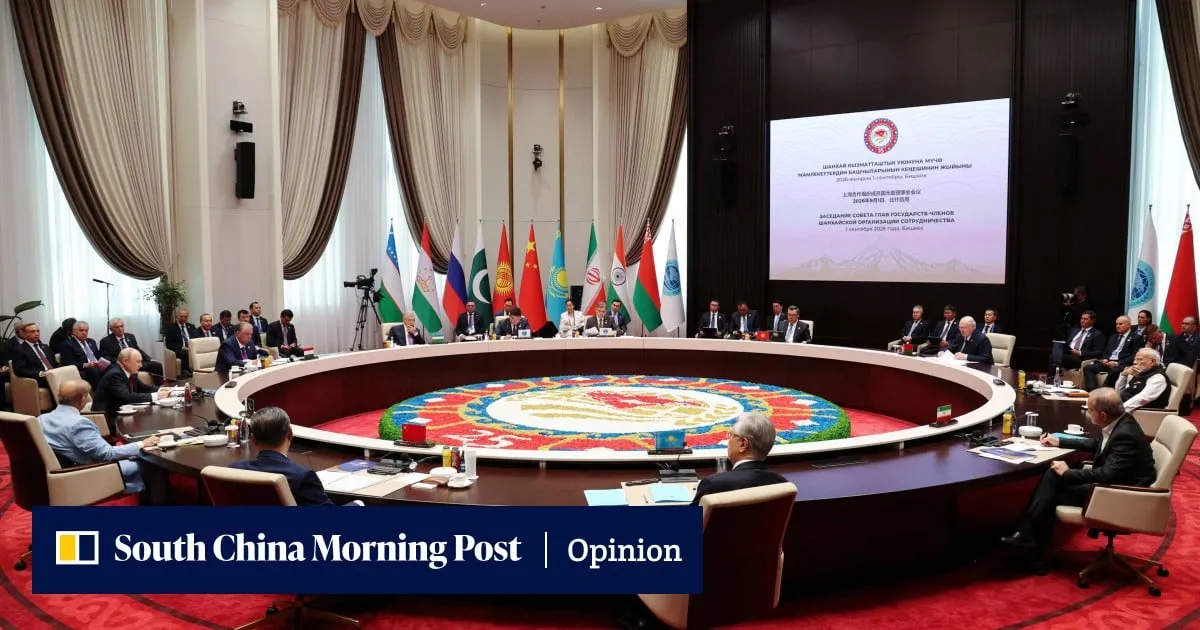
The Shanghai Cooperation Organisation (SCO) was born 25 years ago as a modest mechanism for managing borders between China, Russia and four Central Asian states. At its anniversary summit in Bishkek this week, it looks more consequential – and harder for the United States to dismiss.The timing is important. Russia’s invasion of Ukraine remains unresolved, while the war between Iran and the US has turned the Persian Gulf into another theatre of strategic competition, with energy markets again exposed to disruption around the Strait of Hormuz. The SCO now brings together China, Russia, India, Iran, Pakistan, most of the Central Asian republics and Belarus, alongside partners including Turkey and multiple Gulf states.Its 10 full members represent more than 3.4 billion people and roughly a quarter of global GDP. However, its growing importance is not simply a matter of size.
SRCSouth China Morning Post
LANGEN
LEANCenter-Right
WORDS139
ENT12
WED · 2026-09-02 · 08:30 GMTBRIEF NSR-2026-0902-108425
NSR-2026-0902-108425Analysis·EN·Political Strategy
How the SCO chips away at US power without an alliance system
The Shanghai Cooperation Organisation (SCO), founded 25 years ago to manage borders, is now a more significant entity, making it harder for the United States to disregard. The organization's anniversary summit in Bishkek occurs amidst ongoing geopolitical tensions, including the unresolved conflict in Ukraine and heightened strategic competition in the Persian Gulf involving Iran and the US.
Adriel KasontaSouth China Morning PostFiled 2026-09-02 · 08:30 GMTLean · Center-RightRead · 1 min
South China Morning PostFIG 01
Reading time
1min
Word count
139words
Sources cited
0cited
Entities identified
12entities
Quality score
100%
§ 01
Briefing Summary
AI-generatedNEWSAR · AI
The Shanghai Cooperation Organisation (SCO), founded 25 years ago to manage borders, is now a more significant entity, making it harder for the United States to disregard. The organization's anniversary summit in Bishkek occurs amidst ongoing geopolitical tensions, including the unresolved conflict in Ukraine and heightened strategic competition in the Persian Gulf involving Iran and the US. The SCO's membership has expanded to include China, Russia, India, Iran, Pakistan, most Central Asian republics, Belarus, Turkey, and several Gulf states. Its ten full members collectively represent over 3.4 billion people and approximately a quarter of global GDP, underscoring its growing influence.
Confidence 0.85Claims 4Entities 12
§ 02
Article analysis
Model · rule-basedFraming
Political Strategy
Diplomatic
Tone
Measured
AI-assessed
CalmNeutralAlarmist
Factuality
0.70 / 1.00
Factual
LowHigh
Sources cited
0
No named sources
FewMany
§ 03
Key claims
4 extracted01
The 10 full members of the SCO represent over 3.4 billion people and approximately a quarter of global GDP.
statistic
Confidence
1.00
02
The SCO now includes China, Russia, India, Iran, Pakistan, most Central Asian republics, Belarus, Turkey, and multiple Gulf states as partners.
factual
Confidence
1.00
03
The Shanghai Cooperation Organisation (SCO) was established 25 years ago as a mechanism for managing borders between China, Russia and four Central Asian states.
factual
Confidence
1.00
04
The SCO's growing importance is not solely based on its size.
factual
Confidence
0.90
§ 04
Full report
1 min read · 139 words§ 05
Entities
12 identifiedKey playerOppositionContextPositiveNeutralNegative
Locations11
R
Russia
CountryContext
3x
80
C
China
CountryContext
2x
80
US
United States
CountryOpposition
3x
70
CA
Central Asian states
RegionContext
2x
60
I
Iran
CountryContext
2x
50
B
Bishkek
CityContext
50
U
Ukraine
CountryContext
50
SO
Strait of Hormuz
StrategicContext
40
I
India
CountryContext
40
P
Pakistan
CountryContext
40
PG
Persian Gulf
RegionContext
40
§ 06
Keywords & salience
8 termsshanghai cooperation organisation
1.00
us power
0.90
strategic competition
0.80
russia ukraine war
0.70
iran us relations
0.60
energy markets
0.50
strait of hormuz
0.40
global gdp
0.40
§ 07
Topic connections
Interactive graph Network visualization showing 41 related topics
View Full Graph Person Organization Location Event|Click node to navigate|Edge numbers = shared articles