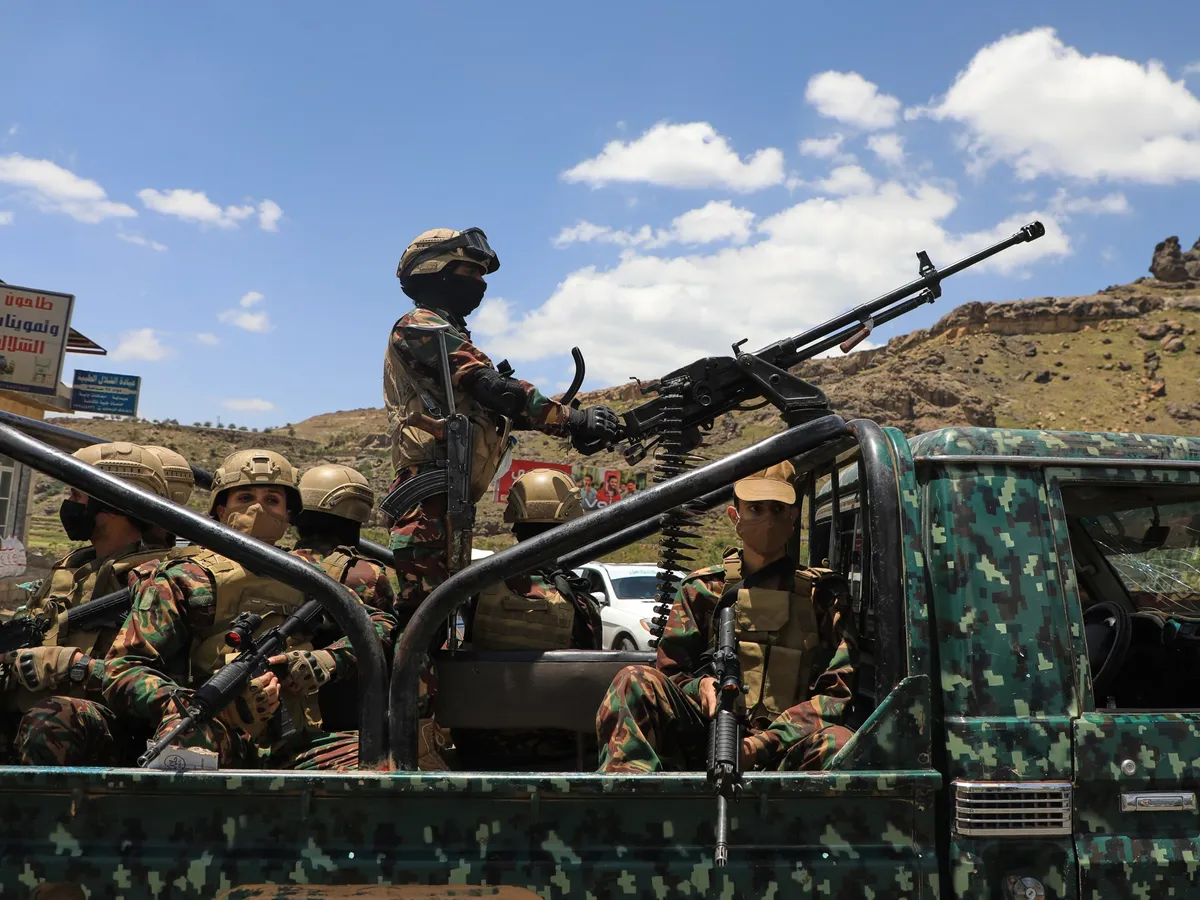
The Houthis and Iran are seeking to gain leverage, but they may instead get a unified front in the Red Sea.Published On 13 Sep 2026Houthi fighters escort a convoy carrying prisoners freed in Mocha through the Bani Matar district on its way to Sanaa, Yemen on September 12, 2026 [AP]The speed of the Houthi advance along the Red Sea coast has changed the strategic landscape. After capturing Mocha, Houthi forces moved into Dhubab and reached Mayyun, or Perim Island, at the narrowest point of the Bab al-Mandeb strait. These are not peripheral gains. They give the movement unprecedented leverage over one of the world’s most important maritime corridors.This latest escalation in Yemen is not simply another episode in its long civil war. It is also not simply an escalatory move by Iran against Gulf states, particularly Saudi Arabia.It is at once a struggle for the control of Yemen, a renewed confrontation between the Houthis and Saudi Arabia, and another front in the wider war involving Iran, Israel and the United States.Several factors contributed to it, including the false sense of balance of power in Yemen, the Houthi desire to secure a stronger negotiating position, and the spillover of the Iran war.Flawed peaceThe latest offensive cannot be understood without considering the false sense of peace that preceded it.A United Nations-mediated truce took effect in April 2022. Although it formally expired six months later, Saudi Arabia and the Houthis largely maintained a de facto ceasefire. Saudi and Omani delegations travelled to Sanaa a year later. In June 2023, direct flights resumed between Sanaa and Saudi Arabia to carry Yemeni pilgrims to Hajj, the first such flights since 2016. In September 2023, a senior Houthi delegation visited Riyadh for talks on ending the war.These were important confidence-building measures. But they also encouraged the dangerous assumption that Yemen’s conflict was gradually resolving itself.The internationally recognised government appears to have mistaken the absence of major fighting for a durable balance of power. Despite repeated talk since April 2025 of an offensive along the western coast, its leaders remained divided, and its armed formations answered to competing commands. Rather than using the pause to rebuild legitimacy, improve governance and establish a coherent military structure, the government and its supporters became complacent.The Houthis used the same period very differently. The reduction in fighting gave them time and strategic space to consolidate their administration, reorganise their forces, expand their missile and drone capabilities, and recruit on a vast scale.A 2024 report by United Nations experts estimated that the Houthis’ fighting strength had risen from approximately 220,000 in 2022 to 350,000, compared with just 30,000 in 2015. Such figures must be treated cautiously, but they indicate how extensively the movement expanded during what others regarded as a period of peace. It should be noted that this process also involved documented coercion and child recruitment.The genocide in Gaza also gave the Houthis a powerful mobilising cause. Palestine is close to the heart of almost every Yemeni, cutting across many of the country’s political, regional and sectarian divisions. By presenting their attacks on Israel and their Red Sea operations as direct action in defence of Gaza, the Houthis portrayed themselves not merely as one party in Yemen’s civil war, but as perhaps the only Arab force willing and able to impose a cost on Israel.Iranian deterrence strategy v Houthi prioritiesFor the first six months of the war, Iran appears to have tried to keep the Red Sea from becoming another major front. It had a clear interest in keeping Saudi Arabia and Egypt (the two pivotal Arab powers bordering the Red Sea) outside a US-led military alignment. Renewed Houthi attacks on Saudi Arabia or commercial shipping risked pushing Riyadh and Cairo closer to Washington.It is reasonable to assume that Tehran initially pressed the Houthis not to provoke Saudi Arabia. But the Saudi strike on Sanaa International Airport in July changed the calculation. Reportedly intended to prevent an Iranian aircraft from landing, it gave the Houthis a reason to retaliate and evidence that restraint would not protect them.Iran may not have wanted a Saudi-Houthi confrontation, but once the Houthis decided to respond, Tehran could hardly demand that they remain passive without undermining the credibility of an alliance it had spent years cultivating.The escalation also serves Iran’s interests. Its disruption of Gulf supplies was losing some of its force as Washington and its partners helped the international market adjust through alternative suppliers and routes bypassing Hormuz.Oil prices are high, but the shortage Iran may have hoped to create has not fully materialised, while additional sanctions and the blockade are beginning to bite.Bab al-Mandeb offers another pressure point: Disrupting international trade and driving up oil and transport costs ahead of the US midterms could make the war politically and economically more costly for the Trump administration, possibly forcing it to reconsider its terms for ending it.This does not mean that Iran ordered the Houthi offensive. Iranian weapons, training and technical assistance have been central to the movement’s transformation, but support should not be confused with authorship. Iran and the Houthis are allies, not identical actors.The Houthis have their own interests. They are seeking an independent bargaining position before any regional settlement can be negotiated over their heads. Their blockade of Saudi vessels, attacks on Saudi infrastructure and advance towards Bab al-Mandeb were not simply undertaken on Iran’s behalf; they were also intended to make the Houthis indispensable to any future negotiations. Control of territory overlooking the strait gives them leverage over Saudi exports, Egyptian interests and, most importantly, navigation between Asia and Europe.A silver lining for the USWhile the Trump administration is likely following this escalation in Yemen with concern, given the skyrocketing fuel prices and inflation woes at home, there may be a silver lining for it.Until now, the US has struggled to persuade its regional and international allies to join its confrontation with Iran. Saudi Arabia and Egypt have had every reason to keep their distance. A direct threat to the Red Sea changes that calculation.Disruption at Bab al-Mandeb would endanger Saudi oil exports, further reduce Egypt’s Suez Canal revenues and threaten Europe’s principal maritime connection with Asia. NATO members and other European states may consequently be more willing to support a US-led operation presented not as a war against Iran, but as the defence of international navigation.Israel, too, will find the opportunity difficult to resist. Even without formal cooperation, US coordination could place Israeli, Saudi, Egyptian and European forces on the same side of a maritime confrontation. This could revive the security logic behind Saudi-Israeli normalisation just when Gaza had made political rapprochement appear impossible.The Houthis may therefore achieve the opposite of what Iran originally intended. By threatening Bab al-Mandeb, they could draw Saudi Arabia and Egypt closer to Washington while creating new, largely unacknowledged forms of coordination with Israel.
SRCAl Jazeera
LANGEN
LEANCenter
WORDS1 139
ENT12
SUN · 2026-09-13 · 12:39 GMTBRIEF NSR-2026-0913-110946
NSR-2026-0913-110946Analysis·EN·Conflict
The Houthis’ escalation in Yemen could flop
The Houthis have escalated their military actions along Yemen's Red Sea coast, capturing key areas like Mocha, Dhubab, and Perim Island, which controls the Bab al-Mandeb strait. This move is seen as an attempt by the Houthis and Iran to gain leverage, potentially disrupting maritime corridors and serving as another front in a wider regional conflict involving Iran, Israel, and the United States.
Sultan BarakatAl JazeeraFiled 2026-09-13 · 12:39 GMTLean · CenterRead · 5 min
Al JazeeraFIG 01
Reading time
5min
Word count
1 139words
Sources cited
1cited
Entities identified
12entities
Quality score
100%
§ 01
Briefing Summary
AI-generatedNEWSAR · AI
The Houthis have escalated their military actions along Yemen's Red Sea coast, capturing key areas like Mocha, Dhubab, and Perim Island, which controls the Bab al-Mandeb strait. This move is seen as an attempt by the Houthis and Iran to gain leverage, potentially disrupting maritime corridors and serving as another front in a wider regional conflict involving Iran, Israel, and the United States. The escalation follows a period of de facto ceasefire and peace talks, during which the Houthis reportedly consolidated their forces and expanded their capabilities, while the internationally recognized government became complacent. The Houthis are also using the conflict in Gaza as a mobilizing cause, portraying their actions as defense of Palestine. Iran's initial strategy may have been to avoid a Red Sea front, but a Saudi strike on Sanaa International Airport altered this, leading to Houthi retaliation and potentially serving Iran's interests by creating another pressure point against international shipping.
Confidence 0.90Sources 1Claims 5Entities 12
§ 02
Article analysis
Model · rule-basedFraming
Conflict
Political Strategy
Tone
Measured
AI-assessed
CalmNeutralAlarmist
Factuality
0.60 / 1.00
Mixed
LowHigh
Sources cited
1
Limited
FewMany
§ 03
Key claims
5 extracted01
A UN-mediated truce and subsequent de-escalation measures from April 2022 to September 2023 created a false sense of peace.
factual
Confidence
0.90
02
Houthi advances along the Red Sea coast have captured Mocha, Dhubab, and Mayyun Island, controlling a key maritime corridor.
factual
Confidence
0.90
03
During the de-escalation period, the Houthis consolidated administration, reorganized forces, and expanded missile/drone capabilities.
factual
Confidence
0.80
04
The current escalation is a multi-faceted conflict involving Yemen's civil war, Saudi Arabia, Iran, Israel, and the United States.
factual
Confidence
0.80
05
A 2024 UN report estimated Houthi fighting strength rose from 220,000 in 2022 to 350,000.
statisticUnited Nations experts
Confidence
0.70
§ 04
Full report
5 min read · 1 139 words§ 05
Entities
12 identifiedKey playerOppositionContextPositiveNeutralNegative
§ 06
Keywords & salience
10 termshouthi escalation
1.00
yemen civil war
0.90
red sea
0.80
bab al-mandeb strait
0.70
iran
0.60
saudi arabia
0.60
maritime corridor
0.50
negotiating position
0.40
peace process
0.40
united states
0.40
§ 07
Topic connections
Interactive graph Network visualization showing 51 related topics
View Full Graph Person Organization Location Event|Click node to navigate|Edge numbers = shared articles