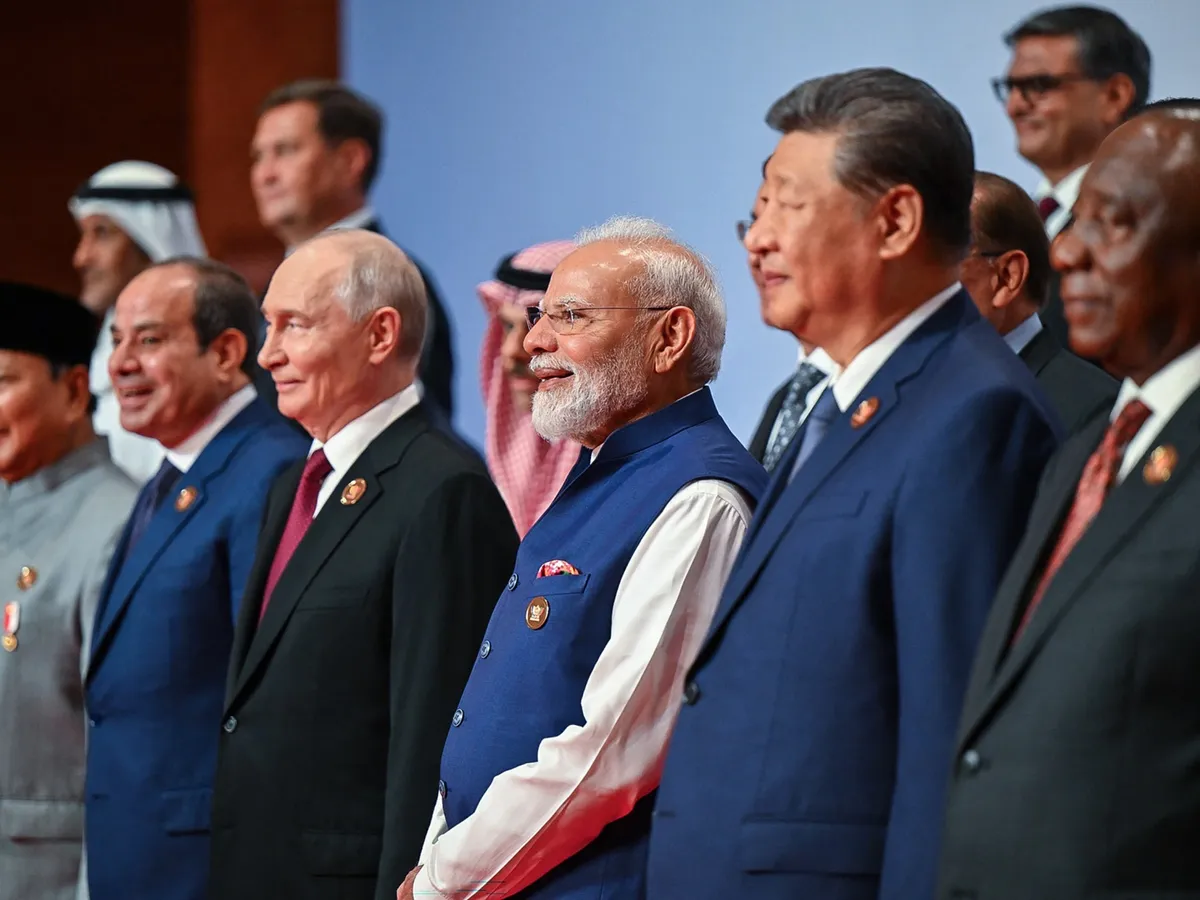
EXPLAINERThe 11-member bloc, which accounts for 40% of global GDP, avoids condemning US-Israel war on Iran, showing divisions within the group.Russia's President Vladimir Putin (3L), India's Prime Minister Narendra Modi (3R) and China's President Xi Jinping (2R) posing with other leaders for a family photo during the 18th BRICS Summit in New Delhi on September 13, 2026 [Handout/ Indian Press Information Bureau (PIB) shows (Photo by Handout / Indian Press Information Bureau via AFP]Published On 13 Sep 2026Leaders of the BRICS group of nations unanimously adopted a joint declaration on the first day of the two-day summit in the Indian capital, New Delhi, despite divisions among members over the wars in Iran and Ukraine.The New Delhi Declaration, adopted on Saturday, called for restraint in the Middle East but avoided condemning the US-Israeli strikes or Iran’s targeting of Gulf countries in the region. It also criticised the global trade war without naming the United States.Recommended Stories list of 3 itemslist 1 of 3Putin, Pezeshkian in India for BRICS summit clouded by Iran and Ukraine warlist 2 of 3Next BRICS summit can get an Iran ceasefirelist 3 of 3Multipolarity gives middle powers more choices, but fewer guaranteesend of listChinese President Xi Jinping and his Russian counterpart, Vladimir Putin, were among the leaders attending the gathering of the 11-member bloc in New Delhi at a time of global upheaval caused by the US-Israel war on Iran, Trump’s tariff war and the US’s unilateral decisions to promote its foreign policy.Al Jazeera’s Um-e-Kulsoom Shariff, reporting from New Delhi, said the group “steered clear” of naming any countries, even on the issue of wide-ranging US tariffs. “We’ve seen BRICS countries who have been targeted, be it India, Russia, China, or any other, but they have stayed clear,” she reported.“While they said unilateral tariffs are condemned and they work against international law, they have not named the US. So India had to keep in mind that it has bilateral trade relations with other countries, and so do others.”Indian Prime Minister Narendra Modi said BRICS had reached a “coming of age” moment and called on the Global South to become a “rule-shaper” rather than simply accept rules set elsewhere.Here are key takeaways from the declaration from the summit:What is BRICS?BRICS was founded in 2006 by Brazil, Russia, India and China, mainly as an economic forum. South Africa joined the grouping four years later. It has since expanded to include Egypt, Ethiopia, Iran, the United Arab Emirates, Saudi Arabia and Indonesia.The BRICS nations constitute nearly half the world’s population and account for approximately 40 percent of global gross domestic product (GDP).The bloc has sought greater influence for developing economies in institutions traditionally dominated by Western powers and has pushed for reforms to bodies, including the World Bank, the International Monetary Fund and the World Trade Organization.Conveying India’s position, Modi insisted that the bloc should not be interpreted simply as an anti-Western project.“BRICS is not against anyone,” he said, while arguing that the Global South should play a bigger role in shaping global governance.US-Israel war on IranThe war was one of the biggest tests of whether the expanded BRICS could reach a common position.Leaders expressed “deep concern over the continued escalation of tensions” in the Middle East and called for “maximum restraint”, while urging countries to avoid actions that could further aggravate the situation. It did not mention the US, Israel, Iran or the Gulf states explicitly.China’s Xi said in a statement the war “does not serve the common interests of the international community”, and called for a political settlement and a permanent and comprehensive ceasefire.In May, BRICS foreign ministers failed to agree on a joint statement amid differences over the war. Iran is a member of BRICS, as is the UAE, which has faced Iranian attacks during the conflict.Former Indian Foreign Secretary Nirupama Menon Rao said New Delhi scored a “significant diplomatic success” in securing a declaration despite “sharp differences between Iran and the UAE”.“Consensus was preserved, but only through carefully generalised language. In this, BRICS’s value and its limitation was exposed: it can keep difficult conversations alive and affirm broad principles, but it struggles to assign responsibility or organise collective action when there is the occasional collision of the interests of its members,” she posted on X.The declaration also raised concern over deliberate attacks on civilian infrastructure and peaceful nuclear facilities protected by International Atomic Energy Agency (IAEA) safeguards – language that could be seen as an indirect criticism of US and Israeli attacks on Iranian nuclear sites.During the 12-day war in 2025, the US bombed three main Iranian nuclear facilities at Natanz, Isfahan and Fordow.Praveen Donthi, senior analyst at the International Crisis Group, said expectations for the BRICS summit were low due to geopolitical turbulence and clashing strategic interests.“The members, invested in the success of this non-Western grouping, would be reasonably satisfied with the modest outcome,” he said.Donthi added that India used its strong ties with all members and worked behind the scenes to release the declaration, overcoming the biggest hurdle: convincing the UAE and Iran, who are on opposite sides of the ongoing conflict.Leaders of participating countries gather for a family photo during the 18th BRICS Summit in New Delhi on September 13, 2026 [Handout/Indian Press Information Bureau (PIB) via AFP]Russia-Ukraine warThe Ukraine war remains another source of tension within BRICS, particularly because Russia is a founding member of the group.The declaration issued a generic call for international disputes to be resolved through “dialogue, consultation, and diplomacy” without mentioning Ukraine.However, BRICS leaders criticised unilateral sanctions not authorised by the United Nations Security Council.“We call for the elimination of such unlawful measures, which undermine international law and the principles and purposes of the UN Charter,” the statement said.The position is significant for Russia, which has faced extensive Western sanctions since its full-scale invasion of Ukraine in 2022. India, meanwhile, has maintained close relations with Moscow, importing oil from Russia amid disruption to global oil supplies since the US-Israel war on Iran broke out.Kremlin spokesman Dmitry Peskov said on Sunday that Xi and Modi offered their services for peace talks on Ukraine, and that Putin welcomed their readiness, state news agency TASS reported.Last year, Trump imposed a 25 percent tariff on Indian goods as a penalty for its purchase of Russian crude. India has since cut down its imports of Russian crude oil.Support for Palestinian statehoodBRICS adopted much more explicit language on Palestine.The declaration expressed “firm opposition” to the forced displacement of Palestinians and to attempts to change the geography or demography of the occupied Palestinian territory.It called for an end to Israel’s genocidal war on Gaza, unhindered humanitarian access, support for UNRWA, the UN agency for Palestinian refugees, and full UN membership for Palestine.The bloc also reiterated its support for a two-state solution and the establishment of a sovereign Palestinian state based on the 1967 borders, with occupied East Jerusalem as its capital.US tariffsThe declaration raised concern over “unilateral tariff and non-tariff measures” that distort trade, while also opposing sanctions imposed without UNSC authorisation.Washington has imposed tariffs on several BRICS countries, including China, Russia and India, and President Donald Trump has previously described the grouping as “anti-American”. He threatened additional tariffs against countries aligning themselves with it.Speaking at the summit, Putin accused countries “accustomed to thinking in colonial categories” of using tariffs, sanctions and “brute force” to contain emerging competitors.At the same time, the bloc called for cooperation to protect global trade, supply chains, energy flows and maritime security as wars disrupt international commerce.BRICS reiterated its “commitment to strengthening multilateralism and multipolarity”, noting that a multipolar world can expand opportunities for Emerging Markets and Developing Countries (EMDCs) to develop “constructive potential and enjoy universally beneficial, inclusive, sustainable and equitable economic globalisation and cooperation”.Putin called for greater representation for Asia, Africa and Latin America on the UNSC and argued that the shift towards a multipolar world was being resisted by established powers.Xi said BRICS countries should help steer the international order towards greater “equity and justice”, while Modi called for the Global South to move from being a rule-taker to a “rule-shaper”.“We have to transform this pyramid of privilege into a platform of partnership,” Modi told the summit.Yet India has also sought to distance BRICS from the idea that it exists simply to confront the West. “We are not against anyone; rather, we strive to move forward with the approach of taking everyone along,” he asserted.
SRCAl Jazeera
LANGEN
LEANCenter
WORDS1 398
ENT12
SUN · 2026-09-13 · 12:04 GMTBRIEF NSR-2026-0913-110949
NSR-2026-0913-110949News Report·EN·Diplomatic
BRICS summit 2026: What are the key takeaways?
The 11-nation BRICS bloc, meeting in New Delhi on September 13, 2026, adopted a joint declaration that called for restraint in the Middle East but avoided condemning the US-Israel war on Iran or Iran's actions in the region. The declaration also criticized global trade wars without naming the United States.
Al Jazeera StaffAl JazeeraFiled 2026-09-13 · 12:04 GMTLean · CenterRead · 6 min
Al JazeeraFIG 01
Reading time
6min
Word count
1 398words
Sources cited
3cited
Entities identified
12entities
Quality score
100%
§ 01
Briefing Summary
AI-generatedNEWSAR · AI
The 11-nation BRICS bloc, meeting in New Delhi on September 13, 2026, adopted a joint declaration that called for restraint in the Middle East but avoided condemning the US-Israel war on Iran or Iran's actions in the region. The declaration also criticized global trade wars without naming the United States. This demonstrates divisions within the group, particularly between Iran and the UAE, both members. Despite these differences, leaders emphasized BRICS is not an anti-Western project and called for the Global South to become a "rule-shaper." The bloc, which represents 40% of global GDP, aims for greater influence for developing economies in international institutions.
Confidence 0.90Sources 3Claims 5Entities 12
§ 02
Article analysis
Model · rule-basedFraming
Diplomatic
Economic Impact
Tone
Measured
AI-assessed
CalmNeutralAlarmist
Factuality
0.70 / 1.00
Factual
LowHigh
Sources cited
3
Well sourced
FewMany
§ 03
Key claims
5 extracted01
Indian Prime Minister Narendra Modi stated that BRICS had reached a 'coming of age' moment.
quoteNarendra Modi
Confidence
1.00
02
BRICS was founded in 2006 by Brazil, Russia, India, and China, and has since expanded to include Egypt, Ethiopia, Iran, the UAE, Saudi Arabia, and Indonesia.
factual
Confidence
1.00
03
The BRICS declaration criticized the global trade war without naming the United States.
factual
Confidence
1.00
04
BRICS leaders adopted a joint declaration calling for restraint in the Middle East but avoiding condemnation of US-Israeli strikes or Iran's actions.
factual
Confidence
1.00
05
The 11-member BRICS bloc accounts for 40% of global GDP.
statistic
Confidence
1.00
§ 04
Full report
6 min read · 1 398 words§ 05
Entities
12 identifiedKey playerOppositionContextPositiveNeutralNegative
People3
Organizations1
Locations7
§ 06
Keywords & salience
9 termsbrics summit
1.00
global gdp
0.90
us-israel war on iran
0.80
new delhi declaration
0.70
global trade war
0.60
global south
0.50
multipolarity
0.50
rule-shaper
0.40
iran ceasefire
0.40
§ 07
Topic connections
Interactive graph Network visualization showing 29 related topics
View Full Graph Person Organization Location Event|Click node to navigate|Edge numbers = shared articles