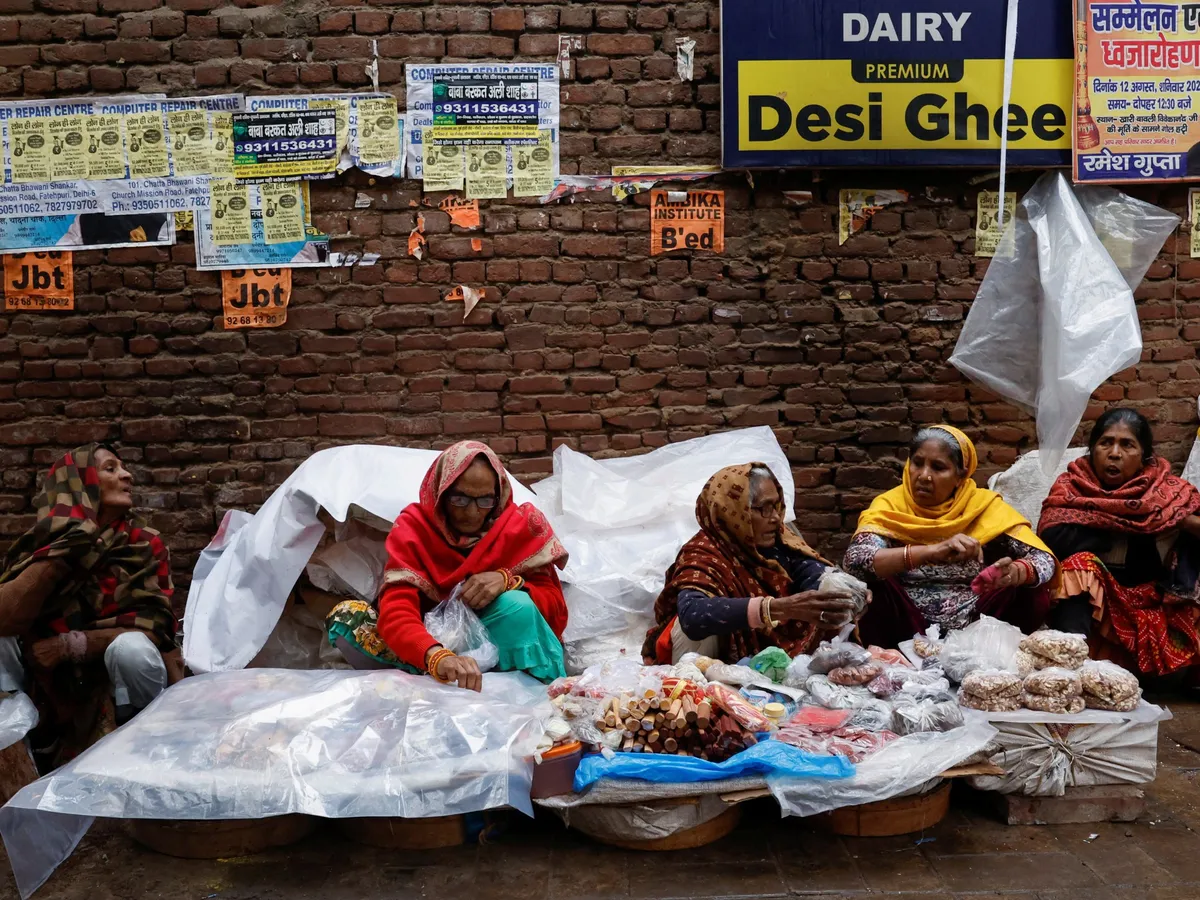
A quarter of the world’s population faces a surging cost of living crisis, because of the wars in the Middle East.Waiting for customers at a spices and dry fruits market in the old quarters of Delhi in India, January 31, 2024 [Sahiba Chawdhary/ Reuters]Published On 18 Sep 2026India, Pakistan, Bangladesh and Nepal are together home to nearly two billion people, about 23 percent of the world’s population. Even before the war on Iran, the region depended heavily on imported energy, much of it from Gulf countries.But the extent and nature of exposure of different South Asian countries to Gulf supplies and the Strait of Hormuz varied significantly.Now, they are all feeling the effects of the prolonged and expanding war, as more and more supply routes become choked.South Asia’s dependence on Gulf energyIndia imports about 85 percent of the crude oil it consumes – it is the world’s third-largest crude importer.Before the war, Gulf producers, including Iraq, Saudi Arabia, the UAE and Kuwait, were among its major suppliers, while Qatar was a leading source of liquefied natural gas (LNG). India has a more diversified supply network than its South Asian neighbours, with crude also arriving from Russia, Africa and the Americas.Pakistan is also highly dependent on imported energy, particularly crude oil, petroleum products and LNG. Saudi Arabia, the UAE and Kuwait have traditionally been important oil suppliers, while Qatar is its main long-term LNG provider.Bangladesh produces natural gas domestically, but increasingly relies on imported LNG as local production struggles to meet demand.Qatar is one of its main LNG suppliers, while the country also imports refined petroleum products.Nepal has no direct crude oil or LNG imports from the Gulf. Instead, the landlocked country relies on India for virtually all of its petroleum products, including petrol, diesel, kerosene and LPG. Its exposure to Gulf disruptions is indirect: higher costs or supply shortages in India can feed through to Nepal’s fuel supplies and prices.India faces the largest exposure in absolute volumes, while Pakistan and Bangladesh have fewer alternatives for some critical energy supplies. Nepal’s dependence is one step removed, but disruptions to India’s energy supply chain can quickly reach the Nepali market.As is often the case, it is the poor and economically vulnerable who are bearing the brunt of the crisis.‘Financially, I feel completely helpless’Sajida Jibran is a 45-year-old housekeeper in Pakistan’s southern coastal city of Karachi.[Courtesy Sajida Jibran/Al Jazeera] (Al Jazeera)She works long hours in an affluent neighbourhood, has a husband who can no longer work due to health issues and she has three children in middle and high school.Jibran says her rent has gone up from 15,000 Pakistani rupees ($54) at the end of last year to 25,000 rupees ( 90) this past month.“Before the war, everyone could eat and drink. I could buy meat, chicken, but since the war started, even vegetables have become so expensive that it is difficult to buy them,” she said.“The price of electricity has increased a lot, our bill used to come to around 1,500 [rupees] ($5.4), but now it starts at 5,000 ($18). The gas bill is also very high and comes to a minimum of 2,000 rupees ($7),” said Jibran. Natural gas bills in Pakistan have historically been minimal because it was locally produced, but having depleted its reserves, Pakistan largely imports natural gas.The hardest decision Jibran has had to make was to stop paying her children’s school fees: she could either educate them or feed them.“I had always hoped that my children would study, get a good education and have the opportunity to attend good schools. I can barely manage to put food on the table. Beyond that, there is very little I can do for them.” she said. “When I see my children sitting at home, unable to continue their studies, I can’t sleep, day or night. Financially, I feel completely helpless.”‘The rising prices are making everything unaffordable’Balendra Singh is a security guard in India’s national capital, New Delhi. The sixty-seven-year-old lives in a small room in Noida, a city adjacent to New Delhi, with six of his family members. After the US-Israeli war on Iran broke out, he had to send some family back to his village in Lucknow to curtail expensive city life. Lucknow is the capital of Uttar Pradesh state, in which Noida is too.[Courtesy Balendra Singh/Al Jazeera]“I cannot afford to feed so many mouths in a big city today. The inflation has gotten the better of us,” Singh said. “The rising prices are making everything unaffordable – and our salaries stay the same.”Singh explains how it’s not about what they are putting on the table to eat, but it’s how many people are eating in an expensive city like Noida.Singh doesn’t own a vehicle, but feels the pinch of rising fuel prices in the extra cost of the rickshaw rides he needs to commute to work.“The base prices of rickshaws have risen. Even if that rise is five rupees, it is really big for us – because in a month, that’s like 300 rupees ($3) increase for to-and-fro travel to work,” he says, before describing how he and the remaining members of his family in Noida are adapting to the higher cost of living. “We may eat fish once a week rather than thrice a week and put fewer onions in the gravy.”Singh says when the LNG supply was disrupted earlier in the war, he and his neighbours started using old wood-based fuels. He says he knows the smoke is harmful to health but they had no option — all because of a war that he says he and his country have nothing to do with.“My children did not attack Iran. My children do not support this war. But we are left here to bear the burden of faraway politics. I want to appeal to the government to take measures to insulate us from the rising prices.”Pressure spreading through householdsAsma Begum is a housewife, mother of two and works as a domestic worker in Bangladesh’s capital, Dhaka.She works in one household, washing dishes and doing other domestic chores, earning around 5,000 taka a month ($41). She would like to earn more, but there appears to be less domestic work available.Moudud Sajun / Al Jazeera (Al Jazeera)“Rich people are also under financial pressure,” she said. “They are trying to manage the household work themselves without keeping domestic help.”For Asma, that illustrates how the cost-of-living pressure is spreading from one household to another: families facing higher expenses cut discretionary spending, including paid domestic help, which in turn reduces the income opportunities available to lower-income workers like her.“Everyone has the same problem,” she adds. “We all survive by working.”Asma says that the strain is not limited to her household. Her parents live in the southern coastal district of Barishal. Her father and brother work as construction workers in the same neighbourhood, while her mother cooks at a mess, despite suffering from cancer.“They are struggling in the same way.”‘The cost of everything has gone up in recent months’Gyanu Basent works as a porter in the Gaushala area of Nepal’s capital, Kathmandu. Aged 58, he is the father of a 15-year-old and has his ageing father and siblings as dependents too.[Courtesy Basent/Al Jazeera] (Al Jazeera)Basent never went to school and had to move to Kathmandu to find work.“We used to do farming before, but monkeys won’t let us do agriculture. Also, a local cooperative in the village embezzled my father’s life savings,” he said.“I mostly work as a porter these days. I carry all kinds of loads and these days I am mostly carrying LPG gas [cylinders],” adding that he does not have consistent work.“I earn around 500 (taka) per day ($4) and there is no set earning. When there is little work, I hardly make 200-300,” says Basent.He eats in budget-friendly restaurants rather than cooking himself because the cost of essentials has soared in recent months.“I haven’t been able to send much to my family. Luckily for me, a nonprofit is paying for my daughter’s education. My father manages his money from his elderly allowance,” he said. “I use whatever I save to buy clothes, gifts for my daughter and help my family however I can.”Reporting from Noida, India, by Yashraj Sharma; from Dhaka, Bangladesh, by Moudud Sajan and from Kathmandu, Nepal, by Samik Kharel
SRCAl Jazeera
LANGEN
LEANCenter
WORDS1 383
ENT12
FRI · 2026-09-18 · 10:33 GMTBRIEF NSR-2026-0918-112250
NSR-2026-0918-112250News Report·EN·Economic Impact
‘My children did not attack Iran’: 2bn South Asians suffer from distant war
A prolonged war in the Middle East is causing a significant cost of living crisis for nearly two billion people in South Asia, approximately 23 percent of the world's population. Countries like India, Pakistan, Bangladesh, and Nepal, which heavily rely on imported energy from Gulf nations, are experiencing surging prices for fuel, electricity, and food.
Alia ChughtaiAl JazeeraFiled 2026-09-18 · 10:33 GMTLean · CenterRead · 6 min
Al JazeeraFIG 01
Reading time
6min
Word count
1 383words
Sources cited
2cited
Entities identified
12entities
Quality score
100%
§ 01
Briefing Summary
AI-generatedNEWSAR · AI
A prolonged war in the Middle East is causing a significant cost of living crisis for nearly two billion people in South Asia, approximately 23 percent of the world's population. Countries like India, Pakistan, Bangladesh, and Nepal, which heavily rely on imported energy from Gulf nations, are experiencing surging prices for fuel, electricity, and food. This economic strain is disproportionately affecting the poor and vulnerable, forcing families to make difficult choices like cutting back on education or reducing household expenses. The disruptions to supply routes and increased energy costs are directly impacting the daily lives and financial stability of millions in the region.
Confidence 0.90Sources 2Claims 5Entities 12
§ 02
Article analysis
Model · rule-basedFraming
Economic Impact
Human Interest
Tone
Measured
AI-assessed
CalmNeutralAlarmist
Factuality
0.80 / 1.00
Factual
LowHigh
Sources cited
2
Limited
FewMany
§ 03
Key claims
5 extracted01
Sajida Jibran, a housekeeper in Karachi, Pakistan, has seen her rent increase from 15,000 to 25,000 Pakistani rupees.
quoteSajida Jibran
Confidence
1.00
02
India imports about 85 percent of the crude oil it consumes, making it the world’s third-largest crude importer.
statistic
Confidence
1.00
03
India, Pakistan, Bangladesh, and Nepal are home to nearly two billion people, approximately 23 percent of the world’s population.
statistic
Confidence
1.00
04
The poor and economically vulnerable are bearing the brunt of the cost of living crisis.
factual
Confidence
0.90
05
A quarter of the world’s population faces a surging cost of living crisis due to wars in the Middle East.
factual
Confidence
0.90
§ 04
Full report
6 min read · 1 383 words§ 05
Entities
12 identifiedKey playerOppositionContextPositiveNeutralNegative
Locations12
I
India
CountryContext
9x
90
P
Pakistan
CountryContext
6x
90
B
Bangladesh
CountryContext
4x
80
N
Nepal
CountryContext
4x
80
I
Iran
CountryContext
3x
80
ME
Middle East
RegionContext
70
GC
Gulf countries
RegionContext
5x
70
SO
Strait of Hormuz
StrategicContext
60
SA
Saudi Arabia
CountryContext
2x
50
UA
United Arab Emirates
CountryContext
2x
50
K
Kuwait
CountryContext
2x
50
I
Iraq
CountryContext
50
§ 06
Keywords & salience
10 termssouth asia
1.00
cost of living crisis
1.00
energy dependence
0.90
middle east war
0.80
imported energy
0.70
supply routes
0.60
economic vulnerability
0.50
crude oil
0.40
liquefied natural gas
0.40
strait of hormuz
0.40
§ 07
Topic connections
Interactive graph Network visualization showing 51 related topics
View Full Graph Person Organization Location Event|Click node to navigate|Edge numbers = shared articles