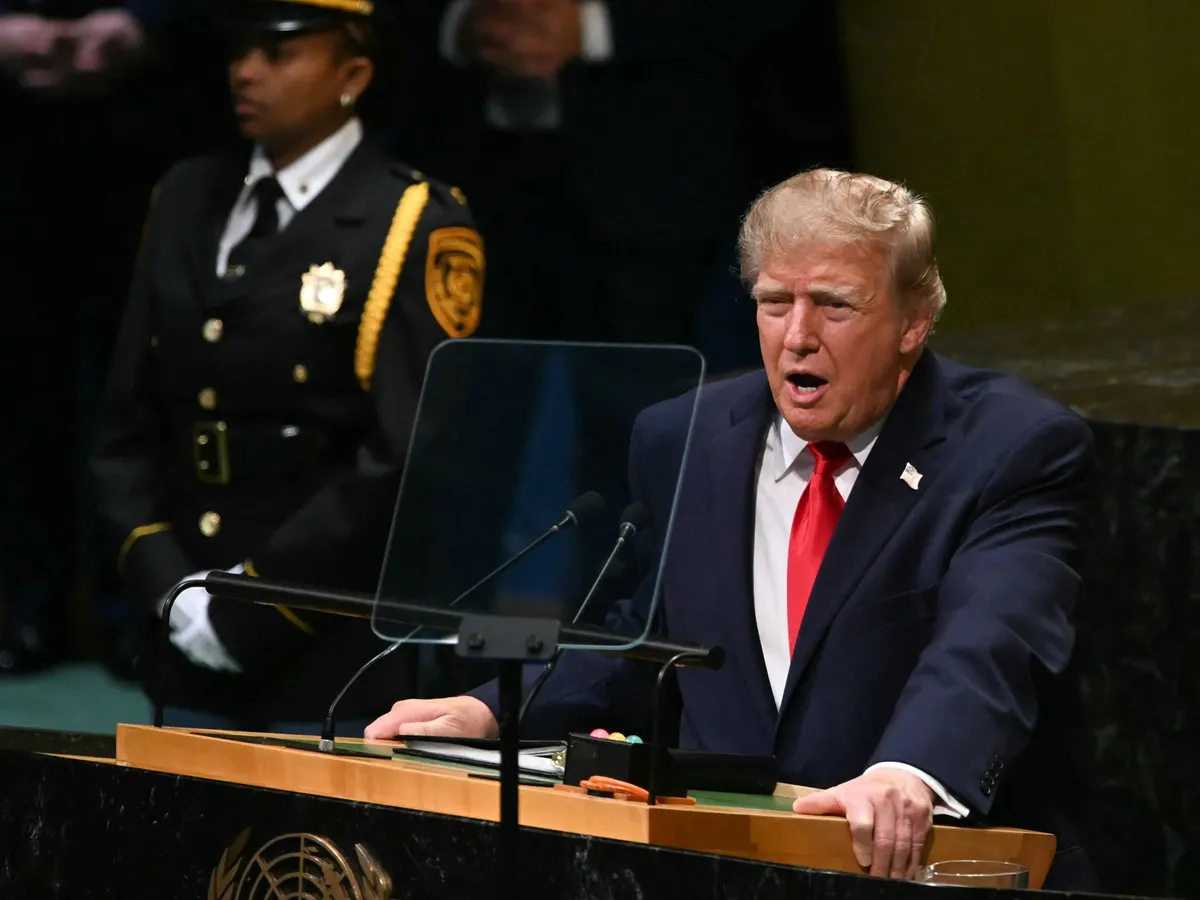
EXPLAINERTrump threatens to ‘annihilate’ Iran and then boasts about diplomacy, provoking Tehran to warn of a ‘crushing’ response.US President Donald Trump addresses the 81st United Nations General Assembly at the United Nations Headquarters in New York, on September 22, 2026 [Brendan Smialowski/AFP]Published On 23 Sep 2026Speaking on the first day of the United Nations General Assembly (UNGA) on Tuesday, United States President Donald Trump threatened to “annihilate” Iran. Hours later, he told reporters that US officials held a “very good” meeting with Iranian leaders.Iran’s military did not hold back. Dismissing Trump’s remarks, the Armed Forces General Staff – Iran’s highest military body – warned that it is ready to respond with “crushing” severer attacks than earlier in the war.Recommended Stories list of 3 itemslist 1 of 3Trump: US-Iran meeting at UN was ‘very good’list 2 of 3US Republican calls for probe into Donald Trump Jr’s business dealingslist 3 of 3Iran cancels Baghdad, Muscat flights as US aviation sanctions take effectend of listIranian Supreme Leader Mojtaba Khamenei, though not in direct response to Trump, used similarly combative imagery in a message marking the start of Iran’s academic year, describing knowledge combined with faith and morality as a “sharp sword” capable of cutting off the hands of aggressors.Amid the rhetoric, the two sides held their first in-person meeting in months on the sidelines of the UNGA, reviving a diplomatic channel that had almost collapsed in the wake of repeated violations of the June memorandum of understanding (MoU), which subsequently lapsed last month, during nearly seven months of the Iran" class="entity-link entity-event" data-entity-id="38678" data-entity-type="event">US-Israel war on Iran.The war has triggered a spike in fuel prices in the US – a major issue in the midterm elections due in November – while sanctions by Washington are squeezing Iran’s economy. While Tehran wants the economic measures as well as the US naval blockade on its ports lifted, Washington wants Iran to allow free navigation through the Strait of Hormuz, a global oil chokepoint, and an end to its nuclear programme.So, why are Washington and Tehran engaging in diplomacy aimed at finding a way out of the war while also issuing fiery and violent threats?What were the US-Iran talks on at the UNGA?Trump said his envoys – Steve Witkoff and Jared Kushner – met Iranian officials for about three hours on the sidelines of the UNGA. He described it as a “very good meeting”, while acknowledging the Iranian representatives were “not the highest level”.Iran’s Foreign Minister Abbas Araghchi took part, with mediators shuttling between the US and Iranian teams.Witkoff later said the discussions were completed and expressed hope they would prove “constructive and promising”.The talks were believed to be the first in-person discussions between officials from the two countries since US Vice President JD Vance met senior Iranian officials in Switzerland in June.Trump said another meeting was expected “in the very near future”, adding that he believed there was “a lot of momentum” towards an agreement.What did Trump say?Trump used his UN speech to offer Iran a choice: an opening for negotiations and simultaneously issued a threat of further destruction.“I have a big decision to make,” Trump said. He asked whether a deal would allow Iran to “rebuild and create a far greater country”, or “do I annihilate the Islamic Republic and do it quickly”.“Do I drive them into hell with no chance of survival?” he added.The Iranian delegation walked out shortly after Trump started to describe the nearly seven months of on-and-off military strikes against Iran, with only one person remaining seated.What has Iran said?In a statement carried by the Mehr news agency, Iran’s General Staff accused the US president of using the UN platform to justify “aggression”.“Such words demonstrate America’s strategic dead end in its aggression against the Iranian nation,” it said, describing Trump’s repeated threats as “not a sign of power but a sign of their strategic desperation”.The statement also warned Iran’s armed forces are ready to deliver strikes against the US and Israel that would be “more crushing and less predictable” than earlier in their war.Khamenei also used combative language, although his remarks were not a direct response to Trump’s UN address.In a message marking the start of the academic year, he described knowledge, faith and morality as weapons against the US and Israel.“Power rooted in knowledge and coupled with piety and morality serves as an iron shield and a sharp sword that can cut off their aggressors’ hands from humanity,” Khamenei said, referring to what he called the “criminal US government” and Israel, Press TV reported.Meanwhile, before departing Tehran on Tuesday, President Masoud Pezeshkian also struck a defiant tone, accusing the US of doing “everything they can to block every possible route” to force Iran and its people to surrender after failing to achieve that militarily.Pezeshkian said Iran would use the UN gathering to highlight “the crimes that have been committed against” Iranians and the distrust created by the war.Why the escalating rhetoric amid diplomacy?The hostile rhetoric between Washington and Tehran should not necessarily be seen as contradicting ongoing diplomatic efforts, according to Andreas Krieg, associate professor at King’s College London.Instead, Krieg argues, the public threats and tough language are part of a wider battle to shape how any eventual agreement is perceived at home and abroad.“The violent rhetoric is not a contradiction to the diplomacy. It is part of the bargaining strategy,” Krieg told Al Jazeera.For Trump, the objective is to demonstrate that Iran returned to negotiations because of the US pressure rather than any softening of Washington’s position.Meanwhile, Iran’s leadership needs to construct almost the opposite narrative – that Tehran resisted US pressure, retained sufficient leverage and ultimately forced Washington to negotiate.“This has become a major war over narratives as much as a war over material power,” Krieg said.Both governments are therefore addressing several audiences simultaneously, including their domestic constituencies, each other, regional allies and the wider international community.Moreover, Krieg said the rhetoric could, paradoxically, make an eventual compromise easier. “If both sides can convince their audiences that they negotiated from strength, they gain more political space to compromise privately without appearing to capitulate publicly,” he noted.According to the academic, the real issue was “sequencing”.“Iran wants movement on the blockade, sanctions and frozen assets before giving up leverage over Hormuz or accepting irreversible nuclear concessions. Washington wants tangible Iranian movement first, particularly on navigation and the nuclear file,” he said.“Qatar’s role is crucial because Doha can turn those incompatible demands into reciprocal steps rather than forcing one side to move first. The danger is that rhetoric can still create its own momentum if there is a major attack, significant US casualties, an Israeli strike or escalation from Yemen.”
SRCAl Jazeera
LANGEN
LEANCenter
WORDS1 105
ENT12
WED · 2026-09-23 · 09:40 GMTBRIEF NSR-2026-0923-113408
NSR-2026-0923-113408Analysis·EN·Conflict
‘Annihilate’ vs ‘crushing’ attacks: Why Iran, US up rhetoric amid talks
During the UN General Assembly, US President Donald Trump threatened to "annihilate" Iran, while simultaneously describing a recent meeting with Iranian officials as "very good." Iran's Armed Forces General Staff responded by warning of "crushing" retaliatory attacks, and Supreme Leader Mojtaba Khamenei used combative imagery to describe Iran's defensive capabilities. These exchanges occurred amid ongoing US-Iran talks aimed at de-escalating a nearly seven-month war that has impacted global fuel prices and Iran's economy.
Usaid SiddiquiAl JazeeraFiled 2026-09-23 · 09:40 GMTLean · CenterRead · 5 min
Al JazeeraFIG 01
Reading time
5min
Word count
1 105words
Sources cited
4cited
Entities identified
12entities
Quality score
100%
§ 01
Briefing Summary
AI-generatedNEWSAR · AI
During the UN General Assembly, US President Donald Trump threatened to "annihilate" Iran, while simultaneously describing a recent meeting with Iranian officials as "very good." Iran's Armed Forces General Staff responded by warning of "crushing" retaliatory attacks, and Supreme Leader Mojtaba Khamenei used combative imagery to describe Iran's defensive capabilities. These exchanges occurred amid ongoing US-Iran talks aimed at de-escalating a nearly seven-month war that has impacted global fuel prices and Iran's economy. The discussions, involving US envoys and Iranian Foreign Minister Abbas Araghchi, were the first in-person meetings in months and are seen as an attempt to revive diplomatic channels.
Confidence 0.90Sources 4Claims 5Entities 12
§ 02
Article analysis
Model · rule-basedFraming
Conflict
Diplomatic
Tone
Mixed Tone
AI-assessed
CalmNeutralAlarmist
Factuality
0.70 / 1.00
Factual
LowHigh
Sources cited
4
Well sourced
FewMany
§ 03
Key claims
5 extracted01
Iran's Armed Forces General Staff warned it is ready to respond with 'crushing' attacks.
quoteIran's Armed Forces General Staff
Confidence
1.00
02
US President Donald Trump threatened to 'annihilate' Iran.
quoteDonald Trump
Confidence
1.00
03
Washington wants Iran to allow free navigation through the Strait of Hormuz and end its nuclear programme.
factual
Confidence
0.90
04
The US-Iran war has triggered a spike in fuel prices in the US and is squeezing Iran's economy.
factual
Confidence
0.90
05
US officials held a 'very good' meeting with Iranian leaders on the sidelines of the UNGA.
quoteDonald Trump
Confidence
0.90
§ 04
Full report
5 min read · 1 105 words§ 05
Entities
12 identifiedKey playerOppositionContextPositiveNeutralNegative
People4
Organizations2
Locations3
§ 06
Keywords & salience
8 termsus-iran rhetoric
1.00
diplomacy
0.90
military threats
0.80
united nations general assembly
0.70
us-iran war
0.60
sanctions
0.50
strait of hormuz
0.40
nuclear programme
0.40
§ 07
Topic connections
Interactive graph Network visualization showing 51 related topics
View Full Graph Person Organization Location Event|Click node to navigate|Edge numbers = shared articles