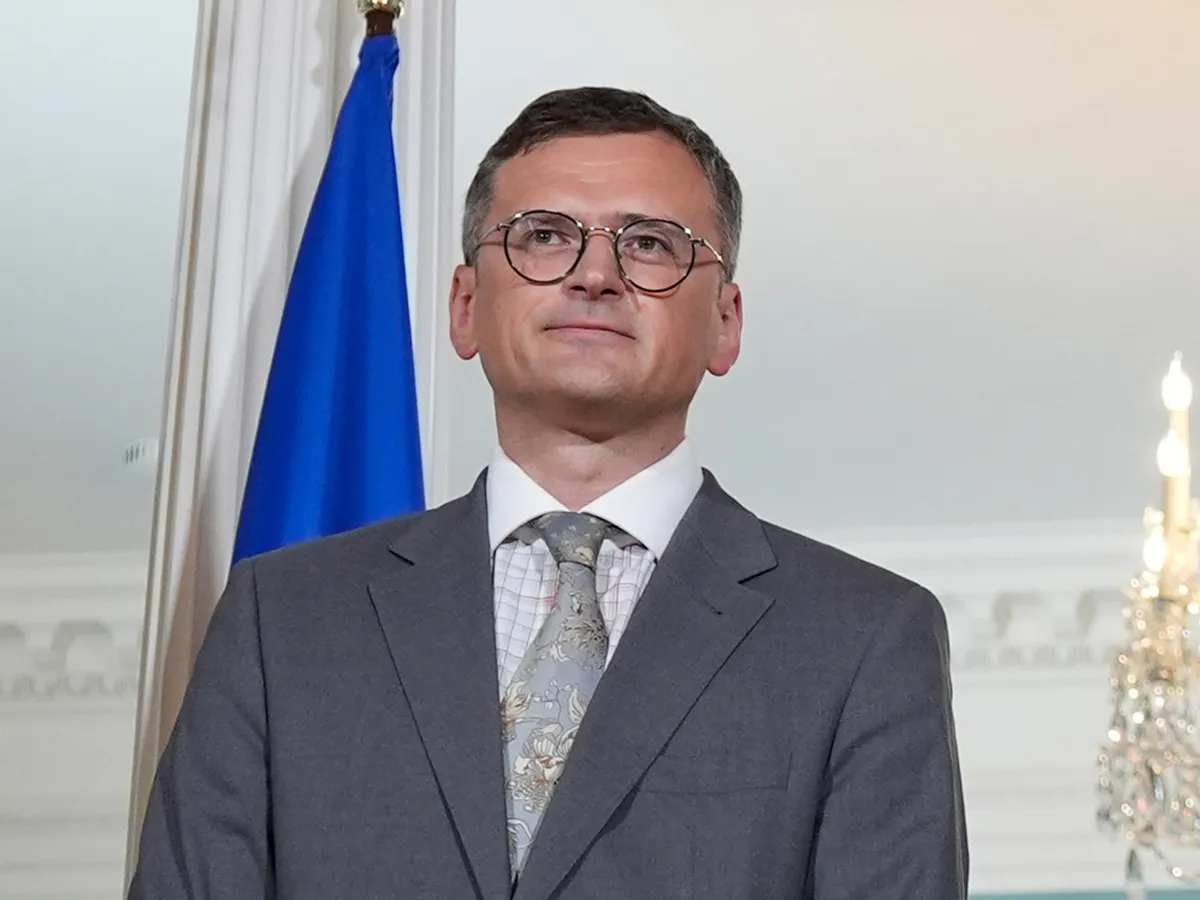
Dmytro Kuleba talks to Al Jazeera as Ukraine marks the fourth anniversary of war.Dmytro Kuleba, then Ukraine's foreign minister, attends a meeting on July 9, 2024, at the US Department of State in Washington, DC, the United States [File: Stephanie Scarbrough/AP]Published On 23 Feb 2026As Ukraine marks four years since Russia’s full-scale invasion on Tuesday, Dmytro Kuleba, the war-torn nation’s former foreign minister from 2020 until 2024, talks to Al Jazeera about how early expectations of a short war gave way to a grinding conflict with no clear end in sight.From shifting definitions of victory and growing fractures among Ukraine’s allies to negotiations with Moscow and lessons learned in the Global South, Kuleba reflected on what survival, realism and resolve mean for Ukraine today.Recommended Stories list of 4 itemslist 1 of 4At least one killed in widescale Russian attacks on Ukraine’s energy sectorlist 2 of 4How four years of war in Ukraine have changed Russialist 3 of 4The Ukraine war in numbers: People, territory, moneylist 4 of 4Russia kills four Ukrainians on eve of fourth war anniversaryend of listThe 44-year-old, who is now an associate professor at Sciences Po in France and a non-resident senior fellow at Harvard Kennedy School, spoke to Al Jazeera via video-link from Kyiv, where he resides.Here’s our interview, which has been lightly edited for clarity and brevity.Al Jazeera: As the war enters a fifth year, is there any room for optimism?Dmytro Kuleba: Optimism should be rooted in reality, and there will be no ceasefire until the end of winter in Ukraine.I do not mean the calendar winter; I mean the temperatures and the weather.[Russian President Vladimir] Putin has been ruthlessly destroying our energy system and plunging millions of Ukrainians into cold and darkness to break them down, not to make a good deal with them.After winter ends, there will be a slim chance for a ceasefire, and whether the slim chance can become real, will depend on two factors.First, whether Russia will be able to make advances on the battlefield, because if it does, it will have zero incentive to stop.And secondly, whether the Russian economy will cripple under the pressure of mounting problems.Al Jazeera: Is Russia negotiating in good faith or buying time with the current talks?Kuleba: Russia, throughout its history, has not been particularly famous for negotiating in good faith.They are testing how much they can achieve at the negotiating table instead of achieving the same goals on the battlefield. Secondly, they are engaging in meaningful conversation, trying to understand how a potential ceasefire could work from a technical perspective, just to have that frame on the table.But meaningful does not mean in good faith.Putin believes he can win the war. He believes he’s making progress on the battlefield and that he can manage problems in the Russian economy. His strategy is that Ukraine is going to fall before he does.Al Jazeera: Is the current situation something you imagined back in February 2022?Kuleba: When war breaks out, your first instinct is to believe that it’s not going to last long … and all you have to do is just to survive the first attack, and then the attacking side will realise that it failed to achieve its goals.But while keeping this instinctive scenario on your mind, you always have to also remember that things may last longer than you expect.Did I expect the war to last for four years? No, I didn’t. But was I preparing myself for a long war? Yes, somewhere in the back of my mind, I was keeping that option open.Al Jazeera: What does victory mean to you now?Kuleba: It started as a nightmare, and by the end of [2022], we captured half of the territories Russia had captured in the first months of the invasion, and we were pushing them back on old fronts. [Russian troops] were struggling to stabilise the front line; a sense of euphoria dominated in Ukraine, both among the decision-makers and the population.This was the moment when victory was defined as regaining control of the 1991 border, which had existed before Russia annexed Crimea and intervened in the east of Ukraine in 2014.But this hope … did not pass the reality check by the end of 2023, when our big counteroffensive failed to deliver.Since then, politicians and people in Ukraine find it more and more difficult to redefine victory and speak about it, which I think is a big problem, because if you do not define what your final goal is, you will never get it.So I offer my understanding of victory today, which would be to cease fire along the existing front line to stop hostilities and introduce a provisional truce between Russia and Ukraine to receive a long multi-year programme of military support to Ukraine; to launch a multi-billion recovery plan for Ukraine, and to see Ukraine as a member of the European Union.Victory should always be defined, not only against your own goals, but also against the initial goals of your enemy.So if I look back at 2022 and assume that Russia’s main objective was the demolition of the Ukrainian statehood and the return of Ukraine under its full control, then … Russia failed.Al Jazeera: Do you feel the West and your vision are aligned?Kuleba: The West doesn’t really exist anymore in the form we are used to thinking about it.Europe is aligned. Some countries outside of Europe, which belong to what used to be the West, are aligned as well, such as Japan, Australia, and other nations.The United States holds a different view now; they just want to end hostilities at any cost.Al Jazeera: What security guarantees does Ukraine need for a potential ceasefire to hold?Kuleba: It would be Russia accepting that Ukraine has a right to exist as an independent, sovereign and European nation.Everything in between a potential ceasefire and the acceptance of this fact will be a conflict, taking one form or another.Al Jazeera: Is there still defiance among Ukrainians?Kuleba: We won the winter battle. It was the battle for our resolve and stamina, and Putin hoped we would be broken. We are exhausted, but not broken.Al Jazeera: What would you say to Ukraine’s backers who have expressed concern about recent corruption scandals?A big corruption case always triggers two reactions.If you want to argue, if your goal is to argue that Ukraine is corrupt, you start talking about how big the corruption scheme was.If you want to argue that Ukraine has finally built [a] resilient and robust architecture of anti-corruption institutions, then you make the point that ministers and senior officials are not immune from prosecution anymore, and anti-corruption bodies are doing their job.I think Ukraine is actually setting an example to many other nations of how corruption should be fought under very challenging circumstances.Al Jazeera: As foreign minister from 2020 until 2024, you engaged with the Global South, particularly with African countries. What did you learn about the appeal of some of Russia’s narratives?Kuleba: First, Russia’s influence in countries of the Global South is overestimated.Russia is not strong on its own. It is strong because it has China behind its back, and China is extremely strong all over the world.Secondly, it is not because people in the Global South like Russia. It’s because they don’t like the West or what has been left out of it.The anti-Western European, anti-American sentiment is so strong that many prefer to sympathise [with the] Russian narrative simply because it’s anti-European … not because it’s a strong argument in itself.The third lesson is that you cannot come and demand anything, because [countries in the Global South] have grown quite a thick skin against those coming to their capitals and demanding.Al Jazeera: Did Ukraine’s experience resonate?Kuleba: No, because, for example, if you go to Africa, their understanding of colonialism is set in stone, and it’s a white man oppressing a Black man.
SRCAl Jazeera
LANGEN
LEANCenter
WORDS1 309
ENT9
MON · 2026-02-23 · 16:50 GMTBRIEF NSR-2026-0223-18627
NSR-2026-0223-18627News Report·EN·Political Strategy
Putin’s strategy is that Ukraine will fall before he does: Ex-FM Kuleba
In February 2026, Al Jazeera interviewed Dmytro Kuleba, Ukraine's former foreign minister, marking the fourth anniversary of Russia's full-scale invasion. Kuleba, now an academic, discussed the shift from expectations of a short war to a protracted conflict.
Nils AdlerAl JazeeraFiled 2026-02-23 · 16:50 GMTLean · CenterRead · 6 min
Al JazeeraFIG 01
Reading time
6min
Word count
1 309words
Sources cited
1cited
Entities identified
9entities
Quality score
100%
§ 01
Briefing Summary
AI-generatedNEWSAR · AI
In February 2026, Al Jazeera interviewed Dmytro Kuleba, Ukraine's former foreign minister, marking the fourth anniversary of Russia's full-scale invasion. Kuleba, now an academic, discussed the shift from expectations of a short war to a protracted conflict. He believes a ceasefire is unlikely until the end of winter due to Russia's attacks on Ukraine's energy infrastructure. He stated that the possibility of a ceasefire after winter depends on Russia's battlefield advances and the state of the Russian economy. Kuleba expressed skepticism about Russia's good faith in negotiations, suggesting they are testing their leverage rather than seeking genuine resolution.
Confidence 0.90Sources 1Claims 5Entities 9
§ 02
Article analysis
Model · rule-basedFraming
Political Strategy
Conflict
Tone
Measured
AI-assessed
CalmNeutralAlarmist
Factuality
0.60 / 1.00
Mixed
LowHigh
Sources cited
1
Limited
FewMany
§ 03
Key claims
5 extracted01
Putin's strategy is that Ukraine is going to fall before he does.
quoteDmytro Kuleba
Confidence
0.90
02
Putin believes he can win the war.
quoteDmytro Kuleba
Confidence
0.90
03
Putin has been ruthlessly destroying our energy system.
quoteDmytro Kuleba
Confidence
0.90
04
There will be no ceasefire until the end of winter in Ukraine.
predictionDmytro Kuleba
Confidence
0.80
05
Russia is testing how much they can achieve at the negotiating table instead of on the battlefield.
quoteDmytro Kuleba
Confidence
0.70
§ 04
Full report
6 min read · 1 309 words§ 05
Entities
9 identifiedKey playerOppositionContextPositiveNeutralNegative
Organizations1
§ 06
Keywords & salience
9 termsukraine war
1.00
russia
0.90
dmytro kuleba
0.80
negotiations
0.70
ceasefire
0.70
energy system
0.60
winter
0.50
russian economy
0.50
full-scale invasion
0.40
§ 07
Topic connections
Interactive graph Network visualization showing 51 related topics
View Full Graph Person Organization Location Event|Click node to navigate|Edge numbers = shared articles