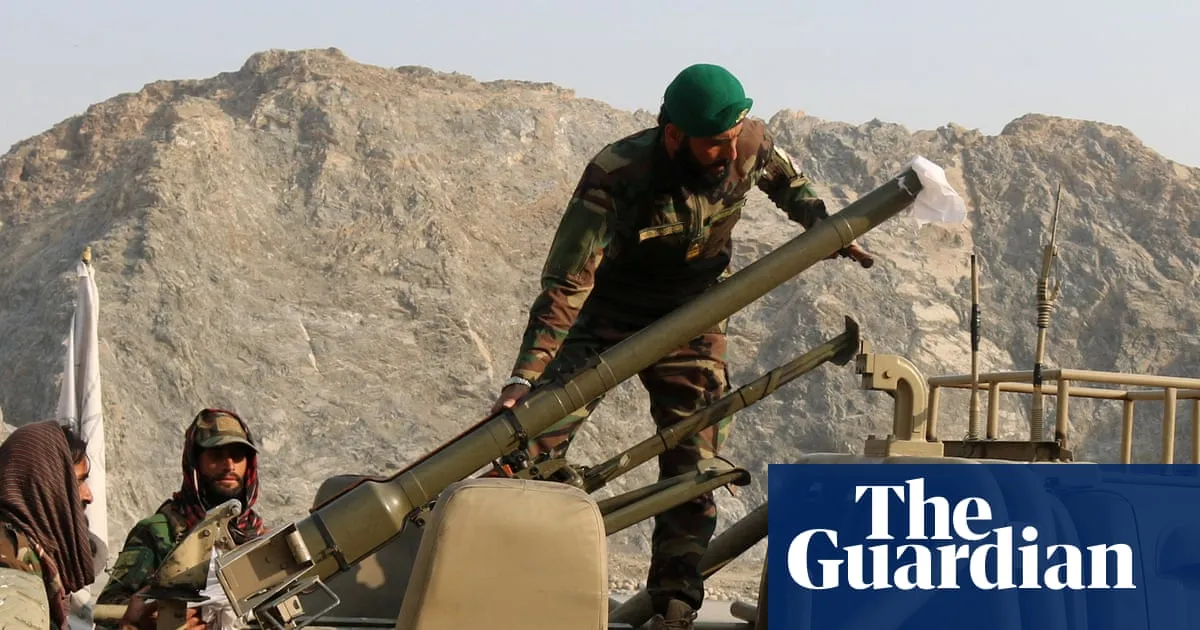
Days after the Taliban swept to power in 2021, Pakistan’s then spymaster appeared in Kabul on what looked to many like a victory lap. Sipping tea in the lobby of the Afghan capital’s fanciest hotel, Lt Gen Faiz Hameed told reporters: “Don’t worry, everything will be OK.”This week it became clear just how badly Pakistan had miscalculated how it could rely on the Taliban, as Islamabad unleashed airstrikes in Afghanistan and troops from both countries fought each other on the border.Pakistan’s defence minister, Khawaja Muhammad Asif, said patience had finally run out after calling repeatedly on the Taliban to stop Pakistani militants from using Afghan territory as a sanctuary from which to attack.Pakistan’s predicament is the mirror opposite of accusations made by the US-led international coalition in Afghanistan against Pakistan before 2021: that the Taliban were being allowed to use Pakistan as a safe haven.“This is blowback, big time,” said Kamran Bokhari, a senior director at the Washington-based New Lines Institute thinktank. “If you support proxies who challenge your own national identity and your national narrative, they don’t think that you’re ideologically legitimate, then it is only a matter of time before they turn their guns on you.”In 2011, Hillary Clinton as US secretary of state had put it bluntly when visiting Pakistan: “You can’t keep snakes in your back yard and expect them only to bite your neighbours.”Bokhari said Afghanistan was not Pakistan’s only problem on its western flank, with a weakening Iran set to ignite trouble on that border, and Tehran no longer in a position to help Pakistan manage the Taliban.The Taliban deny that their territory is being used against Pakistan and on Friday they again implored Islamabad to enter into negotiations with the militant group behind many of the attacks, known as Tehreek-e-Taliban Pakistan (TTP).The TTP emerged in 2007 and waged terror across Pakistan for a decade, but it had weakened in the years before the Taliban took Kabul. Since then there has been a surge in attacks in Pakistan.The Taliban and the TTP fought together against international forces in Afghanistan, and the TTP had hosted its jihadi brothers in Pakistan. With the Taliban in power, it was payback time for the TTP.The TTP says it is seeking to impose its own extreme version of Islam on Pakistan, where 95% of the population is Muslim and the constitution stipulates that all laws have to be in line with Islam.Pakistan says it has been forced to make tough choices over decades of instability in Afghanistan. After the 9/11 attacks and the US invasion of Afghanistan, Islamabad became alarmed at what it perceived as the influence of its arch-enemy India on the Afghan government.Pakistan sought a more friendly Afghanistan and the Taliban were seen as the only viable option, analysts say, though Islamabad formally remained a close American ally.That US alliance ignited a radical reaction at home, led by the TTP, which was behind the assassination of the former prime minister Benazir Bhutto, the massacre of more than 130 children at a school, and the taking of territory including the Swat valley, where they shot the schoolgirl Malala Yousafzai.The Pakistan military’s bet was that the Afghan insurgents were “good” jihadists, separate in nature from the “bad” Pakistani insurgents they were fighting. That distinction between the two movements, always shaky, has become increasingly blurred as many Taliban members have joined the TTP now that there is no jihad to fight inside Afghanistan.Mosharraf Zaidi, a spokesperson for Pakistan’s prime minister, Shehbaz Sharif, said: “It is ludicrous and disingenuous for any honest broker to argue that this is a comeuppance for Pakistan, given that the current position of Pakistan is the same as it has always been: stop supporting terrorism in Pakistan.”Antonio Giustozzi, a senior research fellow at London’s Royal United Services Institute (Rusi), said Pakistan’s strategy was to inflict pain on Afghanistan through airstrikes and an economic blockade, to compel a change in approach or replacement of the leader, Haibatullah Akhundzada.“Bombing Afghanistan was a mistake as Haibatullah had to retaliate or lose credibility,” Giustozzi said. “There’s been a wave of nationalism in Afghanistan that’s made Haibatullah stronger.”The Taliban have turned so far against Pakistan that they are also supporting a secular Pakistani insurgency that is seeking to separate the country’s natural resources-rich province of Balochistan, Giustozzi said.The TTP has been led in recent years by Noor Wali Mehsud, who has managed to unite its squabbling factions and pursue a new strategy where it focuses its attacks on the army and the police rather than civilians.Asif Durrani, formerly Pakistan’s special envoy for Afghanistan, said the Taliban were told to choose between Pakistan and the TTP and they went for the latter.“The Taliban are part of a war economy,” Durrani said. “They are not behaving like a government, they are still in militant mode.”
SRCThe Guardian - World News
LANGEN
LEANCenter-Left
WORDS802
ENT8
FRI · 2026-02-27 · 18:12 GMTBRIEF NSR-2026-0227-19901
NSR-2026-0227-19901Analysis·EN·National Security
Pakistan’s patience runs out after badly miscalculating over Taliban
In 2021, Pakistan believed the Taliban's rise to power in Afghanistan would be beneficial. However, Pakistan's military has now launched airstrikes in Afghanistan and engaged in border clashes, signaling a breakdown in relations.
Saeed Shah in IslamabadThe Guardian - World NewsFiled 2026-02-27 · 18:12 GMTLean · Center-LeftRead · 4 min
The Guardian - World NewsFIG 01
Reading time
4min
Word count
802words
Sources cited
3cited
Entities identified
8entities
Quality score
100%
§ 01
Briefing Summary
AI-generatedNEWSAR · AI
In 2021, Pakistan believed the Taliban's rise to power in Afghanistan would be beneficial. However, Pakistan's military has now launched airstrikes in Afghanistan and engaged in border clashes, signaling a breakdown in relations. Pakistan accuses the Taliban of allowing Pakistani militants, specifically the Tehreek-e-Taliban Pakistan (TTP), to use Afghan territory as a base for attacks. The TTP, which seeks to impose its extreme version of Islam in Pakistan, has increased attacks since the Taliban takeover. The Taliban denies harboring the TTP and urges Pakistan to negotiate with the group. Analysts suggest Pakistan's support of proxies has backfired, creating instability along its western border, with a weakening Iran adding to the challenges.
Confidence 0.90Sources 3Claims 5Entities 8
§ 02
Article analysis
Model · rule-basedFraming
National Security
Political Strategy
Tone
Measured
AI-assessed
CalmNeutralAlarmist
Factuality
0.60 / 1.00
Mixed
LowHigh
Sources cited
3
Well sourced
FewMany
§ 03
Key claims
5 extracted01
The TTP says it is seeking to impose its own extreme version of Islam on Pakistan.
factualTTP
Confidence
1.00
02
The TTP emerged in 2007 and waged terror across Pakistan for a decade.
factual
Confidence
1.00
03
The Taliban deny that their territory is being used against Pakistan.
factualTaliban
Confidence
1.00
04
Pakistan's defence minister said patience had finally run out after calling on the Taliban to stop Pakistani militants.
quoteKhawaja Muhammad Asif
Confidence
1.00
05
Pakistan unleashed airstrikes in Afghanistan and troops from both countries fought each other on the border.
factual
Confidence
1.00
§ 04
Full report
4 min read · 802 words§ 05
Entities
8 identifiedKey playerOppositionContextPositiveNeutralNegative
Organizations2
§ 06
Keywords & salience
9 termstaliban
1.00
pakistan
1.00
tehreek-e-taliban pakistan (ttp)
0.90
afghanistan
0.80
cross-border attacks
0.70
safe haven
0.60
islamabad
0.60
blowback
0.50
proxy warfare
0.50
§ 07
Topic connections
Interactive graph Network visualization showing 51 related topics
View Full Graph Person Organization Location Event|Click node to navigate|Edge numbers = shared articles