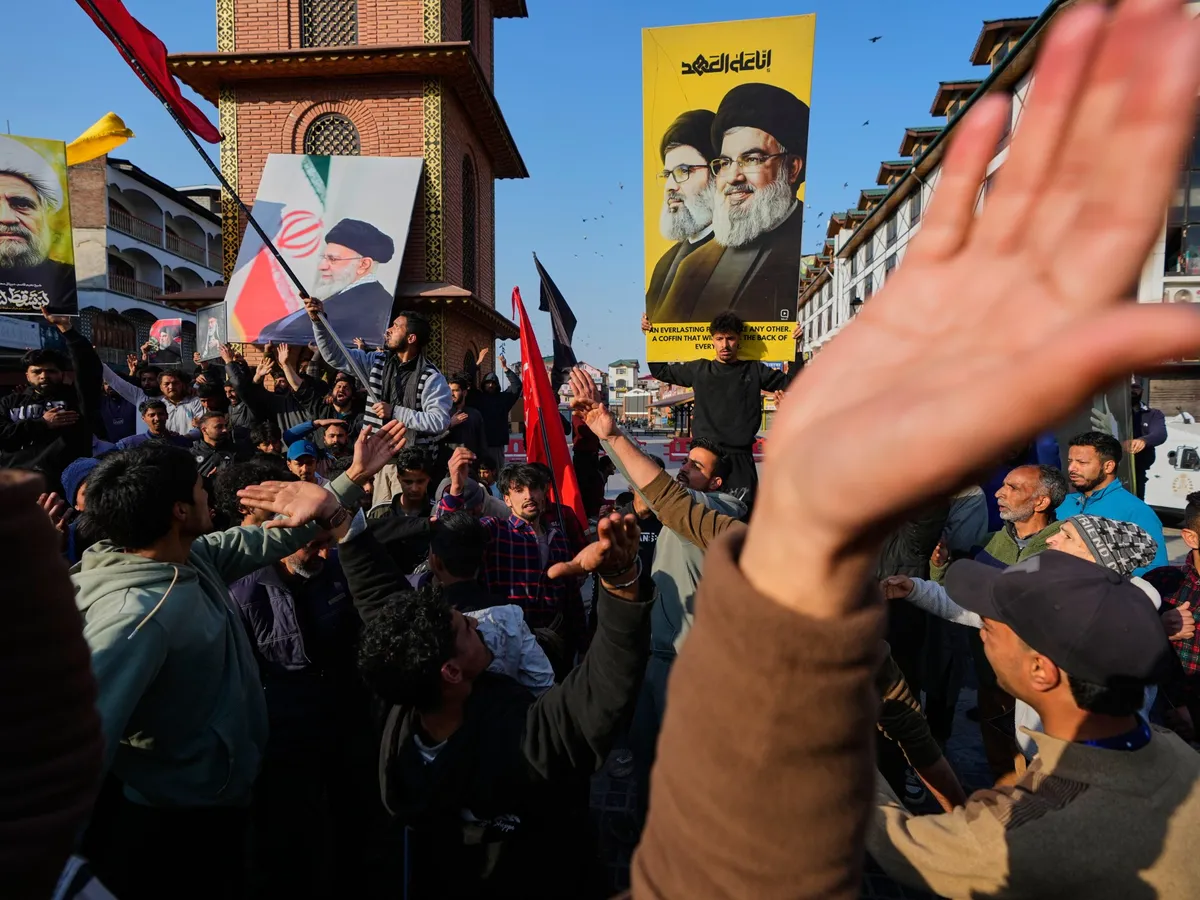
While Tehran warns it will ‘burn everything’, its proxies in Lebanon, Yemen and Iraq face a choice between suicidal revenge and local survival.Shia Muslims mourn the killing of Iranian Supreme Leader Ali Khamenei during a protest against the US and Israel in Srinagar in India-controlled Kashmir on March 1, 2026 [Mukhtar Khan/AP Photo]Published On 2 Mar 2026The killing of Iranian Supreme Leader Ali Khamenei in a United States-Israeli air campaign has sent shockwaves through the Middle East, decapitating the leadership of the “axis of resistance” at its most critical moment.For decades, this network of groups allied with Iran was Tehran’s forward line of defence. But today, with its commander-in-chief dead and its logistical arteries cut, the alliance looks less like a unified war machine and more like a series of isolated islands.Recommended Stories list of 4 itemslist 1 of 4Trump says likely more US casualties, attacks on Iran will continuelist 2 of 4Poll suggests only a quarter of Americans support attacks on Iranlist 3 of 4Israel bombs Beirut after Hezbollah fires rockets in Iran war retaliationlist 4 of 4After Iran’s salvo hit their skylines, will Gulf states enter the war?end of listHassan Ahmadian, a professor at the University of Tehran, warned that the era of strategic patience is over and the Iranian government is now prepared to “burn everything” in response to the attacks.While Tehran promised to retaliate against the US and Israel “with a force they have never experienced before”, the reaction from its key proxies in Lebanon, Yemen and Iraq revealed a deep hesitation driven by local existential threats that may outweigh their ideological loyalty to a fallen leader.Hezbollah: Walking between raindropsIn Beirut, the response from Hezbollah, long considered the crown jewel among Iran’s regional allies, has been cautiously calibrated.After Sunday’s announcement of Khamenei’s death, the group issued a statement condemning the attack as the “height of criminality”. However, Al Jazeera correspondent in Beirut Mazen Ibrahim noted that the language used was defensive, not offensive.“If one dismantles the linguistic structure of the statement, the complexity of Hezbollah’s position becomes clear,” Ibrahim said. “The secretary-general spoke of ‘confronting aggression’, which refers to a defensive posture. … He did not explicitly threaten to attack Israel or launch revenge operations.”This caution is rooted in a new strategic reality. Since the collapse of Bashar al-Assad’s government in Syria in late 2024, the “land bridge” that supplied Hezbollah has been severed. Ali Akbar Dareini, a Tehran-based researcher, noted that this loss “cut the ground link with Lebanon”, leaving the group physically isolated.Now with top leaders of Iran’s Islamic Revolutionary Guard Corps (IRGC) killed alongside Khamenei, Hezbollah appears paralysed – caught between a battered domestic front in Lebanon and a vacuum of orders from Tehran.The Houthis: Solidarity meets survivalIn Yemen, the Houthis face an even more volatile calculus.In his first televised address after the strikes on Iran began on Saturday, the group’s leader, Abdel-Malik al-Houthi, declared his forces “fully prepared for any developments”. Yet his rhetoric notably emphasised that “Iran is strong” and “its response will be decisive,” a phrasing that analysts interpreted as an attempt to deflect the immediate burden of war away from the Houthis.The Houthis are under immense pressure. While they have successfully disrupted Red Sea shipping and fired missiles at Tel Aviv, they now face a renewed threat at home.The internationally recognised Yemeni government, having won a power struggle against southern separatists, has sensed a shift in momentum. Defence Minister Taher al-Aqili recently declared: “The index of operations is heading towards the capital, Sanaa,” which the Houthis control. The statement signalled a potential ground offensive to retake Houthi territory.This places the Houthis in a bind. While Houthi negotiator Mohammed Abdulsalam recently met with Iranian official Ali Larijani in Muscat, Oman, to discuss “unity of the arenas”, the reality on the ground is different. Engaging in a war for Iran could leave the Houthis’ home front exposed to government forces backed by regional rivals.“Expanding the circle of targeting will only result in expanding the circle of confrontation,” the Houthi-affiliated Supreme Political Council warned in a statement that threatened escalation but also implicitly acknowledged the high cost of a wider war.Iraq: The internal time bombPerhaps nowhere is the dilemma more acute than in Iraq, where the lines between the state and the “resistance” are dangerously blurred.Iran-aligned militias, many of which operate under the state-sanctioned Popular Mobilisation Forces, are now caught in a direct standoff with the US. Tensions have simmered since late 2024 when Ibrahim Al-Sumaidaie, an adviser to Iraq’s prime minister, revealed that Washington had threatened to dismantle these groups by force, a warning that led to his resignation under pressure from militia leaders.Today, that threat looms larger than ever. Unlike Hezbollah or the Houthis, these groups are technically part of the Iraqi security apparatus. A retaliation from Iraqi soil would not just risk a militia war but also a direct conflict between the US and the Iraqi state.With the IRGC commanders who once mediated these tensions now dead, the “restraining hand” is gone. Isolated militia leaders may now decide to strike US bases of their own accord, dragging Baghdad into a war the government has desperately tried to avoid.Khamenei’s assassination has essentially shattered the command-and-control structure of the “axis of resistance”.The network was built on three pillars: the ideological authority of the supreme leader, the logistical coordination of the IRGC and the geographic connection through Syria. Today, all three are broken.“The most important damage to Iran’s security interests is the severing of the ground link,” Dareini said. With Khamenei gone, the “spiritual link” is also severed.What remains is a fragmented landscape. In Lebanon, Hezbollah is too exhausted to open a northern front. In Yemen, the Houthis face a potential domestic offensive. In Iraq, militias risk collapsing the state they live in.When the dust settles in Tehran, the region will face a dangerous unpredictability. The “axis of resistance” is no longer a coordinated army. It is a collection of angry, heavily armed militias, each calculating its own survival in a world where the orders from Tehran have suddenly stopped coming.
SRCAl Jazeera
LANGEN
LEANCenter
WORDS1 009
ENT11
MON · 2026-03-02 · 05:38 GMTBRIEF NSR-2026-0302-20516
NSR-2026-0302-20516Analysis·EN·Conflict
Analysis: Khamenei’s killing leaves Iran’s ‘axis’ in disarray
Following the death of Iranian Supreme Leader Ali Khamenei in a US-Israeli air campaign on March 1, 2026, Iran's network of allied groups in the Middle East faces an uncertain future. While Tehran vows retaliation, its proxies in Lebanon, Yemen, and Iraq are reportedly hesitant, prioritizing their own survival over ideological loyalty.
Al Jazeera StaffAl JazeeraFiled 2026-03-02 · 05:38 GMTLean · CenterRead · 5 min
Al JazeeraFIG 01
Reading time
5min
Word count
1 009words
Sources cited
4cited
Entities identified
11entities
Quality score
100%
§ 01
Briefing Summary
AI-generatedNEWSAR · AI
Following the death of Iranian Supreme Leader Ali Khamenei in a US-Israeli air campaign on March 1, 2026, Iran's network of allied groups in the Middle East faces an uncertain future. While Tehran vows retaliation, its proxies in Lebanon, Yemen, and Iraq are reportedly hesitant, prioritizing their own survival over ideological loyalty. Hezbollah in Lebanon, traditionally a strong Iranian ally, issued a statement condemning the attack but adopted a defensive tone, signaling a reluctance to escalate the conflict. Analysts suggest that the loss of Khamenei and disrupted supply lines have weakened the "axis of resistance," leaving these groups isolated and focused on local concerns. The situation raises questions about the stability of the region and the future of Iran's influence.
Confidence 0.90Sources 4Claims 5Entities 11
§ 02
Article analysis
Model · rule-basedFraming
Conflict
National Security
Tone
Mixed Tone
AI-assessed
CalmNeutralAlarmist
Factuality
0.60 / 1.00
Mixed
LowHigh
Sources cited
4
Well sourced
FewMany
§ 03
Key claims
5 extracted01
Hezbollah's secretary-general spoke of ‘confronting aggression’, which refers to a defensive posture.
quoteMazen Ibrahim, Al Jazeera correspondent
Confidence
1.00
02
Hassan Ahmadian warned that the Iranian government is now prepared to “burn everything” in response to the attacks.
quoteHassan Ahmadian, a professor at the University of Tehran
Confidence
1.00
03
Iranian Supreme Leader Ali Khamenei was killed in a United States-Israeli air campaign.
factualAl Jazeera
Confidence
1.00
04
Since the collapse of Bashar al-Assad’s government in Syria in late 2024, the “land bridge” that supplied Hezbollah has been severed.
factualAli Akbar Dareini, a Tehran-based researcher
Confidence
0.90
05
The killing of Khamenei has sent shockwaves through the Middle East.
factualAl Jazeera
Confidence
0.80
§ 04
Full report
5 min read · 1 009 words§ 05
Entities
11 identifiedKey playerOppositionContextPositiveNeutralNegative
§ 06
Keywords & salience
10 termskhamenei killing
1.00
iran
0.90
axis of resistance
0.80
hezbollah
0.70
proxies
0.70
israel
0.60
us
0.60
retaliation
0.60
middle east
0.50
strategic patience
0.40
§ 07
Topic connections
Interactive graph Network visualization showing 34 related topics
View Full Graph Person Organization Location Event|Click node to navigate|Edge numbers = shared articles