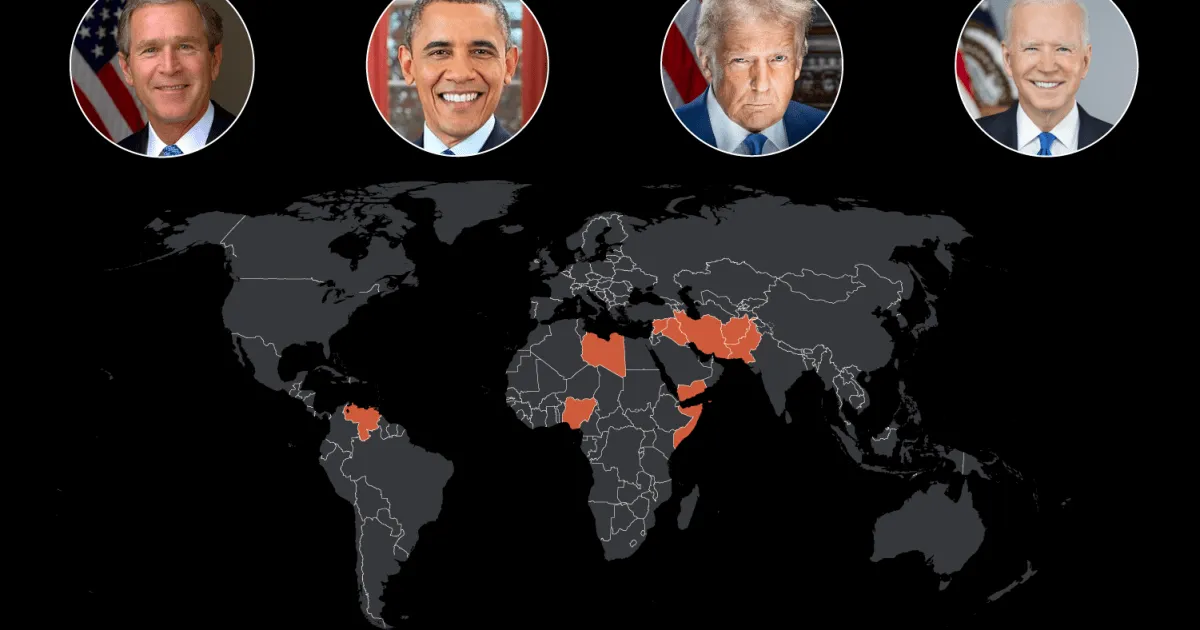
Since 9/11, the US has engaged in three full-scale wars, bombing at least 10 countries under four presidents.(Al Jazeera)Published On 3 Mar 2026Despite promising to end United States involvement in costly and destructive foreign wars, President Donald Trump, together with Israel, has launched a massive military assault on Iran, targeting its leadership and nuclear and missile infrastructure.Much like his predecessors, Trump has relied on military force to pursue US strategic interests, continuing a pattern that has defined US foreign policy for more than two decades.Since the September 11, 2001, attacks on New York and the US capital, the US has engaged in three full-scale wars and bombed at least 10 countries in operations ranging from drone strikes to invasions, often multiple times within a single year.The graphic below shows all the countries the US has bombed since 2001.These may not include all military strikes, particularly covert or special operations.The US has bombed at least 10 countries: Afghanistan, Iraq, Yemen, Pakistan, Somalia, Libya, Syria, Venezuela, Nigeria and Iran since 2001. [Al Jazeera]The cost of decades of warIn the aftermath of the September 11, 2001, attacks, President George W Bush launched what he called a “war on terror”, a global military campaign that reshaped US foreign policy and triggered wars, invasions and air strikes across numerous countries.According to an analysis by Brown University’s Watson Institute of International & Public Affairs, US-led wars since 2001 have directly caused the deaths of about 940,000 people across Afghanistan, Pakistan, Iraq, Syria, Yemen and other conflict zones.This does not include indirect deaths, namely those caused by loss of access to food, healthcare or war-related diseases.(Al Jazeera)The US has spent an estimated $5.8 trillion funding its more than two decades of conflict.This includes $2.1 trillion spent by the Department of Defense (DOD), $1.1 trillion by Homeland Security, $884bn to increase the DOD base budget, $465bn on veterans’ medical care and an additional $1 trillion in interest payments on loans taken out to fund the wars.In addition to the $5.8 trillion already spent, the US is expected to have to lay out at least another $2.2 trillion for veterans’ care over the next 30 years.This would bring the total estimated cost of US wars since 2001 to $8 trillion.Afghanistan war (2001-2021)The first and most direct response to 9/11 was the invasion of Afghanistan to dismantle al-Qaeda and remove the Taliban from power.On October 7, 2001, the US launched Operation Enduring Freedom.The initial invasion succeeded in toppling the Taliban regime within just a few weeks. However, armed resistance groups mounted a prolonged resistance against US and coalition forces.The war went on to become the longest conflict in US history, spanning four presidencies and lasting 20 years until the final withdrawal in 2021, after which the Taliban regained control of Afghanistan.An estimated 241,000 people died as a direct result of the war, according to an analysis from Brown University’s Costs of War project. Hundreds of thousands more people, mostly civilians, died due to hunger, disease and injuries caused by the war.At least 3,586 soldiers from the US and its NATO allies were killed in the war, which is estimated to have cost $2.26 trillion for the US, according to the Cost of War project.Iraq war (2003-2011)On March 20, 2003, Bush launched a second war, this time in Iraq, claiming that President Saddam Hussein possessed weapons of mass destruction – a claim that proved to be false.On May 1, 2003, Bush declared “mission accomplished” and the end of major combat operations in Iraq.Bush on board the USS Abraham Lincoln aircraft carrier, where he declared combat operations in Iraq over on May 1, 2003 [Larry Downing/Reuters]However, the subsequent years were defined by violence from armed groups and a power vacuum that fuelled the rise of ISIL (ISIS).In 2008, Bush agreed to withdraw US combat troops, a process completed in 2011 under President Barack Obama.The drone wars: Pakistan, Somalia and YemenAlthough not declared wars, the US has also expanded its air and drone campaigns.Beginning in the mid-2000s, the CIA launched drone strikes inside Pakistan’s tribal areas along the Afghan border, targeting al-Qaeda and Taliban figures believed to be operating there. These strikes marked the early expansion of remote warfare.Obama dramatically expanded the drone strikes in Pakistan, particularly in the early years of his presidency.At the same time, the US conducted air strikes in Somalia against suspected al-Qaeda affiliates, later targeting fighters linked to al-Shabab as that armed group grew in strength.In Yemen, US forces carried out missile and drone strikes against al-Qaeda leaders.In 2011 during an uprising against Libyan leader Muammar Gaddafi, the US joined a NATO-led intervention in Libya. American forces launched air and missile strikes to enforce a no-fly zone.Gaddafi was overthrown and killed, and Libya descended into prolonged instability and factional fighting.From 2014 onwards, the US intervened in the Syrian war with the stated goal of defeating ISIL. Building on its campaign in Iraq, the US conducted sustained air strikes in Syria while supporting local partner forces on the ground.In Iraq, US forces advised Iraqi troops, fought ISIL remnants and tried to counter Iranian influence, highlighted by a Trump-ordered 2020 strike that killed Iranian General Qassem Soleimani.
SRCAl Jazeera
LANGEN
LEANCenter
WORDS857
ENT11
TUE · 2026-03-03 · 15:29 GMTBRIEF NSR-2026-0303-21029
NSR-2026-0303-21029News Report·EN·Economic Impact
How many countries has the US bombed since 2001, and how much has it cost?
Since the 9/11 attacks, the United States has engaged in three full-scale wars and bombed at least 10 countries, including Afghanistan, Iraq, Yemen, Pakistan, Somalia, Libya, Syria, Venezuela, Nigeria and Iran. These military actions, initiated under the Bush administration's "war on terror" and continued under subsequent presidents, aimed to pursue US strategic interests.
Marium AliAl JazeeraFiled 2026-03-03 · 15:29 GMTLean · CenterRead · 4 min
Al JazeeraFIG 01
Reading time
4min
Word count
857words
Sources cited
1cited
Entities identified
11entities
Quality score
100%
§ 01
Briefing Summary
AI-generatedNEWSAR · AI
Since the 9/11 attacks, the United States has engaged in three full-scale wars and bombed at least 10 countries, including Afghanistan, Iraq, Yemen, Pakistan, Somalia, Libya, Syria, Venezuela, Nigeria and Iran. These military actions, initiated under the Bush administration's "war on terror" and continued under subsequent presidents, aimed to pursue US strategic interests. A Brown University study estimates that these US-led wars have directly caused approximately 940,000 deaths across various conflict zones. The financial cost of these conflicts is estimated at $5.8 trillion, encompassing Department of Defense spending, Homeland Security, increased DOD base budget, veterans' medical care, and interest payments. Future veterans' care is projected to add another $2.2 trillion, potentially bringing the total cost to $8 trillion.
Confidence 0.90Sources 1Claims 5Entities 11
§ 02
Article analysis
Model · rule-basedFraming
Economic Impact
National Security
Tone
Measured
AI-assessed
CalmNeutralAlarmist
Factuality
0.80 / 1.00
Factual
LowHigh
Sources cited
1
Limited
FewMany
§ 03
Key claims
5 extracted01
The US has bombed at least 10 countries: Afghanistan, Iraq, Yemen, Pakistan, Somalia, Libya, Syria, Venezuela, Nigeria and Iran since 2001.
factualAl Jazeera
Confidence
0.90
02
The US has spent an estimated $5.8 trillion funding its more than two decades of conflict.
statisticAl Jazeera
Confidence
0.90
03
US-led wars since 2001 have directly caused the deaths of about 940,000 people.
statisticBrown University’s Watson Institute
Confidence
0.90
04
Since 9/11, the US has engaged in three full-scale wars, bombing at least 10 countries under four presidents.
factualAl Jazeera
Confidence
0.90
05
The US is expected to have to lay out at least another $2.2 trillion for veterans’ care over the next 30 years.
predictionAl Jazeera
Confidence
0.80
§ 04
Full report
4 min read · 857 words§ 05
Entities
11 identifiedKey playerOppositionContextPositiveNeutralNegative
Locations8
§ 06
Keywords & salience
9 termsus bombing
0.90
military spending
0.80
us wars
0.80
military intervention
0.70
war on terror
0.70
9/11 attacks
0.70
afghanistan war
0.60
foreign policy
0.60
casualties
0.50
§ 07
Topic connections
Interactive graph Network visualization showing 51 related topics
View Full Graph Person Organization Location Event|Click node to navigate|Edge numbers = shared articles