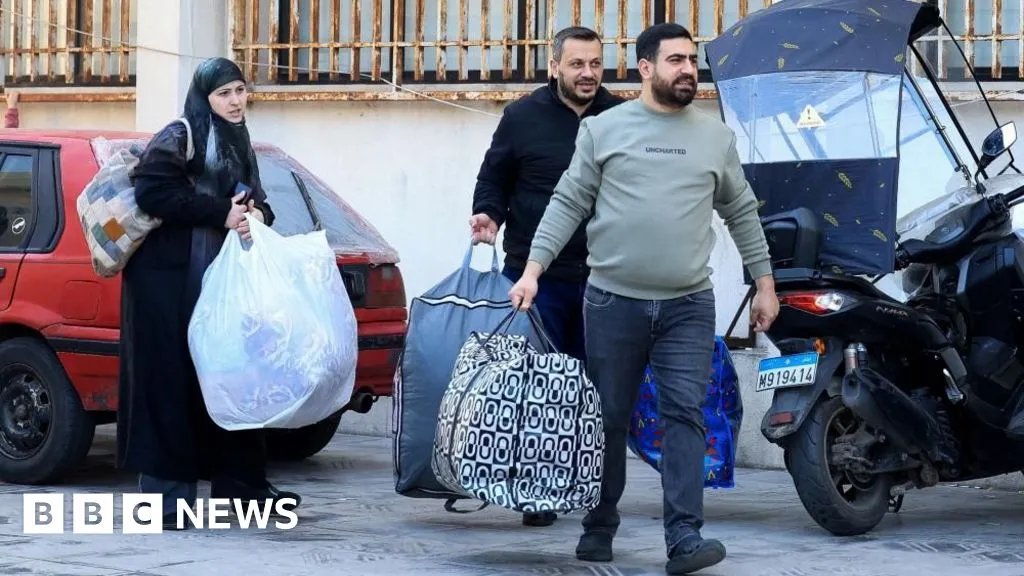
20 minutes agoAlice CuddyInternational reporter, BeirutReutersTens of thousands of civilians have been displaced by the sudden escalation in fightingThe Israeli military has told civilians living in a large swathe of southern Lebanon to leave their homes immediately and move north of the Litani River because of intended military action against Hezbollah.The sweeping orders came as hostilities between Israel and the Iran-backed group continued to escalate. Hours after issuing the instruction, the military said it had begun "a wave of strikes" in the south.Tens of thousands of people in Lebanon have already been displaced since fighting erupted on Monday.One man still living in southern Lebanon told the BBC that he would not leave his home."Let them say whatever they want - I'm not going to Beirut to be on the streets," Mohamed, 25, said."I'm not next to Hezbollah or any of its infrastructure, so I should be fine," he said, adding that he would rather die in his home than flee.Another man said he and his disabled wife had already moved this week and did not know whether they would be able to find shelter further north.In the capital, Beirut, displaced civilians have been sleeping in shelters, on roadsides, in parks and in their cars.Volunteers at food kitchens and shelters told the BBC they were concerned they would not be able to keep up with the rising demand.Those displaced have fled from southern Lebanon, the eastern Bekaa Valley, and the Dahieh suburbs of southern Beirut - the heartlands of Hezbollah and of Lebanon's Shia Muslim community.At one displacement camp on the outskirts of Beirut, hundreds of people got ready for Iftar - a meal eaten at sunset to break the Ramadan fast - on Tuesday evening.Some were still wearing the pyjamas they had on when they fled their homes.Everyone the BBC spoke to had been displaced multiple times before by hostilities between Israel and Hezbollah, a Shia militia and political party that is proscribed as a terrorist organisation in the US, UK and other countries."Last time [I was displaced], I stayed for 26 days in a tent," 56-year-old Lamyaa said. "We were humiliated. God knows how long [it will last this time]."The latest escalation comes after Hezbollah launched rockets and drones at Israel in response to US and Israeli strikes that killed Iran's Supreme Leader Ayatollah Ali Khamenei. The Israeli military responded with air strikes and sent troops into southern Lebanon.Hezbollah's rocket fire in the early hours of Monday morning was the first such action from the group since a November 2024 ceasefire that formally ended 13 months of war. Israel had continued to carry out near-daily strikes on Lebanon, which it said were aimed at Hezbollah targets.In Beirut, strikes this week have largely targeted the Dahieh area, but one early on Wednesday hit a hotel in an upscale suburb in the east of the city.Witnesses said one person had been taken to hospital with serious injuries.Locals said they were shocked, describing the district as safe, with the hotel located in a Christian-majority area less than a mile from the presidential palace.The Israeli military has not yet commented on the attack.Among those displaced from their homes, views are divided over the war."If they [Hezbollah] can't end Israel, I think they should stop - but hopefully we will defeat it," said Lamyaa at the displacement camp, as she criticised the Lebanese military for pulling back from positions on the border with Israel.Nearby, a mother and her two daughters discussed Hezbollah's actions and debated how weakened the group had been by the previous war with Israel."I'm not against what Hezbollah did because either way they [Israel] will hit us," said 33-year-old Batoul. "Our guys will protect us.""There are no more men - they all died," her mother, Zeinab, replied.At a shelter elsewhere in Beirut, mother-of-two Fatima, 32, said she was angry at Hezbollah for pulling Lebanon back into war."I wish Hezbollah had not done it. Now we are homeless and humiliated. Who is happy now? What did they get out of this except for us having to leave our homes?"Others focused only on wanting the war to end."I want to go home. I hope to go back to my village. I hope there will never be war again," said 20-year-old Amal.
SRCBBC News - World
LANGEN
LEANCenter
WORDS708
ENT9
WED · 2026-03-04 · 14:55 GMTBRIEF NSR-2026-0304-21353
NSR-2026-0304-21353News Report·EN·Conflict
Israel tells people in large parts of southern Lebanon to leave ahead of attacks
The Israeli military has ordered civilians in a large area of southern Lebanon to evacuate north of the Litani River due to planned military action against Hezbollah. This order comes amidst escalating hostilities between Israel and the Iran-backed group, with Israel initiating a wave of strikes in the south.
BBC News - WorldFiled 2026-03-04 · 14:55 GMTLean · CenterRead · 3 min
BBC News - WorldFIG 01
Reading time
3min
Word count
708words
Sources cited
4cited
Entities identified
9entities
Quality score
100%
§ 01
Briefing Summary
AI-generatedNEWSAR · AI
The Israeli military has ordered civilians in a large area of southern Lebanon to evacuate north of the Litani River due to planned military action against Hezbollah. This order comes amidst escalating hostilities between Israel and the Iran-backed group, with Israel initiating a wave of strikes in the south. Tens of thousands of Lebanese civilians have already been displaced since the recent surge in fighting. Displaced individuals are fleeing from southern Lebanon, the Bekaa Valley, and southern Beirut, seeking refuge in shelters, roadsides, and parks, with concerns rising about the capacity to meet the growing demand for aid. The escalation follows Hezbollah's rocket and drone attacks on Israel, which were a response to US and Israeli strikes.
Confidence 0.90Sources 4Claims 5Entities 9
§ 02
Article analysis
Model · rule-basedFraming
Conflict
Human Interest
Tone
Measured
AI-assessed
CalmNeutralAlarmist
Factuality
0.80 / 1.00
Factual
LowHigh
Sources cited
4
Well sourced
FewMany
§ 03
Key claims
5 extracted01
I'm not going to Beirut to be on the streets. I'm not next to Hezbollah or any of its infrastructure, so I should be fine.
quoteMohamed, 25
Confidence
1.00
02
Hezbollah's rocket fire was the first such action since a November 2024 ceasefire.
factualReuters
Confidence
1.00
03
Hezbollah launched rockets and drones at Israel in response to US and Israeli strikes.
factualReuters
Confidence
1.00
04
Tens of thousands of people in Lebanon have already been displaced since fighting erupted on Monday.
factualReuters
Confidence
1.00
05
Israeli military told civilians in southern Lebanon to leave their homes immediately and move north of the Litani River.
factualIsraeli military
Confidence
1.00
§ 04
Full report
3 min read · 708 words§ 05
Entities
9 identifiedKey playerOppositionContextPositiveNeutralNegative
Organizations1
§ 06
Keywords & salience
9 termsisraeli military action
0.90
southern lebanon
0.90
hezbollah
0.90
displacement
0.80
civilian evacuation
0.70
military strikes
0.70
escalation of fighting
0.60
beirut
0.50
litani river
0.40
§ 07
Topic connections
Interactive graph Network visualization showing 51 related topics
View Full Graph Person Organization Location Event|Click node to navigate|Edge numbers = shared articles