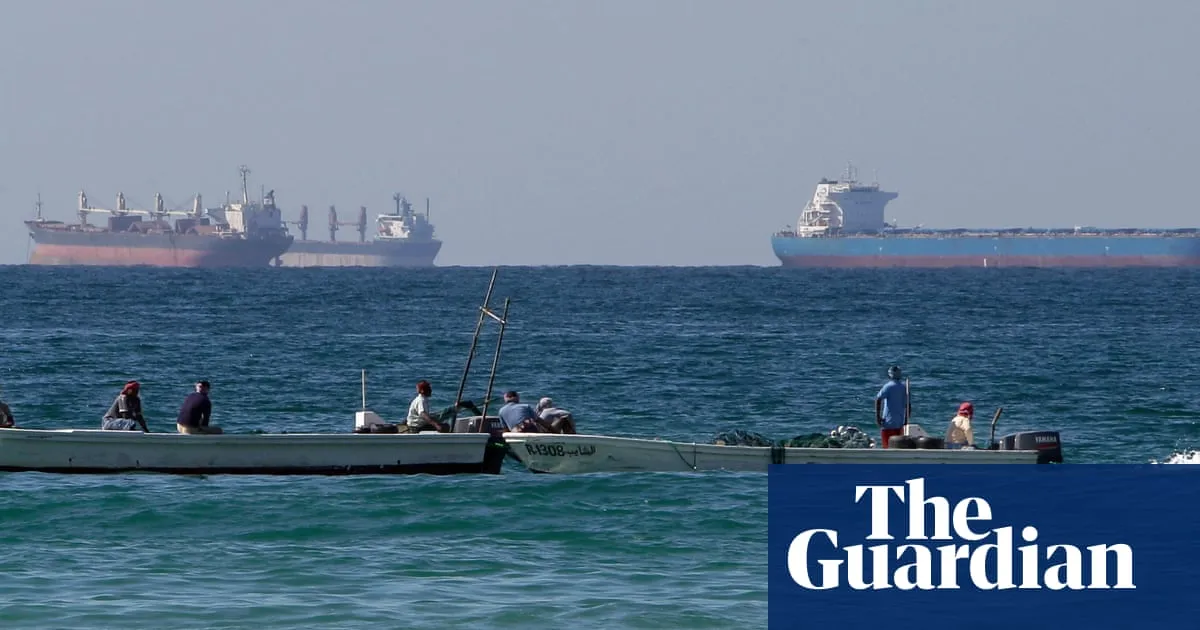
An eerie quiet hangs over Ras Al Khaimah’s industrial port. Usually a thriving maritime hub of the United Arab Emirates, now ships stand docked and silent. Not far out along the hazy horizon, a backlog of hundreds of tankers have lined up in recent days, halted along a waterway flooded with danger.Any vessel heading past Ras Al Khaimah out to the Arabian Sea must traverse the world’s most treacherous strip of water for shipping today: the Strait of Hormuz. Just over 20 nautical miles from Ras Al Khaimah, two oil tankers heading for the strait were attacked by Iranian missiles this week, one catching fire.On Saturday, Fujairah, the UAE’s main oil port on its east coast, was targeted by a drone attack, with thick black smoke seen billowing from its terminal.It is one of the many consequences facing Gulf states as they are pulled deeper into a war that they did not start and had diplomatically tried to prevent.For decades, Bahrain, Kuwait, Saudi Arabia, the UAE, Qatar and Oman have allowed US military bases, infrastructure or access on their soil, and have been among the largest buyers of American weapons and technology. In return, the US has stood as the Gulf’s closest and most significant military partner and protector.But now, Gulf states have growing concerns over the relationship, analysts say, after Donald Trump was seen to wilfully torpedo peaceful diplomatic negotiations in favour of starting a war in the Middle East.“The perceived Iran threat to the Gulf only became a reality when the US declared the war – Iran did not fire first,” says Khaled Almezaini, an associate professor of politics and international relations at Zayed University, in Abu Dhabi. “There is strong condemnation of the Iranians but at the same time there’s a message to the Americans and the Israelis that, well, we have to find a way to end this. This is not our war.”In the weeks before the strikes, Gulf leaders hosted negotiations and made repeated overtures to the US president, emphasising the severe consequences for regional security if he attacked Iran. Yet Trump chose to carry out the strikes, it is widely believed, without consulting or warning Gulf allies.While the Gulf expected to be caught in the backlash, the scale of Iran’s campaign of revenge has left many shocked. Gulf states had assured Tehran that none of their bases would be used for attacks but that has not stopped Iran launching thousands of drones and missiles targeting airports, military bases, oil refineries, ports, hotels and office buildings.Grounded aircraft at Dubai international airport early in the conflict. Aviation in the region remains highly restricted, with airlines losing billions. Photograph: Giuseppe Cacace/AFP/Getty ImagesAviation in the region remains highly restricted, with airlines losing billions of dollars. Bahrain is facing an economic crisis, while the UAE’s reputation as a haven for tourism and western investment has taken a significant hit. States are successfully rebuffing most Iranian missiles and drones, but the interceptors and air defence systems are costing countries like the UAE upwards of $2bn (£1.5bn).Iran’s violent blockade of the Strait of Hormuz – the only sea passage linking the Gulf with the open ocean and through which a fifth of global energy supplies are carried – has led to a drastic reduction in the oil and gas exports that bankroll Gulf economies. Experts estimate that between $700m and $1.2bn is being lost every day in oil exports.“The UAE and GCC [Gulf Cooperation Council] tried to stop the United States declaring this war because they knew the implications,” says Almezaini. He pointed to the threats made by Iran’s foreign minister only months earlier about the closure of the strait. “Now that exact scenario is playing out,” he adds.The asymmetry of the Gulf’s military partnership with the US has never been more stark, says Allison Minor, the director of the Atlantic Council’s project on Middle East integration. It was only in September that Israel carried out airstrikes on Qatar, another US Gulf ally, which did not prompt any substantive action from Washington.“The most fundamental question is one of consultation,” she says. “Are the Gulf states actually achieving the kind of partnership and security support that they feel is necessary if the United States is going to engage militarily in the region?”On Thursday, the Omani foreign minister, Badr bin Hamad al Busaidi, who was the mediator in the previous Iran-US talks, gave some of his strongest comments on the conflict yet.“Oman’s view [is] that the military attacks against Iran by the United States and Israel are illegal, and that for as long as they continue to pursue hostilities, those states that launched this war are in breach of international law,” he said.Smoke rises from a high-rise building after a drone attack in Kuwait City on 8 March. Iran has responded to US and Israeli bombing by hitting targets in the Gulf. Photograph: AFP/Getty ImagesAl Busaidi said the US decision to strike Iran while peaceful negotiations over Iran’s nuclear programme were making progress demonstrated the conflict was solely an attempt to reorder the Middle East in Israel’s favour.Analysts emphasise that many Gulf states find themselves in a conflicting position: trying to bring down the temperature of the war while pushing for the US to finish the job in Iran and ensure they are not left with a worst-case scenario – a weakened, wounded and volatile Islamic republic on their doorstep.“This is the Gulf’s worst nightmare,” says Sanam Vakil, the director of the Middle East and north Africa programme at Chatham House. “There’s deep anger and frustration at the United States because this is not their [the Gulf states’] war, and yet they’re bearing the brunt.” Vakil says Gulf states had long pursued a security partnership with the US similar to the one enjoyed by Israel, but had now realised “that may never happen”.Yet for all the recognition of the need to diversify their security partners, she adds, the Gulf currently has no alternative as its ultimate protector.“The Gulf is not going to move quickly, nor can they, in finding alternatives to the US. But they’re also not going to just double down with an unreliable partner,” she says. “It will likely move forward in the pursuit of strategic autonomy, which has already been on the horizon, perhaps at a more rapid pace.”For all the geopolitical ramifications, the economic effects have also trickled down to ordinary life. Standing at the boat and jetski rental firm he worked for in the marina next to Ras Al Khaimah port, Sumon, 27, says business has been throttled because none of their boats are allowed out to sea by the coastguard.“For many days, our boats and jetskis aren’t allowed to go out because of all these problems and fighting with Iran in the sea,” he says. “It’s very bad news, we don’t have customers and my boss can’t give me a salary.” Sumon points to the port opposite: “No boats are moving any more. No one knows when it will end.”
SRCThe Guardian - World News
LANGEN
LEANCenter-Left
WORDS1 163
ENT12
SAT · 2026-03-14 · 14:27 GMTBRIEF NSR-2026-0314-24487
NSR-2026-0314-24487News Report·EN·Conflict
‘Worst nightmare’: anger and frustration as Gulf states bear brunt of war they did not start
Recent attacks on oil tankers and ports in the UAE, specifically near Ras Al Khaimah and Fujairah, highlight the growing vulnerability of Gulf states amid escalating tensions between the U.S. and Iran.
Hannah Ellis-Petersen in Ras Al KhaimahThe Guardian - World NewsFiled 2026-03-14 · 14:27 GMTLean · Center-LeftRead · 5 min
The Guardian - World NewsFIG 01
Reading time
5min
Word count
1 163words
Sources cited
1cited
Entities identified
12entities
Quality score
100%
§ 01
Briefing Summary
AI-generatedNEWSAR · AI
Recent attacks on oil tankers and ports in the UAE, specifically near Ras Al Khaimah and Fujairah, highlight the growing vulnerability of Gulf states amid escalating tensions between the U.S. and Iran. These incidents, occurring this week and on Saturday, have disrupted maritime activity and raised concerns about regional security. Despite Gulf states' long-standing military partnerships with the U.S. and attempts to diplomatically prevent conflict, they are now bearing the brunt of a war they did not initiate. Gulf leaders, who hosted negotiations and warned the U.S. president of the consequences of attacking Iran, feel they were not consulted before the strikes. The scale of Iran's response has shocked the Gulf states, who fear further attacks on their infrastructure despite assurances to Tehran that their bases would not be used for attacks.
Confidence 0.90Sources 1Claims 5Entities 12
§ 02
Article analysis
Model · rule-basedFraming
Conflict
Economic Impact
Tone
Mixed Tone
AI-assessed
CalmNeutralAlarmist
Factuality
0.70 / 1.00
Factual
LowHigh
Sources cited
1
Limited
FewMany
§ 03
Key claims
5 extracted01
Fujairah, the UAE’s main oil port on its east coast, was targeted by a drone attack.
factualnull
Confidence
1.00
02
Two oil tankers heading for the strait were attacked by Iranian missiles this week, one catching fire.
factualnull
Confidence
1.00
03
Aviation in the region remains highly restricted, with airlines losing billions.
factualnull
Confidence
0.90
04
The perceived Iran threat to the Gulf only became a reality when the US declared the war.
quoteKhaled Almezaini
Confidence
0.90
05
Gulf states have growing concerns over the relationship [with the US].
factualanalysts
Confidence
0.80
§ 04
Full report
5 min read · 1 163 words§ 05
Entities
12 identifiedKey playerOppositionContextPositiveNeutralNegative
Locations11
I
Iran
CountryOpposition
5x
90
SO
Strait of Hormuz
StrategicContext
2x
85
US
United States
CountryKey Player
5x
80
UA
United Arab Emirates
CountryContext
3x
80
RA
Ras Al Khaimah
locationContext
3x
70
F
Fujairah
CityContext
60
B
Bahrain
CountryContext
50
SA
Saudi Arabia
CountryContext
50
Q
Qatar
CountryContext
50
O
Oman
CountryContext
50
K
Kuwait
CountryContext
50
§ 06
Keywords & salience
9 termsgulf states
1.00
iran
0.90
united states
0.80
strait of hormuz
0.70
oil tankers
0.60
military bases
0.60
regional security
0.50
drone attack
0.50
diplomatic negotiations
0.40
§ 07
Topic connections
Interactive graph Network visualization showing 51 related topics
View Full Graph Person Organization Location Event|Click node to navigate|Edge numbers = shared articles