The US raises concerns, however analysts say Pakistan’s missile programme is focused on India, which has longer-range missiles.Nuclear-capable missile Ghauri is driven past with its launcher during a Pakistan National Day parade in Islamabad, on March 23, 2007 [File photo: Mian Khursheed/Reuters]Published On 19 Mar 2026Islamabad, Pakistan – The United States’s top intelligence official has placed Pakistan alongside Russia, China, North Korea and Iran as a country whose advancing missile capabilities could eventually put US territory within reach.Presenting the 2026 Annual Threat Assessment [PDF] before the Senate Intelligence Committee on Wednesday, Director of National Intelligence Tulsi Gabbard said the five countries were “researching and developing an array of novel, advanced or traditional missile delivery systems with nuclear and conventional payloads, that put our homeland within range”.Recommended Stories list of 4 itemslist 1 of 4Will US sanctions make any difference to Pakistan’s missiles programme?list 2 of 4How Pakistan’s Asim Munir became Trump’s ‘favourite field marshal’list 3 of 4What are India and Pakistan’s military and nuclear capabilities?list 4 of 4Pakistan slams US sanctions on ballistic missile programmeend of listOn Pakistan specifically, Gabbard told lawmakers that “Pakistan’s long-range ballistic missile development potentially could include ICBMs with the range capable of striking the homeland”.The written assessment went further, placing Pakistan across multiple threat categories.On missiles, it said Pakistan “continues to develop increasingly sophisticated missile technology that provides its military the means to develop missile systems with the capability to strike targets beyond South Asia, and if these trends continue, Inter-Continental Ballistic Missiles (ICBMs) that would threaten the US”.On weapons of mass destruction, it assessed that Pakistan, alongside China, North Korea and Russia, would “probably continue to research, develop, and field delivery systems that will increase their ranges and accuracy, challenge US missile defences, and provide new WMD-use options”.The report also flagged South Asia as a region of “enduring security challenges”, warning that India-Pakistan relations “remain a risk for nuclear conflict”.It referenced last year’s Pahalgam attack in Indian-administered Kashmir as an example of how violence by armed groups can trigger crises, while noting that “President Trump’s intervention de-escalated the most recent nuclear tensions” and that “neither country seeks to return to open conflict”.The assessment projected that threats to the US homeland could expand from more than 3,000 missiles today to at least 16,000 by 2035.Pakistan’s Ministry of Foreign Affairs has not issued a formal response to Wednesday’s testimony so far, and Al Jazeera’s queries have gone unanswered.Tughral Yamin, a former army brigadier and specialist on arms control and nuclear affairs, said Gabbard was not the first US official to raise such concerns.“Similar remarks have been made in the past. Officially, Pakistan has countered such rhetoric by pointing out that Pakistani deterrence — both conventional and nuclear — is meant against India. Even with India, Pakistan seeks peace at honourable terms and not because US chose to identify Pakistan is a threat,” he told Al Jazeera.Is Pakistan close to building missiles that can reach the US?Gabbard’s remarks were framed around the future potential of Pakistan’s missile programme, rather than existing capability. But even from that futuristic prism, experts question the logic of the US intelligence assessment.Pakistan’s longest-range operational missile, the Shaheen-III, has an estimated range of roughly 2,750km (1,710 miles), sufficient to cover all of India.An intercontinental ballistic missile is generally defined as having a range exceeding 5,500km (3,420 miles), which Pakistan does not currently possess.But even with shorter range ICBMs, Pakistan would not be in a position even close to reaching US shores: The distance between the two countries exceeds 7,000 miles (11,200km). Only Russia, the US, France, China and the United Kingdom have ICBMs that can travel that distance, while India and North Korea are developing missiles of that range. Israel is speculated to possess an ICBM — the Jericho III — that can travel a comparable distance.In January last year, senior US officials, speaking anonymously at a briefing for nongovernmental experts cited by the Arms Control Association, assessed that Pakistan’s ability to field long-range ballistic missiles was “several years to a decade away”. Gabbard’s latest testimony suggests that assessment has not significantly changed.Washington has nonetheless been closely monitoring Pakistan’s missile programme.In December 2024, the Joe Biden administration sanctioned Pakistan’s National Development Complex, the body responsible for its ballistic missile programme, along with three private companies.The US accused them of procuring items for long-range missile development, including specialised vehicle chassis and missile testing equipment.Jon Finer, then US deputy national security adviser, said at the time that if current trends continued, Pakistan would have “the capability to strike targets well beyond South Asia, including in the United States”.Pakistan pushes backWhile Pakistan has not issued a formal statement on the latest assessment, it has previously described US sanctions as “biased and politically motivated”, accusing Washington of relying on “mere suspicion” and invoking “broad, catch-all provisions” without sufficient evidence.Jalil Abbas Jilani, a former Pakistani ambassador to Washington, rejected Gabbard’s new remarks in a post on X.“Tulsi Gabbard’s assertion at the Senate hearing that the US homeland is within range of Pakistan’s nuclear and conventional missiles is not grounded in strategic reality,” he wrote. “Pakistan’s nuclear doctrine is India-specific, aimed at maintaining credible deterrence in South Asia, not projecting power globally.”Abdul Basit, a former Pakistani high commissioner to India, also criticised the comparison.“Pakistan’s nuclear programme has always been India-specific. Such self-serving and groundless assertions only betray Gabbard’s incorrigible biases,” he wrote on social media.Pakistan has long maintained that its nuclear and strategic programmes are calibrated solely to deter India. Three months after its May 2025 conflict with India, Pakistan announced the formation of its Army Rocket Force Command (ARFC).It has also accused Washington of double standards, pointing to deepening US strategic cooperation with New Delhi, including advanced defence technology transfers, while penalising Islamabad for pursuing what it sees as necessary deterrence.Yamin said Gabbard “quite conveniently” overlooked India’s longer-range missile capabilities.He pointed to systems such as the Agni-V, with a range of more than 5,000km (3,100 miles), and the Agni-IV, which can travel about 4,000km (2,485 miles). India’s Defence Research and Development Organisation — its government military R&D institution — is currently developing the Agni VI missile, an ICBM that could have a range of up to 12,000km (7,450 miles).Debate over intentNevertheless, in a June 2025 article in Foreign Affairs magazine, Vipin Narang, a former US Department of Defense official, and Pranay Vaddi, a former US National Security Council official, wrote that US intelligence agencies believed Pakistan was developing a missile “that could reach the continental United States”.They suggested Islamabad’s motivation might not be India, which its current arsenal already covers, but rather to deter Washington from intervening in a future India-Pakistan conflict or from launching a preventive strike against Pakistan’s nuclear arsenal.Pakistani analysts have challenged that premise.Rabia Akhtar, a nuclear security scholar, said Gabbard’s statement reflected “a persistent flaw in US threat assessments, which is substituting worst-case speculation for grounded analysis”.“Pakistan’s deterrence posture is India-centric. Folding it into a US homeland threat narrative is misleading. The claim that Pakistan is pursuing capabilities to target the US ignores decades of evidence. Its nuclear programme, doctrine, and missile development have remained India-centric. Even its longest-range systems are calibrated to deny India strategic depth, not project power beyond the region,” she told Al Jazeera.Still, Christopher Clary, a political scientist at the University at Albany, said Gabbard’s assessment clarifies an open question about the Trump administration’s stance.“It was unclear up until now whether the Trump administration’s [decision to stay] quiet on alleged Pakistan ICBM development arose because the issue had gone away, perhaps because Pakistan quietly had settled US concerns,” he wrote on X. “But the US intelligence community assesses apparently that the issue persists.”Akhtar, who is also the director at Centre for Security, Strategy and Policy Research, University of Lahore, reiterated that there is no evidence that Pakistan is designing missiles to reach beyond targets associated with India’s present or future capabilities.“A more serious conversation would move beyond worst-case speculation and engage with the regional logic that actually drives nuclear decision-making in South Asia,” she said.Gabbard’s assessment comes at a complex moment in US-Pakistan relations.Over 2025, the two countries underwent a diplomatic reset, driven in part by the four-day conflict between India and Pakistan in May.Trump has repeatedly cited his administration’s role in brokering the ceasefire between the nuclear-armed neighbours that brought the fighting to a halt, claiming credit on dozens of occasions. The episode helped open the door to a broader recalibration in ties, including Pakistan’s nomination of Trump for the Nobel Peace Prize. India has maintained that the ceasefire occurred without third-party involvement.Relations appeared to warm further when Trump hosted Pakistan’s army chief, Field Marshal Asim Munir, for a private White House lunch in June. It marked the first time a US president had hosted a Pakistani military chief who was not also the head of state.Munir visited Washington twice more later in the year, including a September meeting that also involved Prime Minister Shehbaz Sharif.At the Sharm el-Sheikh summit in October aimed at ending Israel’s genocidal war in Gaza, Trump described Munir as “my favourite field marshal” and has praised him repeatedly.Pakistan’s strategic relevance has also extended to the Middle East. Its ties with Gulf states and working relationship with Tehran have made it a useful interlocutor, including during the continuing US-Israeli strikes on Iran. In September, Pakistan and Saudi Arabia signed a mutual defence agreement, days after Israel struck Doha, Qatar’s capital, with a missile, raising concerns across the Gulf over whether regional nations could continue to depend on a US security umbrella.
SRCAl Jazeera
LANGEN
LEANCenter
WORDS1 586
ENT11
THU · 2026-03-19 · 10:29 GMTBRIEF NSR-2026-0319-25991
NSR-2026-0319-25991News Report·EN·National Security
Gabbard says Pakistan missiles a future threat to US, but experts push back
In March 2026, US Director of National Intelligence Tulsi Gabbard presented the Annual Threat Assessment to the Senate Intelligence Committee, identifying Pakistan, along with Russia, China, North Korea, and Iran, as countries developing missile technology that could eventually reach the US. The assessment highlighted Pakistan's development of sophisticated missile technology capable of striking targets beyond South Asia, potentially including ICBMs that could threaten the US.
Abid HussainAl JazeeraFiled 2026-03-19 · 10:29 GMTLean · CenterRead · 7 min
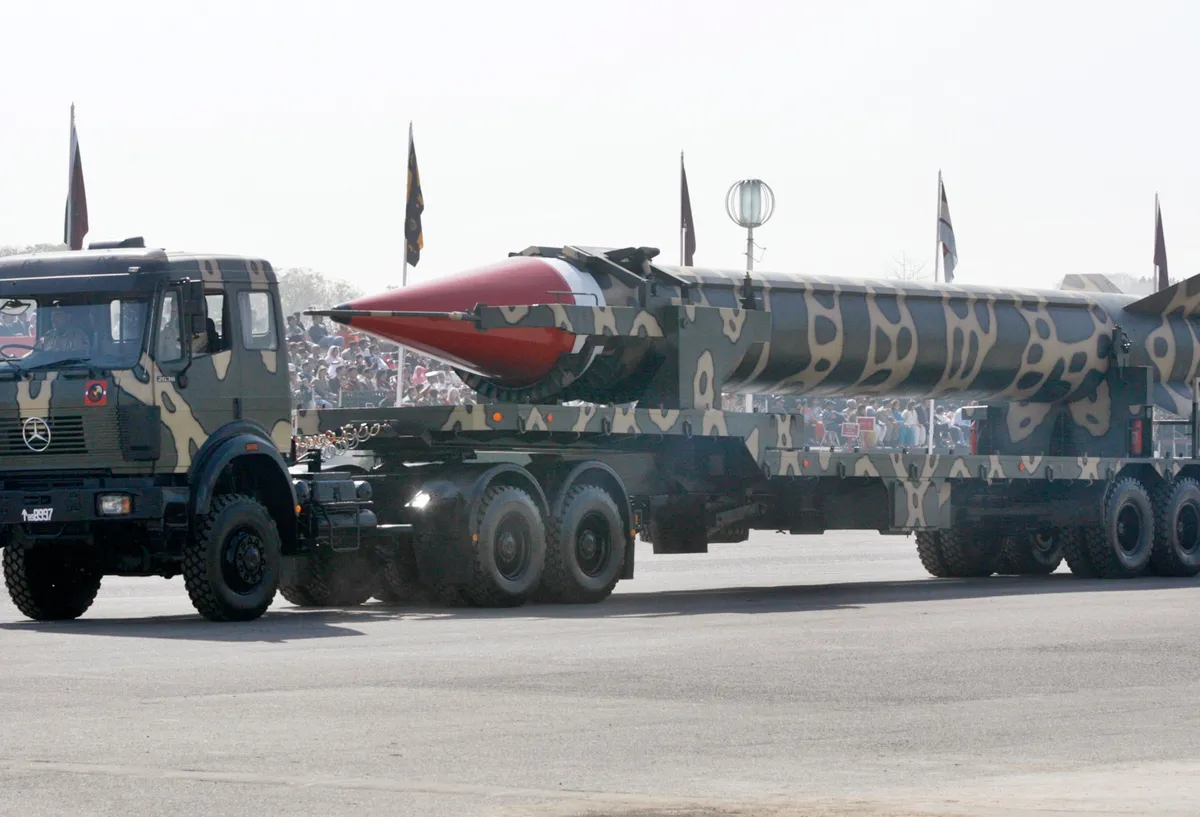
Al JazeeraFIG 01
Reading time
7min
Word count
1 586words
Sources cited
2cited
Entities identified
11entities
Quality score
100%
§ 01
Briefing Summary
AI-generatedNEWSAR · AI
In March 2026, US Director of National Intelligence Tulsi Gabbard presented the Annual Threat Assessment to the Senate Intelligence Committee, identifying Pakistan, along with Russia, China, North Korea, and Iran, as countries developing missile technology that could eventually reach the US. The assessment highlighted Pakistan's development of sophisticated missile technology capable of striking targets beyond South Asia, potentially including ICBMs that could threaten the US. The report also noted Pakistan's ongoing research and development of delivery systems for weapons of mass destruction. While the US raises concerns, analysts suggest Pakistan's missile program is primarily focused on India, which possesses longer-range missiles. The report also flagged the enduring security challenges in South Asia, emphasizing the risk of nuclear conflict between India and Pakistan.
Confidence 0.90Sources 2Claims 5Entities 11
§ 02
Article analysis
Model · rule-basedFraming
National Security
Political Strategy
Tone
Measured
AI-assessed
CalmNeutralAlarmist
Factuality
0.70 / 1.00
Factual
LowHigh
Sources cited
2
Limited
FewMany
§ 03
Key claims
5 extracted01
Pakistan continues to develop increasingly sophisticated missile technology that provides its military the means to strike targets beyond South Asia.
factual2026 Annual Threat Assessment
Confidence
0.90
02
President Trump’s intervention de-escalated the most recent nuclear tensions between India and Pakistan.
factual2026 Annual Threat Assessment
Confidence
0.80
03
Pakistan's long-range ballistic missile development potentially could include ICBMs with the range capable of striking the homeland.
predictionDirector of National Intelligence Tulsi Gabbard
Confidence
0.80
04
India-Pakistan relations remain a risk for nuclear conflict.
factual2026 Annual Threat Assessment
Confidence
0.70
05
Threats to the US homeland could expand from more than 3,000 missiles today to at least 16,000 by 2035.
prediction2026 Annual Threat Assessment
Confidence
0.60
§ 04
Full report
7 min read · 1 586 words§ 05
Entities
11 identifiedKey playerOppositionContextPositiveNeutralNegative
§ 06
Keywords & salience
8 termspakistan missile program
0.90
us threat assessment
0.80
icbm
0.70
nuclear capabilities
0.60
india-pakistan relations
0.60
ballistic missile
0.50
weapons of mass destruction
0.50
south asia
0.40
§ 07
Topic connections
Interactive graph Network visualization showing 51 related topics
View Full Graph Person Organization Location Event|Click node to navigate|Edge numbers = shared articles