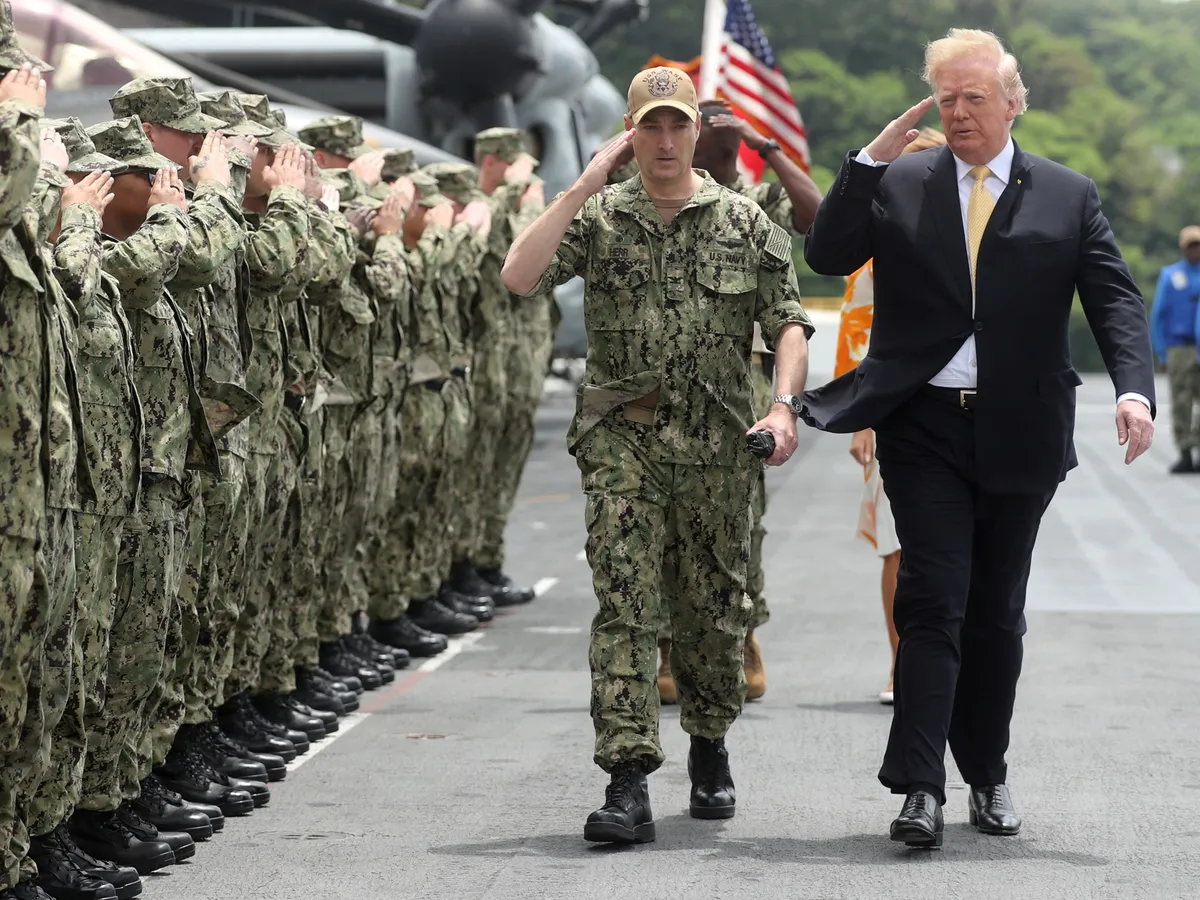
EXPLAINERSeizing strategic islands and destroying Iran’s stock of enriched uranium are options the US is considering.US President Donald Trump salutes soldiers on board the USS Wasp assault ship in Yokosuka, south of Tokyo, Japan, during his first term [File: Jonathan Ernst/Reuters]Published On 30 Mar 2026Expectations of a potential US ground invasion in Iran are mounting as the war enters its second month.Additional US troops have been deployed to the Middle East in recent days as the US Department of Defense prepares for limited ground operations in Iran, according to reports in US media.Recommended Stories list of 3 itemslist 1 of 3Trump wants to invade Iran to seize oil, calls US objectors ‘stupid people’list 2 of 3Smoke rise from Beirut suburbs following Israeli attacklist 3 of 3Iraq risks Arab ties as Iran-aligned groups strike Gulf nationsend of listTwo unnamed US officials told The Washington Post on Saturday that the Defense Department is gearing up for raids on Kharg Island, where 90 percent of Iran’s crude oil exports are processed, and coastal sites close to the Strait of Hormuz. The strait, through which 20 percent of the world’s oil and liquefied natural gas (LNG) supplies are transported in peacetime, was in effect closed by Iran after the first US-Israeli strikes on Tehran a month ago. Since then, only a few mostly Chinese-, Indian- and Pakistani-flagged ships have been granted safe passage.This has crippled global energy markets and sent the price of Brent crude, the global benchmark, soaring from about $65 per barrel pre-war to close to $116 on Monday.(Al Jazeera)The US military plans, which appear to fall short of a full invasion, could involve raids by special operations and conventional infantry troops, the Post reported.On Sunday in an interview with the Financial Times, US President Donald Trump said he wants to “take the oil in Iran” and could seize Kharg Island.Iran’s parliament speaker, Mohammad Bagher Ghalibaf, said US troops would face resistance if they attempted an invasion.“Our men are waiting for the arrival of the American soldiers on the ground to set them on fire and punish their regional allies once and for all,” he said in a statement on Sunday carried by the official IRNA news agency.Is the US ready to invade Iran and what do Trump’s moves so far tell us?Here’s what we know:What forces has the US deployed so far?As of mid-2025, long before the war on Iran began, there were 40,000 to 50,000 US soldiers stationed around the Middle East, comprising personnel stationed in both large, permanent bases and smaller forward sites across the region.Trump has been beefing up the US military presence in the Middle East since the start of this year, initially sending warships, including the Abraham Lincoln aircraft carrier to the Arabian Sea.According to open-source intelligence analysts and military flight-tracking data, the US has deployed more than 120 aircraft to the region since early February. It is the biggest surge in US airpower in the Middle East since the 2003 Iraq War.Reported deployments include E-3 Sentry Airborne Warning and Control System (AWACS) aircraft, F-35 stealth strike fighters and F-22 air superiority jets alongside F-15 and F-16 fighter aircraft. Flight-tracking data showed many of these planes departing bases in the US and Europe, supported by cargo aircraft and aerial refuelling tankers, a sign of sustained operational planning rather than routine rotations, military analysts said.On Tuesday, the Pentagon ordered additional US forces to the Gulf.The reinforcements heading to the Gulf consisted of three distinct formations, each with a different origin, route and timeline.The first is the Tripoli Amphibious Ready Group, centred around the America-class assault ship USS Tripoli and the 31st Marine Expeditionary Unit (MEU).The second is the Boxer Amphibious Ready Group, built around the Wasp-class assault ship USS Boxer and the 11th MEU, based in Southern California in the US.Together, these two Marine groups will add 4,500 Marines and sailors in the region.The third is a contingent of about 2,000 soldiers from the 82nd Airborne Division’s Immediate Response Force, based at Fort Bragg, North Carolina. The airborne infantry division is focused on parachute assaults.In total, nearly 7,000 additional soldiers have been deployed since the war on Iran began.Is this deployment enough for a full-fledged invasion?While a ground invasion of Iran has not been announced by the US, US media reported on Friday that the Pentagon is considering sending a further 10,000 ground soldiers besides the troops already deployed.This would mean the US would have about 17,000 soldiers on the ground in Iran. It is unclear whether any foreign troops would also join the US.This number is far less than the number deployed in March 2003 when the US invaded Iraq.The US-led invasion of Iraq began on March 20, 2003, with a force of 150,000 US soldiers and 23,000 from other countries involved in the initial campaign. In 2011, six months before the final withdrawal of US troops from Iraq, about 45,000 American soldiers remained in the country to train and advise Iraqi forces. As of mid-2025, about 2,500 US soldiers were still stationed in Iraq, but since then, they have mostly been redeployed to other countries, such as Syria.This suggests the US is not preparing for a ground invasion of Iran at present, analysts said.John Phillips, a British safety, security and risk adviser and former military instructor, told Al Jazeera that US deployments right now “point to limited, high-intensity operations like seizing Kharg Island or smaller islands in the Strait of Hormuz to stabilise the waterway and reopen shipping lanes, followed by quick extraction”.“These would start with carrier-based strikes on Iranian air defences, missiles and mines, which could enable helicopter and landing craft assaults by US Marines to neutralise threats, secure airfields or destroy stockpiles while airborne troops drop to hold key terrain or support partners,” he said.He added that primary operations could include the seizure of islands such as Kharg, where US Marines would face defences like landmines while landing and could be ordered to destroy military sites and oil infrastructure.“This could result in high casualties and could be economically crippling for Tehran,” he said.Other operations could include heliborne raids, in which members of the 82nd Airborne approach by parachuting or jumping from helicopters to target missile batteries, fast boats or command nodes along the Hormuz coast.Ian Lesser, distinguished fellow at the German Marshall Fund of the United States, told Al Jazeera that the US forces currently deployed are a “threat in being”, which is more useful as a deterrent and bargaining chip – at least for the moment.He added that an invasion like the one carried out in Iraq is out of the question because that would require much larger forces, differently configured.“Configured for large-scale conventional operations, even an occupation. Politically and operationally, it is virtually out of the question,” he said.What kind of ground operations could take place?Several options, including seizing strategic islands in the Gulf and the Strait of Hormuz or removing Iran’s stockpile of uranium, are being discussed.Christopher Featherstone, associate lecturer at the Department of Politics and International Relations at the University of York, told Al Jazeera that any military operation would be focused and limited rather than a full-scale invasion.“I’d argue that this could be an operation to seize a strategic asset, such as Kharg Island. These resources that have been moved to the region [Marines and the Army’s 82nd Airborne] are very effective but would not be enough to occupy a large area too easily,” he said.
SRCAl Jazeera
LANGEN
LEANCenter
WORDS1 238
ENT10
MON · 2026-03-30 · 15:46 GMTBRIEF NSR-2026-0330-43833
NSR-2026-0330-43833News Report·EN·Conflict
Is the US ready to invade Iran? What Trump’s moves tell us so far
Amidst a month-old war in 2026, the US Department of Defense is reportedly preparing for limited ground operations in Iran, potentially involving raids on Kharg Island and coastal sites near the Strait of Hormuz. These plans, revealed by unnamed US officials, aim to disrupt Iran's oil exports and cripple global energy markets, which have already seen Brent crude prices surge.
Priyanka ShankarAl JazeeraFiled 2026-03-30 · 15:46 GMTLean · CenterRead · 5 min
Al JazeeraFIG 01
Reading time
5min
Word count
1 238words
Sources cited
4cited
Entities identified
10entities
Quality score
100%
§ 01
Briefing Summary
AI-generatedNEWSAR · AI
Amidst a month-old war in 2026, the US Department of Defense is reportedly preparing for limited ground operations in Iran, potentially involving raids on Kharg Island and coastal sites near the Strait of Hormuz. These plans, revealed by unnamed US officials, aim to disrupt Iran's oil exports and cripple global energy markets, which have already seen Brent crude prices surge. President Trump has expressed interest in seizing Iranian oil and Kharg Island. In response, Iran's parliament speaker warned of fierce resistance against any US invasion. The US already had 40,000 to 50,000 soldiers stationed in the Middle East before the war began.
Confidence 0.90Sources 4Claims 5Entities 10
§ 02
Article analysis
Model · rule-basedFraming
Conflict
National Security
Tone
Mixed Tone
AI-assessed
CalmNeutralAlarmist
Factuality
0.70 / 1.00
Factual
LowHigh
Sources cited
4
Well sourced
FewMany
§ 03
Key claims
5 extracted01
Trump said he wants to “take the oil in Iran” and could seize Kharg Island.
quoteDonald Trump
Confidence
1.00
02
The strait was in effect closed by Iran after the first US-Israeli strikes on Tehran a month ago.
factual
Confidence
0.90
03
Expectations of a potential US ground invasion in Iran are mounting as the war enters its second month.
factual
Confidence
0.80
04
The US Department of Defense prepares for limited ground operations in Iran, according to reports in US media.
factual
Confidence
0.70
05
Two unnamed US officials told The Washington Post that the Defense Department is gearing up for raids on Kharg Island.
factualTwo unnamed US officials
Confidence
0.60
§ 04
Full report
5 min read · 1 238 words§ 05
Entities
10 identifiedKey playerOppositionContextPositiveNeutralNegative
Organizations1
§ 06
Keywords & salience
9 termsus iran conflict
1.00
military invasion
0.90
oil seizure
0.80
kharg island
0.70
strait of hormuz
0.70
energy markets
0.60
us military deployment
0.60
ground operations
0.50
donald trump
0.50
§ 07
Topic connections
Interactive graph Network visualization showing 51 related topics
View Full Graph Person Organization Location Event|Click node to navigate|Edge numbers = shared articles