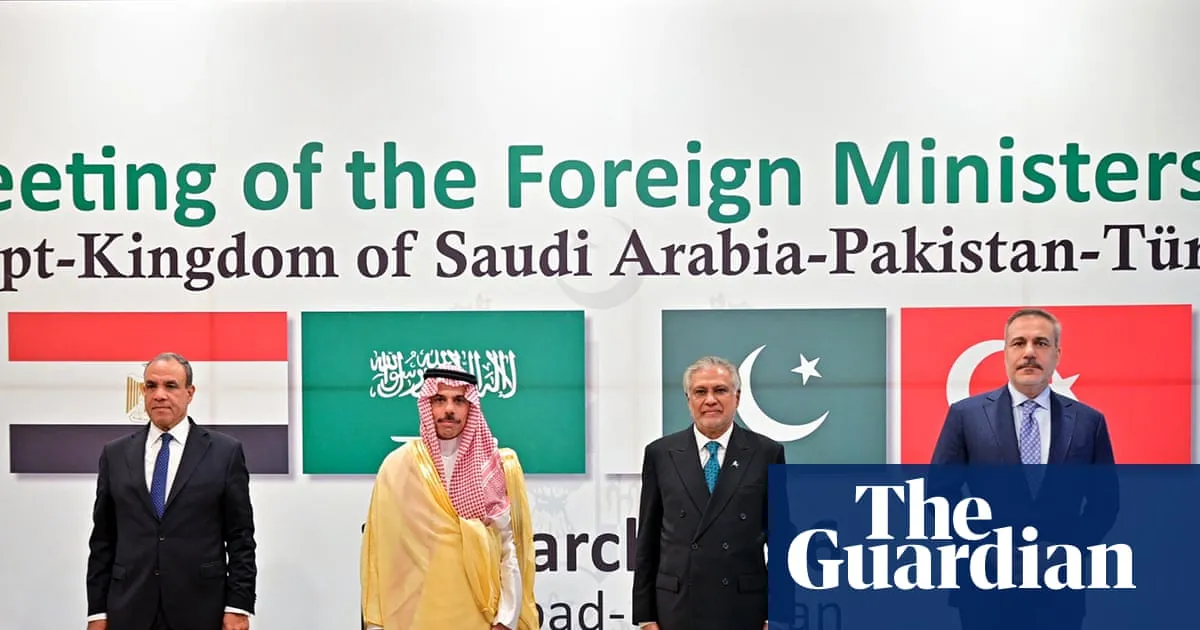
The meeting on Sunday of the foreign ministers of Egypt, Pakistan, Saudi Arabia and Turkey in Islamabad not only represented the best hope for a ceasefire in Iran but was also the embryo for a new order designed to curb Israeli and Iranian dominance after the war.Although the four nations have met as a quartet before, the one-day meeting of foreign ministers in Islamabad on Sunday was, in a way, the official opening ceremony of an initiative that is intriguing diplomats.The group’s first goal, in an increasingly complex web of disputes, is to persuade all sides to stop the escalation and agree a ceasefire. As such, the group will be meeting much more frequently, according to Yasmine Farouk, a Gulf specialist at the International Crisis Group.“This group of four started becoming very active because this is really a dangerous stage of the war,” Farouk said. “We’ve already seen Israel damage nuclear plants inside Iran and the potential deployment of troops. This is the nightmare … that could make some of the Gulf countries who so far say they don’t want the war to stop to realise that this is getting out of hand.“Because if you target desalination waters and the power plants, if you have a nuclear leak in the waters of the Gulf, this is when it becomes a nationwide crisis inside those countries.”The meeting in Islamabad on Sunday made some progress, ending with an Iranian agreement to allow vessels operating under the Pakistani flag to go through the strait of Hormuz, possibly two a day. It is a modest confidence-building measure.It was also established that the group would act as a primary interlocutor with Iran, so keeping indirect negotiating channels open between Tehran and the US. Iran insists this is the only reliable channel and that Donald Trump’s talk of direct talks with Iran is a fiction designed to lower the oil price.Immediately after Sunday’s meeting, Ishaq Dar, Pakistan’s foreign minister, flew to China to brief Beijing on the crisis. A role for China as a guarantor of any agreement, something the US would deplore, has been mooted from inside Iran.At first glance, the quartet’s membership may seem surprising. For instance, Saudi Arabia – repeatedly reported to be, like the United Arab Emirates, privately urging the US to finish off Iran – is an active member. That suggests the Saudis are, at the very least, keeping their options open.Farouk said: “All the options for the Gulf states are costly. They want to see Iran pay a cost for the attacks on them, and also for taking the strait of Hormuz hostage. On the other hand, they cannot know whether the US will ‘finish the job’ without creating chaos and then leaving, something that Saudi Arabia does not want to see.”Qatar, a more natural ally of Turkey, was not present in Islamabad. One explanation is that Qatar is still seething at what it regards as Iran’s betrayal by hitting the Ras Laffan liquid gas facility, even though it had already been shut down. One commentator explained: “Doha, unlike the UAE, is advocating an end to the war, but is not in the mood to be an active mediator on behalf of Iran.”Probably the most committed member of the group, and the one that has invested most in its success, is Turkey. Ankara has long been arguing that talks about Iran’s ballistic missile programme and its support for proxy groups should be conducted with countries in the whole region, not just bilaterally with the US. The issue of Iran’s nuclear programme and the lifting of US sanctions would be negotiated largely bilaterally. The UAE opposes this division.At the weekend, Hakan Fidan, Turkey’s foreign minister, and İbrahim Kalın, the director of Turkish intelligence, urged the Gulf states to see the war’s wider context and realise the risks they were running if they encouraged an outcome in which Israel emerged stronger.Kalın said: “Among the intended objectives of this war is not only elimination of Iran’s nuclear capability but something more dangerous, the laying of the groundwork for a conflict that could last decades among the region’s foundational nations – Turks, Kurds, Arabs and Persians. It would pave the way for a prolonged civil war and blood feuds,” he said.“We know very well that those who started this war are trying to create new facts on the ground in Lebanon, Syria, the Palestinian territories and elsewhere through policies of destruction, annexation and occupation. Attacks by Iran on Gulf countries are unacceptable,” Kalin stressed. “But we must never forget who started the war.”Fidan, in a lengthy interview with A Haber TV on Friday, argued Israel’s goal was for Islamic countries to fall out with one another, allowing it to broaden the anti-Iran coalition. “Unfortunately, the region is being drawn step by step into a game scripted by Israel,” he said. “Gulf countries should not fall for Israel’s game.”He argued that American public opinion had turned against the war, and Trump was struggling to explain the war’s objectives, but a structural difficulty in US politics was the absence of a pressure mechanism in Israel.He added: “If America is going to reach an agreement on negotiations with Iran, it needs to be prepared to exert very serious influence on Israel. We will see who will prevail here. We will see who governs whom and to what extent.”
SRCThe Guardian - World News
LANGEN
LEANCenter-Left
WORDS891
ENT12
MON · 2026-03-30 · 16:01 GMTBRIEF NSR-2026-0330-43978
NSR-2026-0330-43978News Report·EN·Diplomatic
Islamabad talks signal emergence of new four-nation bloc in Middle East
A meeting of the foreign ministers of Egypt, Pakistan, Saudi Arabia, and Turkey in Islamabad signals the potential formation of a new four-nation bloc focused on de-escalating tensions in the Middle East. The group aims to establish a ceasefire amid escalating disputes, particularly between Iran and Israel, and prevent further conflict.
Patrick Wintour Diplomatic editorThe Guardian - World NewsFiled 2026-03-30 · 16:01 GMTLean · Center-LeftRead · 4 min
The Guardian - World NewsFIG 01
Reading time
4min
Word count
891words
Sources cited
2cited
Entities identified
12entities
Quality score
100%
§ 01
Briefing Summary
AI-generatedNEWSAR · AI
A meeting of the foreign ministers of Egypt, Pakistan, Saudi Arabia, and Turkey in Islamabad signals the potential formation of a new four-nation bloc focused on de-escalating tensions in the Middle East. The group aims to establish a ceasefire amid escalating disputes, particularly between Iran and Israel, and prevent further conflict. The immediate goal is to persuade all sides to stop escalation and agree to a ceasefire. The group will act as an intermediary with Iran, maintaining indirect negotiating channels with the US. Following the meeting, Pakistan briefed China on the crisis, suggesting a possible role for China as a guarantor of any agreement.
Confidence 0.90Sources 2Claims 5Entities 12
§ 02
Article analysis
Model · rule-basedFraming
Diplomatic
National Security
Tone
Measured
AI-assessed
CalmNeutralAlarmist
Factuality
0.70 / 1.00
Factual
LowHigh
Sources cited
2
Limited
FewMany
§ 03
Key claims
5 extracted01
This group of four started becoming very active because this is really a dangerous stage of the war.
quoteYasmine Farouk
Confidence
1.00
02
Iran agreed to allow vessels operating under the Pakistani flag to go through the strait of Hormuz.
factualnull
Confidence
0.90
03
The group’s first goal is to persuade all sides to stop the escalation and agree a ceasefire.
factualnull
Confidence
0.90
04
The group would act as a primary interlocutor with Iran, keeping indirect negotiating channels open between Tehran and the US.
factualnull
Confidence
0.80
05
The meeting in Islamabad was the official opening ceremony of a new initiative.
factualnull
Confidence
0.80
§ 04
Full report
4 min read · 891 words§ 05
Entities
12 identifiedKey playerOppositionContextPositiveNeutralNegative
Organizations1
§ 06
Keywords & salience
9 termsmiddle east
0.90
new four-nation bloc
0.80
ceasefire
0.80
iran
0.70
israeli dominance
0.60
gulf countries
0.50
negotiating channels
0.50
escalation
0.40
strait of hormuz
0.40
§ 07
Topic connections
Interactive graph Network visualization showing 51 related topics
View Full Graph Person Organization Location Event|Click node to navigate|Edge numbers = shared articles