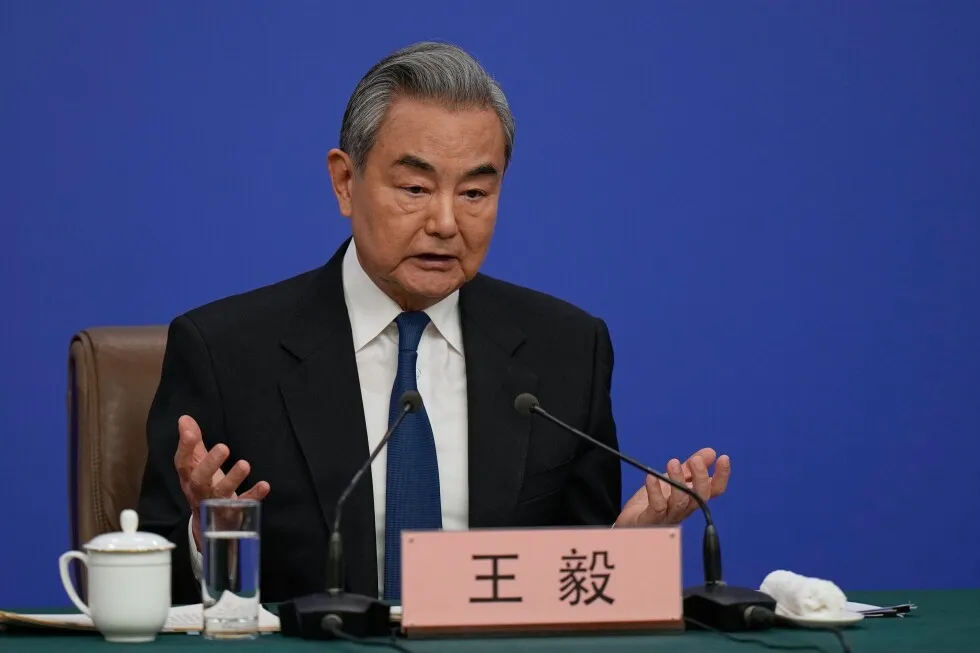
China aims to show global leadership with Iran war diplomacy. US appears uninterested 1 of 3 | Chinese Foreign Minister Wang Yi speaks during a press conference on the sideline of the National People’s Congress (NPC) at the media center, in Beijing, Sunday, March 8, 2026. (AP Photo/Andy Wong) 2 of 3 | Chinese President Xi Jinping applauds during the closing session of the National People’s Congress (NPC) at the Great Hall of the People in Beijing, Thursday, March 12, 2026. (AP Photo/Ng Han Guan) 3 of 3 | A child holds a Chinese national flag near the Hall of Prayer for Good Harvests at the Temple of Heaven in Beijing, China, Friday, April 3, 2026. (AP Photo/Vincent Thian) 1 of 3 Chinese Foreign Minister Wang Yi speaks during a press conference on the sideline of the National People’s Congress (NPC) at the media center, in Beijing, Sunday, March 8, 2026. (AP Photo/Andy Wong) Add AP News on Google Add AP News as your preferred source to see more of our stories on Google. 2 of 3 Chinese President Xi Jinping applauds during the closing session of the National People’s Congress (NPC) at the Great Hall of the People in Beijing, Thursday, March 12, 2026. (AP Photo/Ng Han Guan) Add AP News on Google Add AP News as your preferred source to see more of our stories on Google. 3 of 3 A child holds a Chinese national flag near the Hall of Prayer for Good Harvests at the Temple of Heaven in Beijing, China, Friday, April 3, 2026. (AP Photo/Vincent Thian) Add AP News on Google Add AP News as your preferred source to see more of our stories on Google. Updated [hour]:[minute] [AMPM] [timezone], [monthFull] [day], [year] WASHINGTON (AP) — China is stepping up its diplomacy on the Iran war, putting forward a five-point proposal with Pakistan, rallying support from Gulf countries and opposing a United Nations proposal to use any force necessary to open the Strait of Hormuz.It is China’s latest push for a more prominent role in global affairs, though it may prove to be more rhetorical than substantive, with the U.S. appearing uninterested in Beijing’s efforts.“The war with Iran is the priority of all countries in and outside the region,” said Sun Yun, director of the China program at the Stimson Center, a Washington-based think tank. “It is an opportunity China will not miss to demonstrate its leadership and diplomatic initiative.”Danny Russel, a former senior U.S. diplomat, described China’s diplomacy as “performative” and compared the five-point proposal for ending the Iran war with its 12-point plan for Ukraine in 2023, which was “filled with platitudes but never acted on.” “Its narrative is that while Washington is reckless, aggressive and heedless of the cost to others, China is a principled and responsible champion of peace,” said Russel, a distinguished fellow at the Asia Society Policy Institute. “What we are seeing from China is messaging, not mediation.”China has been working “tirelessly for peace” since the outbreak of the war, said Liu Pengyu, spokesperson for the Chinese Embassy in Washington. How the US views China’s diplomacyThe Trump administration appears to have little enthusiasm for the prospect of China’s mediation, according to U.S. officials.The U.S. has soured on third-party mediation efforts, and it has little interest in boosting China’s international stature or giving it an opening to claim success in the Middle East, said three U.S. officials, who spoke on condition of anonymity because they were not authorized to publicly discuss potential diplomatic options. One of the officials described the administration’s position on the Chinese-Pakistani effort as “agnostic,” neither endorsement nor rejection, but all three stressed that could change if President Donald Trump weighs in before his planned summit with Chinese President Xi Jinping. For Beijing, there could be an incentive to see the war subside before Trump travels to China in mid-May. Citing demands of the war, Trump postponed the trip initially set for the end of March.“There is no guarantee that Trump may not delay the trip to China again if the war rages on,” Sun said.The war saw a major escalation Friday when Iran shot down two U.S. military aircraft, a first since the war began five weeks ago. Trump told NBC News that it would not impact negotiations with Iran, just days after declaring in a national address that the U.S. has “beaten and completely decimated Iran.” Beijing is calculating the pain from the closure of the Strait of HormuzFor now, China is more insulated from the disruption in the Strait of Hormuz than other countries after diversifying its energy sources and reducing dependence on fossil fuels.China relies on Iran for only about 13% of its oil imports, and Beijing is working with Tehran to allow the passage of Chinese-flagged vessels through the critical waterway, where Iran’s stranglehold has sent energy prices soaring. China also maintains a large strategic petroleum reserve. While China has positioned itself to cushion short-term shocks, analysts say Beijing is worried about a protracted war and has an interest in trying to bring it to an end. “An escalation of the conflict will start to harm Chinese interests,” Russel said. “Because China’s growth model is so export-heavy, prolonged energy shocks and shipping disruption will mean costlier inputs and weaker global demand that damage its vulnerable economy.”Besides not wanting to see a long war, China “welcomes the opportunity to suggest that it is helping mitigate a crisis of America’s making, especially as the Trump administration’s lack of a considered strategy for containing the fallout becomes more apparent,” said Ali Wyne, a senior research and advocacy adviser on U.S.-China relations at the International Crisis Group. China has undertaken a flurry of diplomacyAfter the war began, Chinese Foreign Minister Wang Yi spoke with counterparts from Russia, Oman, Iran, France, Israel, Saudi Arabia and the United Arab Emirates. He told Iran that China cherished its friendship, urged Israel to cease military actions and expressed that China would be willing to play a role in seeking peace.This past week, Wang hosted his Pakistani counterpart in Beijing to hash out their five-point proposal, calling for an end to hostilities and the reopening of the strait.He has held more than 20 phone calls with regional foreign ministers, and a special envoy has visited several countries in the region, aiming to promote peace and deescalate tensions, Liu said.Wang sought support for China’s plan from the European Union’s foreign policy chief Kaja Kallas, telling her it represented “broad, international consensus,” the Chinese foreign ministry said. Wang told Saudi Foreign Minister Prince Faisal bin Farhan that halting the fighting was the most urgent matter. Wang also spoke this week with Bahrain’s foreign minister, Abdullatif bin Rashid Al Zayani, to explain why China opposed Bahrain’s U.N. proposal to allow military force to open the Strait of Hormuz. Wang said actions by the U.N. Security Council should help ease tensions “rather than endorse illegal acts of war, still less add fuel to the fire.”China and Russia argued that the U.S. or other countries could exploit a U.N.-backed mechanism to escalate the deadly war, according to a U.N. diplomat, who spoke on the condition of anonymity to discuss diplomatic conversations.Both countries appear to have less immediate need to see the strait fully open. While China has been able to pay to get some of its ships through, Russia is benefiting from the high price of oil, its main export.Hoping to avoid a veto, Bahrain significantly watered down its proposal to authorize defensive — but not offensive — action to ensure vessels can safely transit the strait. A vote was pushed back until next week. To solve the problem of the strait, China says a ceasefire is needed. But its plan with Pakistan has been met with mostly silence from the U.S.One of the U.S. officials said the plan is difficult to assess because it is less of a roadmap to peace than a vague appeal for respect for international law and the importance of diplomacy and the U.N.'s role.___Amiri reported from the United Nations. Tang joined the AP Washington bureau in 2023 after spending 11 years in Beijing as a China correspondent. She covers anything related to the Indo-Pacific region with a focus on U.S.-China competitions Amiri covers foreign policy and the United Nations as a correspondent for The Associated Press, based in New York.
SRCAssociated Press (AP)
LANGEN
LEANCenter
WORDS1 391
ENT12
SAT · 2026-04-04 · 06:23 GMTBRIEF NSR-2026-0404-51803
NSR-2026-0404-51803News Report·EN·Political Strategy
China aims to show global leadership with Iran war diplomacy. US appears uninterested
China is increasing its diplomatic efforts regarding the Iran war, aiming to demonstrate global leadership. China has proposed a five-point plan with Pakistan, is seeking support from Gulf nations, and opposes the UN proposal to use force to open the Strait of Hormuz.
By
DIDI TANG, FARNOUSH AMIRI and MATTHEW LEEAssociated Press (AP)Filed 2026-04-04 · 06:23 GMTLean · CenterRead · 6 min
Associated Press (AP)FIG 01
Reading time
6min
Word count
1 391words
Sources cited
3cited
Entities identified
12entities
Quality score
100%
§ 01
Briefing Summary
AI-generatedNEWSAR · AI
China is increasing its diplomatic efforts regarding the Iran war, aiming to demonstrate global leadership. China has proposed a five-point plan with Pakistan, is seeking support from Gulf nations, and opposes the UN proposal to use force to open the Strait of Hormuz. This initiative is seen as an opportunity for China to showcase its diplomatic capabilities. However, the United States appears uninterested in China's involvement. A former U.S. diplomat described China's diplomacy as "performative".
Confidence 0.90Sources 3Claims 5Entities 12
§ 02
Article analysis
Model · rule-basedFraming
Political Strategy
Diplomatic
Tone
Measured
AI-assessed
CalmNeutralAlarmist
Factuality
0.70 / 1.00
Factual
LowHigh
Sources cited
3
Well sourced
FewMany
§ 03
Key claims
5 extracted01
China is opposing a United Nations proposal to use any force necessary to open the Strait of Hormuz.
factualAP
Confidence
0.90
02
The war with Iran is the priority of all countries in and outside the region.
quoteSun Yun, director of the China program at the Stimson Center
Confidence
0.90
03
China is stepping up its diplomacy on the Iran war, putting forward a five-point proposal with Pakistan.
factualAP
Confidence
0.90
04
The U.S. appears uninterested in Beijing’s efforts regarding the Iran war.
factualAP
Confidence
0.80
05
China has been working “tirelessly for peace” since the outbreak of the war.
quoteLiu Pengyu, spokesperson
Confidence
0.70
§ 04
Full report
6 min read · 1 391 words§ 05
Entities
12 identifiedKey playerOppositionContextPositiveNeutralNegative
Organizations3
§ 06
Keywords & salience
9 termschina
0.90
iran war
0.80
global leadership
0.70
diplomacy
0.70
united states
0.60
five-point proposal
0.50
strait of hormuz
0.50
sun yun
0.40
stimson center
0.40
§ 07
Topic connections
Interactive graph Network visualization showing 51 related topics
View Full Graph Person Organization Location Event|Click node to navigate|Edge numbers = shared articles