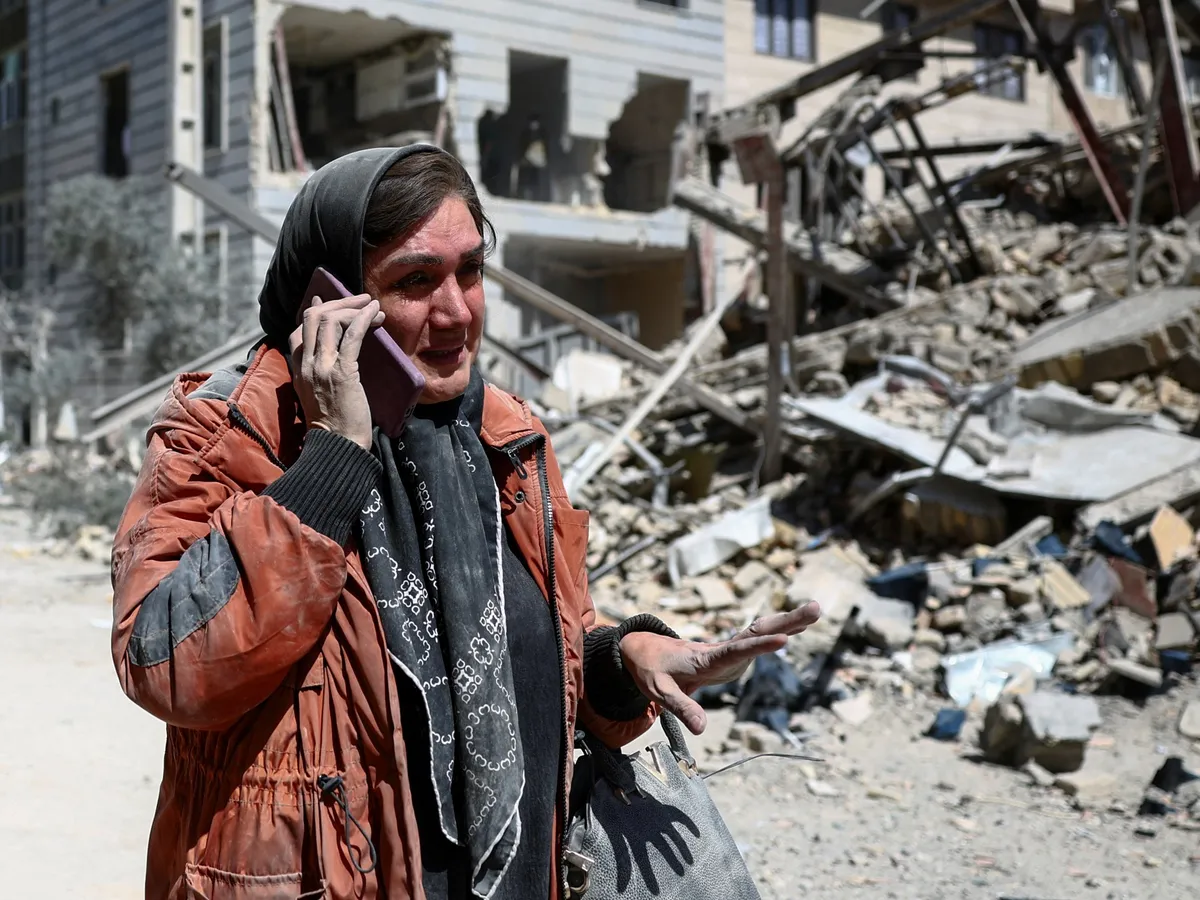
EXPLAINERMediators Pakistan, Turkiye and Egypt are proposing a 45-day ceasefire plan. But Iran is reluctant.A woman talks on a phone amid a damaged residential neighbourhood, as the US-Israel war on Iran continues, in Tehran, March 30, 2026 [Majid Asgaripour/WANA via Reuters]Published On 6 Apr 2026United States President Donald Trump has threatened to blow up Iran’s bridges and power plants if Tehran does not agree to open up the Strait of Hormuz by early morning local time on Wednesday, in a profanity-laced post on his Truth Social platform.“Tuesday will be Power Plant Day, and Bridge Day, all wrapped up in one, in Iran. There will be nothing like it!!!,” he wrote, before turning to abusive language.This is just the latest in a series of deadlines that Trump has laid out – and then deferred – since March 21, when he first threatened to blow up Iran’s electricity plants and energy facilities. But on each occasion, he cited negotiations that he claimed were ongoing with Iran to seek either the opening of the strait – talks that Tehran has repeatedly denied were happening – to justify pushing back his announced deadlines.On Sunday night, Trump issued a specific new deadline: 8pm ET on Tuesday (00:00 GMT, Wednesday), which works out to 3:30am local time in Iran on Wednesday.With less than two days left, mediators, including Pakistan, Egypt and Turkiye, are attempting to secure at least a partial breakthrough to at least postpone, if not end, the risks of a further military escalation by Trump.Already, the US-Israel war on Iran has killed more than 2,000 people in the country. Concurrently, close to 1,500 people have been killed in Israel’s war on Lebanon, as well as more than 100 in Iraq, 24 in Israel and 27 in the Gulf countries. The US has lost 13 service members and, on Sunday, carried out a high-risk rescue operation to pluck an officer out of Iran after his F-15 jet was brought down.But what could a breakthrough between the US and Iran look like, and how likely is it that the mediators can seal a deal in time?Iran’s Minister of Science Hossein Simaee Sarraf inspects damage at the research building of the Shahid Beheshti University, which was hit by a strike, in Tehran, on April 4, 2026 [Majid Asgaripour/WANA via Reuters]A 45-day ceasefire proposalA source close to mediators has confirmed to Al Jazeera that a proposal for a 45-day ceasefire is on the table. The idea is to create a longer window within which Iran and the US can, directly or through mediators, discuss and negotiate the broader differences between them in a bid to arrive at a longer-term agreement to end the war.But officially, Pakistan – the central mediator passing messages between the US and Iran – refused on Monday to confirm or deny the 45-day ceasefire plan. “There have been several reports of a 45-day ceasefire offer, or 15-point exchange,” Pakistan’s Ministry of Foreign Affairs spokesperson Tahir Andrabi told Al Jazeera. “We do not comment on these individual, specific incidents. Our point is that the peace process is ongoing.”Trump’s top envoy for talks with Iran, Steve Witkoff, has previously confirmed that Pakistan passed on a 15-point plan for peace shared by the US with Iran. Tehran had called the US demands under that plan “maximalist” and unacceptable.US publication Axios has also reported the 45-day ceasefire proposal.Officials said mediators were cautious about spelling out details of their communication between the US and Iran in part because of the sensitive nature of attempts at negotiations, and the fast-changing nature of the positions articulated by Washington, in particular.A shorter ceasefireOfficials close to the mediation efforts told Al Jazeera a second proposal is also being considered: a shorter ceasefire. This would not allow for any comprehensive talks aimed at ending the war, but it could create a window for the US and Iran to take confidence-building measures that could, in turn, create momentum for a longer ceasefire.On Monday, Reuters reported that mediators led by Pakistan had shared plans for a short-term pause in fighting, followed by a longer ceasefire, with the US and Iran.The agency said Pakistan’s army chief, Field Marshal Asim Munir, was leading the mediation efforts, and had been on the phone all of Sunday night with US Vice President JD Vance, Witkoff and Iranian Foreign Minister Abbas Araghchi.Under this proposal, Iran would agree to open the Strait of Hormuz – at present, it is only allowing ships from select countries through – pending a larger agreement aimed at ending the war.What has Trump said about ceasefire plans?The US president has continued to warn of a massive military escalation and the prospects of a pause in fighting at the same time.On Sunday, Trump told Fox News chief foreign correspondent Trey Yingst that he believed the US would be able to secure a deal with Iran on the reopening of the Strait of Hormuz by Monday.“I think there is a good chance tomorrow, they are negotiating now,” he said.Reuters also reported that the mediator nations were pressing Iran and the US to agree to a deal by Monday.What is Iran saying?At a news conference on Monday, Iranian Foreign Ministry spokesperson Esmaeil Baghaei confirmed that mediators were passing messages between Iran and the US, but did not confirm or deny specific proposals for a ceasefire.“Whenever necessary, we will clearly inform you about its [the Iranian government’s] announcement” about its response to the mediators’ proposals, he said, before referring to Trump’s threats. “But negotiation is in no way compatible with ultimatums, with crimes, with the threat of committing war crimes.”The US and Israel have already bombed multiple Iranian oil facilities, universities and hospitals, as well as pharmaceutical companies and research institutions – attacks that some experts say might amount to war crimes. Blowing up Iranian bridges and power plants en masse, as Trump has threatened to do, would almost certainly violate the laws of war, analysts have warned.Iranian officials have also said they are unwilling to be bullied into accepting Trump’s unilateral deadlines.On Sunday, Mehdi Tabatabaei, deputy for communications at the Iranian president’s office, said the Strait of Hormuz would only be reopened following the payment of reparations for the damage caused by the war.Meanwhile, Axios reported that Iranian officials were worried that a short-term ceasefire could create a dynamic similar to Gaza and Lebanon, where, despite a truce on paper, Israel and the US could continue to attack Iran whenever they wished.
SRCAl Jazeera
LANGEN
LEANCenter
WORDS1 072
ENT11
MON · 2026-04-06 · 11:12 GMTBRIEF NSR-2026-0406-54540
NSR-2026-0406-54540News Report·EN·Conflict
Trump’s ‘Bridge Day’ threat: Can a last-ditch ceasefire plan work?
In April 2026, mediators Pakistan, Turkiye, and Egypt are proposing a 45-day ceasefire between the US and Iran to de-escalate tensions. This comes as US President Donald Trump threatens military action, specifically targeting Iranian infrastructure like bridges and power plants if Iran does not open the Strait of Hormuz by Wednesday.
Charu KasturiAl JazeeraFiled 2026-04-06 · 11:12 GMTLean · CenterRead · 5 min
Al JazeeraFIG 01
Reading time
5min
Word count
1 072words
Sources cited
3cited
Entities identified
11entities
Quality score
100%
§ 01
Briefing Summary
AI-generatedNEWSAR · AI
In April 2026, mediators Pakistan, Turkiye, and Egypt are proposing a 45-day ceasefire between the US and Iran to de-escalate tensions. This comes as US President Donald Trump threatens military action, specifically targeting Iranian infrastructure like bridges and power plants if Iran does not open the Strait of Hormuz by Wednesday. Trump has issued and deferred similar deadlines previously, citing ongoing negotiations that Iran denies. The US-Israel war on Iran has already resulted in over 2,000 deaths in Iran, with additional casualties in Israel, Lebanon, Iraq, and Gulf countries. The proposed ceasefire aims to create a window for direct or mediated negotiations between the US and Iran.
Confidence 0.90Sources 3Claims 5Entities 11
§ 02
Article analysis
Model · rule-basedFraming
Conflict
Diplomatic
Tone
Mixed Tone
AI-assessed
CalmNeutralAlarmist
Factuality
0.70 / 1.00
Factual
LowHigh
Sources cited
3
Well sourced
FewMany
§ 03
Key claims
5 extracted01
Pakistan’s Ministry of Foreign Affairs spokesperson Tahir Andrabi refused to confirm or deny the 45-day ceasefire plan.
factualTahir Andrabi
Confidence
1.00
02
The US-Israel war on Iran has killed more than 2,000 people in the country.
statisticArticle's own claim
Confidence
0.90
03
Donald Trump has threatened to blow up Iran’s bridges and power plants if Tehran does not open up the Strait of Hormuz.
factualArticle's own claim based on Trump's post
Confidence
0.90
04
Mediators, including Pakistan, Egypt and Turkiye, are attempting to secure a breakthrough to postpone or end the risks of military escalation.
factualArticle's own claim
Confidence
0.80
05
A source close to mediators has confirmed a proposal for a 45-day ceasefire is on the table.
factualSource close to mediators
Confidence
0.70
§ 04
Full report
5 min read · 1 072 words§ 05
Entities
11 identifiedKey playerOppositionContextPositiveNeutralNegative
§ 06
Keywords & salience
9 termsceasefire
0.90
iran
0.90
trump
0.90
united states
0.80
us-israel war on iran
0.70
military escalation
0.70
mediators
0.70
strait of hormuz
0.60
negotiations
0.50
§ 07
Topic connections
Interactive graph Network visualization showing 51 related topics
View Full Graph Person Organization Location Event|Click node to navigate|Edge numbers = shared articles