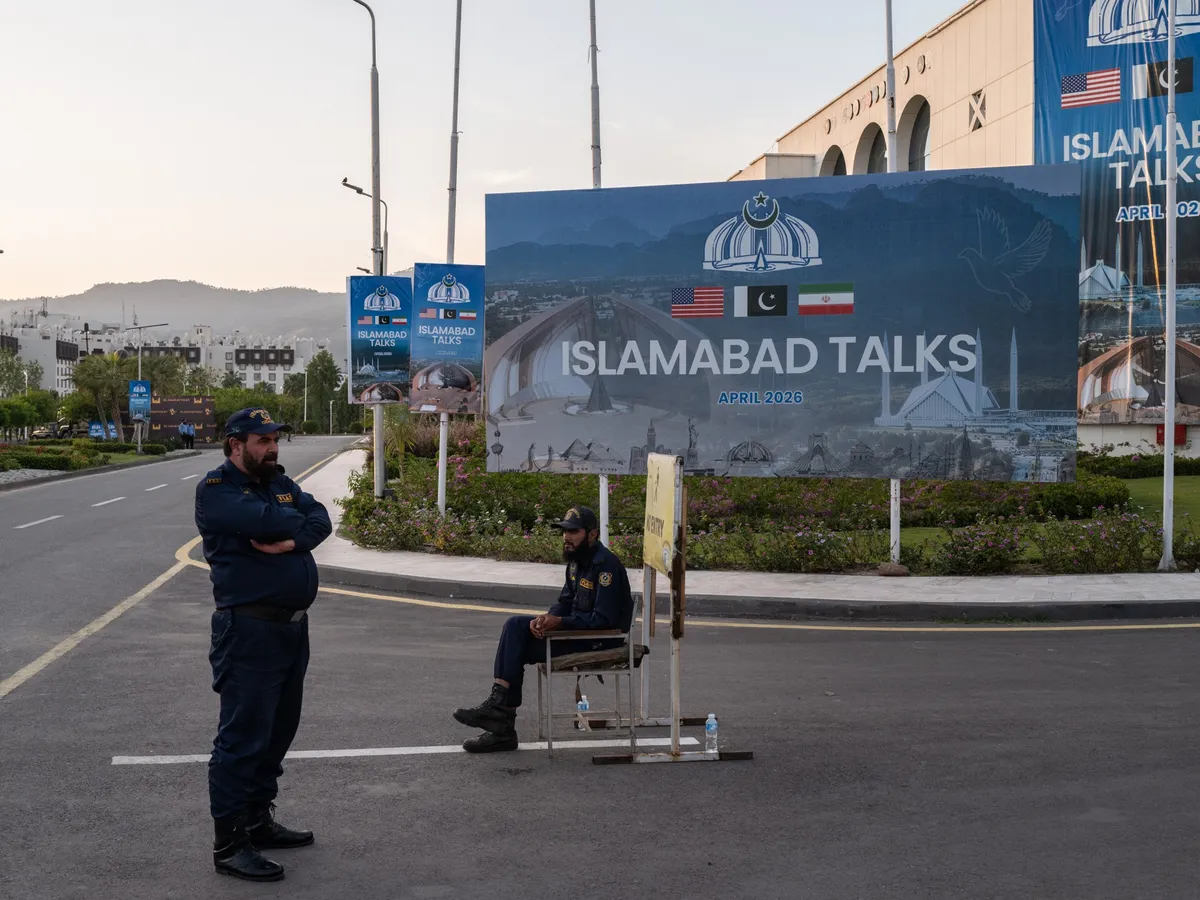
REPORTER'S NOTEBOOKPakistan has rightly been under spotlight as it managed what others couldn’t due to its ties with the Gulf, US as well as China.Pakistani security personnel stand guard outside the Jinnah Convention Centre, where international media have gathered to cover talks between US and Iranian officials, taking place in the nearby Serena Hotel, on April 11, 2026 in Islamabad [Rebecca Conway/Getty Images]Published On 13 Apr 2026Islamabad, Pakistan – The capital woke up on Saturday to lockdown: Roads were sealed, checkpoints appeared, and more than 10,000 security personnel were deployed ahead of ceasefire talks between the United States and Iran.The Iranian delegation arrived late on Friday night, their movement swift and largely unseen. We followed the flight en route to Islamabad via Balochistan. A Pakistani air force plane quickly switched off its call sign inside Pakistani airspace. By the following afternoon, the Americans landed at Nur Khan Air Base, which India claimed to have damaged during the brief war last year.Recommended Stories list of 3 itemslist 1 of 3US and Iran fail to reach a deal after marathon talks in Pakistanlist 2 of 3Pakistan urges US and Iran to uphold ceasefire after talks endlist 3 of 3US-Iran ceasefire talks: What are the key sticking points?end of listOn the tarmac, three extraordinary tail fins stood out. One American, two Iranian. It was a small detail, but in a region defined by symbolism, not insignificant.From the base, the motorcades moved along pre-cleared routes to the Serena Hotel, the venue of the talks. The property, which had been attacked by armed groups in the past, was vacated days earlier. Guests were asked to check out, floors secured, staff vetted. What remained was not a hotel, but a controlled diplomatic environment.The stage was set for the first direct, high-level engagement between post-revolution Iran and the United States… on Pakistani soil.‘To talk or not to talk’ was the questionInside the negotiation room was expectedly a collision of two fundamentally different worldviews – an American “peace through strength” versus the Iranian “resistance with dignity.”“This is a make-or-break moment for lasting peace,” Pakistani prime minister Shahbaz Sharif said the night before.Nothing, it seemed, had been guaranteed. Ahead of the arrival, Iran’s chief negotiator, Mohammad Bagher Ghalibaf, had publicly set conditions – no talks without movement on a ceasefire in Lebanon, and no progress without the unfreezing of Iranian assets abroad.Iran wants the ceasefire to include the Lebanon front, where Israel has continued a brutal campaign, killing more than 2,000 people. Tehran is also seeking the unlocking of its frozen assets due to years of US sanctions, which have crippled its economy.The message was clear: diplomacy, not dictation. Negotiations which could not be detached from the realities of the conflict.Yet, within hours of both delegations landing, separate, bilateral engagements began. For Pakistani officials involved in the process, this was the breakthrough thaw.This was not an unfamiliar setting, and the failures of the recent past lingered. Talks between Washington and Tehran have happened before – in Muscat, Vienna, Geneva and Abu Dhabi. But each round carried with it a familiar undertone: mistrust, layered over years of confrontation and broken commitments. But never before were they face-to-face and at this level – negotiators including the US vice president JD Vance and the speaker of the Iranian parliament Ghalibaf.It was within this context that Islamabad’s role became significant. It was happening amid deepened mistrust. Iranian officials pointed to the killings of its officials, including security chief Ali Larijani, while negotiations were ongoing.Pakistan managed what others couldn’t with geography, religion and regional relations. It has close ties with Gulf states, including Saudi Arabia and Qatar. It shares a long and sensitive border with Iran. Its ports sit close to one of the world’s most critical energy chokepoints – the Strait of Hormuz. And its relationship with China adds another layer of strategic relevance. Unlike several other mediators in the region, it does not host US military bases. Yet its powerful army chief Asim Munir is Donald Trump’s “favourite field marshal”Taken together, these factors placed Islamabad in a position few others could claim – able to speak to all sides, without formally belonging to any.The long nightOnce the talks began, they did not pause for long. Officials described the 21 hours of talks as “continuous, but uneven”.The first session lasted under two hours. It was followed by a pause, which was partly procedural, partly cultural. Dinner was served, but conversations continued, albeit without structure.What followed after that was more intense: Multiple rounds, drafts exchanged, and positions restated. Behind the scenes, there had already been dozens of calls between leaders, red lines redrawn and tremendous pressure from capitals – Washington and Tehran.Those familiar with the discussions say progress came in fragments – small areas of convergence, followed by immediate pushback elsewhere. At times, there were indications that a framework might be within reach. At others, the gaps appeared to widen.“It was a cycle,” one person close to the process said.Throughout, communication lines with capitals remained active. The American delegation was in repeated contact with Washington, including with President Donald Trump. Iranian negotiators, too, were reportedly relaying developments back home.For Pakistan’s leadership – prime minister Sharif, foreign minister Ishaq Dar, and army chief Asim Munir – the days leading up to the talks had already been consumed by preparation. Officials say sleep had been scarce, and coordination was non-stop. The objective, they insist, was modest: not a final agreement, but the outline of one which prevents escalation.Then it all stalledBy the time the final stretch began, expectations had shifted. There had been discussion of extending the talks into a second day. Iranian officials indicated they were willing to stay. But the American side chose to conclude – from the outside, it felt abrupt and shocking.When JD Vance emerged, his assessment was direct. “We have been at it now for 21 hours,” he said. “The good news is that we’ve had substantive discussions. The bad news is that we have not reached an agreement.”He framed the outcome in strategic terms. The United States, he said, had made its position clear – particularly on Iran’s nuclear programme.“We need to see an affirmative commitment that they will not seek a nuclear weapon… not just now, but for the long term. We haven’t seen that yet”. He added that Washington had presented what he described as its “final and best offer”. Washington’s message was: We were flexible, they refused.Iranian officials did not contest the duration or the intensity of the talks. But their interpretation differed sharply. Iran’s ambassador in Islamabad described the negotiations as “not an event, but a process” – one that had, in his words, “laid the foundation” for future engagement.Among the issues cited were demands linked to the Strait of Hormuz, nuclear material and broader regional influence. And behind that measured language, the messaging hardened. State-affiliated outlets, including Fars and Tasnim, characterised the US position as excessive, arguing that Washington had sought concessions it had failed to secure through military pressure.A spokesperson for Iran’s foreign ministry framed the talks in more ideological terms.“For us, diplomacy is a continuation of struggle,” he said, referencing what he described as past “transgressions” by the United States. At the same time, he left space for continuation – stating that progress would depend on “seriousness and good faith” from the other side.
SRCAl Jazeera
LANGEN
LEANCenter
WORDS1 221
ENT10
MON · 2026-04-13 · 11:21 GMTBRIEF NSR-2026-0413-65697
NSR-2026-0413-65697News Report·EN·Diplomatic
How the US-Iran talks in Islamabad unfolded
In April 2026, Islamabad, Pakistan, hosted high-level ceasefire talks between the United States and Iran. The talks, held at the Serena Hotel, were preceded by significant security measures, including road closures and the deployment of thousands of personnel.
Osama Bin JavaidAl JazeeraFiled 2026-04-13 · 11:21 GMTLean · CenterRead · 5 min
Al JazeeraFIG 01
Reading time
5min
Word count
1 221words
Sources cited
1cited
Entities identified
10entities
Quality score
100%
§ 01
Briefing Summary
AI-generatedNEWSAR · AI
In April 2026, Islamabad, Pakistan, hosted high-level ceasefire talks between the United States and Iran. The talks, held at the Serena Hotel, were preceded by significant security measures, including road closures and the deployment of thousands of personnel. The Iranian delegation arrived first, followed by the American delegation at Nur Khan Air Base. Pakistani Prime Minister Shahbaz Sharif emphasized the importance of the talks for lasting peace. The negotiations represented the first direct engagement between the two nations since the Iranian revolution, with differing approaches to peace expected to be a key point of discussion. The talks aimed to address the ongoing ceasefire, with Iran setting conditions regarding Lebanon.
Confidence 0.90Sources 1Claims 5Entities 10
§ 02
Article analysis
Model · rule-basedFraming
Diplomatic
National Security
Tone
Measured
AI-assessed
CalmNeutralAlarmist
Factuality
0.70 / 1.00
Factual
LowHigh
Sources cited
1
Limited
FewMany
§ 03
Key claims
5 extracted01
Iran is also seeking the unlocking of its frozen assets.
factualArticle
Confidence
1.00
02
Iran wants the ceasefire to include the Lebanon front.
factualArticle
Confidence
1.00
03
India claimed to have damaged Nur Khan Air Base during the brief war last year.
factualArticle
Confidence
1.00
04
More than 10,000 security personnel were deployed ahead of ceasefire talks.
factualArticle
Confidence
1.00
05
Talks between US and Iranian officials took place on April 11, 2026 in Islamabad.
factualArticle
Confidence
1.00
§ 04
Full report
5 min read · 1 221 words§ 05
Entities
10 identifiedKey playerOppositionContextPositiveNeutralNegative
§ 06
Keywords & salience
10 termsus-iran talks
1.00
ceasefire talks
0.80
islamabad
0.70
pakistan
0.70
diplomacy
0.60
negotiations
0.60
iran
0.50
us
0.50
peace
0.40
security
0.40
§ 07
Topic connections
Interactive graph Network visualization showing 51 related topics
View Full Graph Person Organization Location Event|Click node to navigate|Edge numbers = shared articles