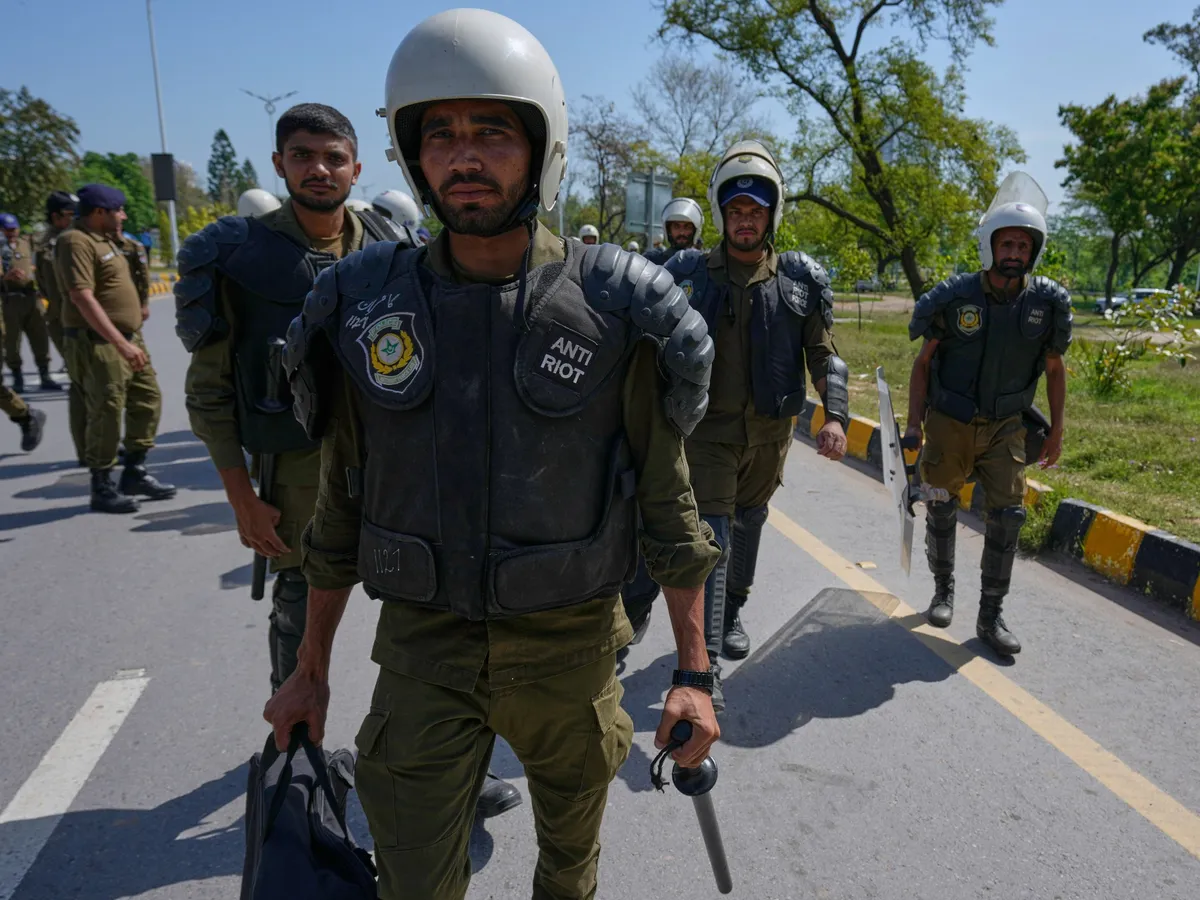
Iranian official says conditions still not met before talks, as Trump re-ups threat of renewed attacks.Police officers walk towards bus for their deployment in Islamabad, Pakistan before planned US-Iran ceasefire talks [File: Anjum Naveed/The Associated Press]Published On 10 Apr 2026The United States delegation has already departed for Saturday’s planned ceasefire negotiations on the US-Israel war with Iran in Islamabad, Pakistan.But on Friday, new tensions emerged between top US and Iranian officials, throwing the upcoming talks — already shrouded in deep distrust — into doubt.Recommended Stories list of 3 itemslist 1 of 3Will Israel and Lebanon start ceasefire talks?list 2 of 3Pakistan sets modest goal for US-Iran summit: A deal to keep talks goinglist 3 of 3Inflation rises in US amid Iran war, Hormuz blockadeend of listAt issue are the conditions in a 10-point Iranian proposal that was the basis for Tuesday’s agreement to pause the fighting and move ahead with diplomacy.Both sides have offered differing accounts of those conditions after agreeing to them. One critical point of discord has been whether the ceasefire applies to Israel’s invasion and ongoing offensive in Lebanon.On Friday, Iranian Parliament Speaker Mohammad Bagher Ghalibaf said the disconnect could derail negotiations before they begin.“Two of the measures mutually agreed upon between the parties have yet to be implemented: a ceasefire in Lebanon and the release of Iran’s blocked assets prior to the commencement of negotiations,” Ghalibaf said in a post on the social media platform X.“These two matters must be fulfilled before negotiations begin.”Ghalibaf is one of the Iranian officials expected to attend the Pakistan talks, alongside Foreign Minister Abbas Araghchi.The Iranian military’s joint command, meanwhile, warned it has its “fingers on the trigger” due to repeated “breaches of trust” by the US and Israel.For his part, Trump re-upped his threats against Iran, telling the New York Post, “We’re loading up the ships with the best weapons ever made, even at a higher level than we used to do a complete decimation.”“And if we don’t have a deal, we will be using them, and we will be using them very effectively,” he added.Afterwards, in a pair of Truth Social posts, Trump signalled his administration planned to take a hard line going into the negotiations.“The Iranians don’t seem to realize they have no cards, other than a short term extortion of the World by using International Waterways,” he wrote, referring to Iran’s control over the Strait of Hormuz.“The only reason they are alive today is to negotiate!”Fighting in Lebanon continuesThe Trump administration has credited Tuesday’s ceasefire agreement with averting a major US escalation in the war.The US president had threatened a “whole civilization will die tonight” just hours before the deal was reached.Still, the Trump administration has not yet released a clear picture of the initial framework it agreed to with Iran, though it has maintained that it is different from the 10-point plan published by Iran.Analysts have said there are yawning gaps between the two sides over issues related to Iran’s future control of the Strait of Hormuz, frozen Iranian assets, the future of Iran’s nuclear programme and Israel’s invasion of Lebanon.The US and Israel have argued that a ceasefire in Lebanon was not part of the deal, contradicting Iran and Pakistan.Still, the US has signalled Israel may dial down its attacks. On Thursday, Trump told an Israeli reporter that he encouraged Israeli Prime Minister Benjamin Netanyahu to make Israeli military operations against Hezbollah more “low-key” in the run-up to the ceasefire talks.Trump’s remarks came after Israeli attacks killed at least 300 people nationwide on Wednesday, in one of the deadliest days of the offensive.Still, Israeli attacks continued on Friday. Al Jazeera correspondent Obaida Hitto reported from the city of Tyre that there is “no sign of any dialback or slowdown here in southern Lebanon”.Kuwait, meanwhile, said it had “dealt with” seven drones fired from Iran into its airspace over the past 24 hours.Vance predicts ‘positive’ outcome from talksDespite the latest threats, US Vice President JD Vance said he expected “positive” results from the talks as he departed for Pakistan on Friday morning.Though he is leading the US delegation, Vance added he had received “pretty clear guidelines” from Trump.“If the Iranians are willing to negotiate in good faith, we are certainly willing to extend an open hand, that’s one thing,” he said.“If they’re going to try to play us, they’re going to find that the negotiating team is not that receptive.”Vance, who is seen as a representative of the non-interventionist branch of Trump’s “Make America Great Again” (MAGA) movement, was tapped to lead the US delegation amid Iran’s distrust of US special envoy Steve Witkoff and Trump’s son-in-law Jared Kushner.Witkoff and Kushner had previously led two rounds of indirect talks on Iran’s nuclear programme.The first round of negotiations was derailed when Israel initiated a 12-day war on Iran in June 2025, which ended with the US striking three of Iran’s key nuclear sites.The second round was scuttled when the US and Israel launched the latest war on February 28.
SRCAl Jazeera
LANGEN
LEANCenter
WORDS833
ENT9
FRI · 2026-04-10 · 19:21 GMTBRIEF NSR-2026-0410-62515
NSR-2026-0410-62515News Report·EN·Diplomatic
New tensions emerge before US-Iran war ceasefire talks in Pakistan
Tensions are high before planned US-Iran ceasefire talks in Islamabad, Pakistan, scheduled for Saturday, aimed at resolving the US-Israel war with Iran. An Iranian official stated that conditions of a previous agreement, including a ceasefire in Lebanon and the release of Iranian assets, have not been met, potentially derailing negotiations.
Al Jazeera StaffAl JazeeraFiled 2026-04-10 · 19:21 GMTLean · CenterRead · 4 min
Al JazeeraFIG 01
Reading time
4min
Word count
833words
Sources cited
4cited
Entities identified
9entities
Quality score
100%
§ 01
Briefing Summary
AI-generatedNEWSAR · AI
Tensions are high before planned US-Iran ceasefire talks in Islamabad, Pakistan, scheduled for Saturday, aimed at resolving the US-Israel war with Iran. An Iranian official stated that conditions of a previous agreement, including a ceasefire in Lebanon and the release of Iranian assets, have not been met, potentially derailing negotiations. The Iranian military warned of action due to perceived breaches of trust by the US and Israel. Meanwhile, Trump reiterated threats of military action against Iran if a deal isn't reached, signaling a hardline stance going into the negotiations. The US delegation has already departed for Pakistan.
Confidence 0.90Sources 4Claims 5Entities 9
§ 02
Article analysis
Model · rule-basedFraming
Diplomatic
National Security
Tone
Mixed Tone
AI-assessed
CalmNeutralAlarmist
Factuality
0.70 / 1.00
Factual
LowHigh
Sources cited
4
Well sourced
FewMany
§ 03
Key claims
5 extracted01
The Trump administration has credited Tuesday’s ceasefire agreement with averting a major US escalation in the war.
factualArticle
Confidence
1.00
02
Trump re-upped his threats against Iran, telling the New York Post, “We’re loading up the ships with the best weapons ever made..."
quoteTrump
Confidence
1.00
03
Two of the measures mutually agreed upon between the parties have yet to be implemented: a ceasefire in Lebanon and the release of Iran’s blocked assets.
quoteMohammad Bagher Ghalibaf
Confidence
1.00
04
The United States delegation has already departed for Saturday’s planned ceasefire negotiations on the US-Israel war with Iran in Islamabad, Pakistan.
factualArticle
Confidence
1.00
05
Fighting in Lebanon continues.
factualArticle
Confidence
0.90
§ 04
Full report
4 min read · 833 words§ 05
Entities
9 identifiedKey playerOppositionContextPositiveNeutralNegative
People3
Locations5
§ 06
Keywords & salience
10 termsus-iran war
1.00
ceasefire talks
0.90
negotiations
0.80
iran
0.70
tensions
0.70
united states
0.70
pakistan
0.60
ceasefire
0.60
diplomacy
0.50
israel
0.40
§ 07
Topic connections
Interactive graph Network visualization showing 51 related topics
View Full Graph Person Organization Location Event|Click node to navigate|Edge numbers = shared articles