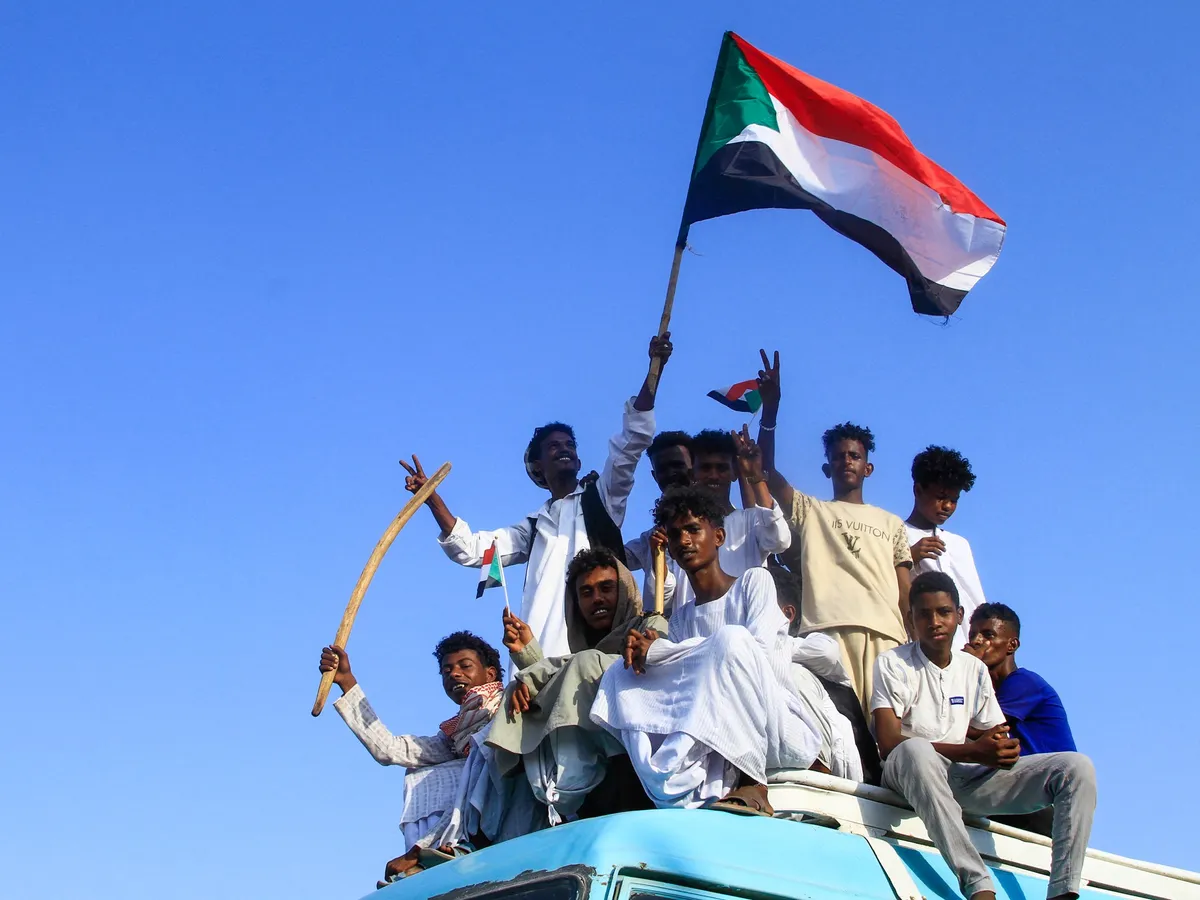
EXPLAINERSudan’s war has displaced millions and caused thousands of deaths, with no clear end in sight to the ongoing violence.People lift national flags during a rally called for by Sudan's Popular Front for Liberation and Justice in Port Sudan on April 24, 2025, to denounce the paramilitary Rapid Support Forces (RSF) [File: AFP]Published On 14 Apr 2026As Sudan’s civil war enters its fourth year, the country remains mired in one of the world’s worst humanitarian crises, and there is no end in sight.Millions of displaced people face hunger, abuse and disease outbreaks, as the country’s healthcare system lies in ruins after three years of devastating war.Recommended Stories list of 3 itemslist 1 of 3The Take: Who is keeping the fight alive in Sudan’s war?list 2 of 3Three babies born into Sudan war every minute, charity warnslist 3 of 3Millions in war-ravaged Sudan surviving on one meal a day, say NGOsend of listThe war erupted on April 15, 2023, after a power struggle between Sudanese Armed Forces (SAF) chief General Abdel Fattah al-Burhan and the paramilitary Rapid Support Forces (RSF) leader Mohamed Hamdan Dagalo, widely known as Hemedti.Al-Burhan and Hemedti had previously cooperated to lead a military coup in October 2021, overthrowing a transitional government that came to power in the wake of the 2019 removal of longtime ruler Omar al-Bashir following a mass uprising.The current conflict has ebbed and flowed, with the SAF currently in control of much of the east and centre of the country, including the capital Khartoum, and the RSF in control of the western Darfur region.So, what do we know about the situation on the ground and is there any hope for an end to the devastating war?Fighting continues amid record displacementAn estimated 14 million people have been forced to flee their homes – roughly a quarter of the country’s population, according to the UN Refugee Agency (UNHCR).UNHCR’s representative in Sudan, Marie-Helene Verney, said that since the start of the conflict, about 4.4 million people have crossed borders, mainly into Chad, Sudan" class="entity-link entity-location" data-entity-id="3169" data-entity-type="location">South Sudan and Egypt.Violence has affected all of Sudan’s 18 states but is mostly concentrated in Darfur, Khartoum, Kordofan and Gezira – which is an agricultural hub that has seen an escalation in fighting recently after attacks by RSF forces.An estimated 40,000 people have been killed, according to the World Health Organization. The violence has included summary executions, attacks on civilians along escape routes, house-to-house raids, and sexual assaults.Efforts to mediate a ceasefire have repeatedly failed, with both sides unwilling to halt hostilities.“Unfortunately, we are not seeing clear progress towards any resolution,” Verney said, noting that fighting continues across large parts of the country, including Darfur, the Kordofan regions and Blue Nile state.Darfur witnessed some of the worst violence in the conflict so far, after the RSF was able to consolidate control over it in October 2025 with its capture of the city of el-Fasher. The United Nations has said that at least 6,000 were killed in just three days of the RSF takeover.International partners have attempted to bring the warring parties together to talk.A primary mediation effort has been led by the “Quad” – the United States, Saudi Arabia, Egypt, and the United Arab Emirates (UAE) – which has focused on aligning external actors to reduce arms flows and pressure the warring parties to reach a ceasefire.But the UAE has also been accused of supporting the RSF, a claim it denies.The Intergovernmental Authority on Development (IGAD) and the African Union (AU) have also engaged in diplomatic initiatives to unite opposing Sudanese political factions and facilitate a political settlement.But those initiatives have so far failed. Nearly 700 civilians were reported killed in drone strikes during the first three months of 2026 alone.Rights abuses and sexual violenceUN agencies report that serious human rights violations persist, including massacres, forced recruitment and arbitrary arrests.Women and girls remain particularly vulnerable to conflict-related sexual violence, often while attempting to flee.In March, Doctors Without Borders, an international medical NGO known by its French initials MSF, reported widespread use of sexual violence as a weapon in Sudan’s ongoing war.The NGO said 3,396 survivors of sexual violence sought treatment in MSF-supported health facilities across North and South Darfur between January 2024 and November 2025.The RSF, in particular, has been accused of carrying out gender-based violence, with one investigation finding that in 87 percent of verified incidents, the perpetrators were RSF fighters.Hunger stalking millionsThe Food and Agriculture Organization (FAO) estimates that 21 million people in Sudan face acute food insecurity, including 6.3 million in emergency conditions.FAO representative Hongjie Yang said rural households in conflict-affected areas such as Darfur and the Kordofan are under severe strain.Food production capacity has been devastated, particularly in Khartoum state. A damaged veterinary laboratory has also halted the production of livestock vaccines, worsening the crisis.According to the FAO, nearly 30.4 million people – almost two-thirds of the population – including 15.6 million children, require urgent humanitarian assistance.More than half the population is acutely food insecure, with famine already confirmed in multiple areas.Agriculture, the main source of food and income for up to 80 percent of the population, is being dismantled by violence, displacement and economic collapse.Shattered health systemDoctors in conflict-hit regions say patients are dying due to a lack of equipment and basic services.“We had to watch two of the babies die before our eyes,” Dr Hasan Babikir at el-Obeid Maternity Hospital told UNFPA, describing the deaths of premature triplets he could not treat due to a shortage of intensive care beds.The hospital, the only referral maternity facility in North Kordofan State, now serves more than 230,000 displaced people, most of them women and girls, many of whom are survivors of sexual violence.More than 40 percent of the population requires urgent health assistance. Hospitals are overwhelmed, and disease outbreaks are spreading. The country is struggling with outbreaks including cholera, malaria, dengue fever, measles, and rubella.Access to healthcare remains limited, with continued attacks on facilities. Attacks have targeted health workers, ambulances, and patients, with Sudan accounting for 82 percent of global deaths from attacks on healthcare in 2025.For example, on April 2, a drone strike on al-Jabalain Teaching Hospital in White Nile State killed 10 people. In late March, a strike on el-Daein Hospital in East Darfur resulted in 70 deaths.The WHO has verified more than 200 attacks on healthcare since the war began, resulting in at least 2,052 deaths.Middle East tensions disrupt aidRegional instability is also affecting humanitarian operations.Restrictions on maritime traffic through key shipping routes have disrupted supply chains, limiting the movement of goods from logistics hubs in the UAE.“Most agencies, including WHO, rely on logistics hubs in the UAE, and what is happening now is significantly affecting our capacity to respond,” said Dr Shible Sahbani, WHO’s representative in Sudan.
SRCAl Jazeera
LANGEN
LEANCenter
WORDS1 121
ENT12
TUE · 2026-04-14 · 16:49 GMTBRIEF NSR-2026-0414-67853
NSR-2026-0414-67853News Report·EN·Human Rights
After three years of war, what is the situation like in Sudan?
Entering its fourth year in April 2026, Sudan's civil war, which began on April 15, 2023, between the Sudanese Armed Forces (SAF) led by General Abdel Fattah al-Burhan and the Rapid Support Forces (RSF) led by Mohamed Hamdan Dagalo (Hemedti), has created a dire humanitarian crisis. The conflict, stemming from a power struggle after a 2021 coup, has displaced an estimated 14 million people, with 4.4 million crossing borders into neighboring countries.
Privilege MusvanhiriAl JazeeraFiled 2026-04-14 · 16:49 GMTLean · CenterRead · 5 min
Al JazeeraFIG 01
Reading time
5min
Word count
1 121words
Sources cited
2cited
Entities identified
12entities
Quality score
100%
§ 01
Briefing Summary
AI-generatedNEWSAR · AI
Entering its fourth year in April 2026, Sudan's civil war, which began on April 15, 2023, between the Sudanese Armed Forces (SAF) led by General Abdel Fattah al-Burhan and the Rapid Support Forces (RSF) led by Mohamed Hamdan Dagalo (Hemedti), has created a dire humanitarian crisis. The conflict, stemming from a power struggle after a 2021 coup, has displaced an estimated 14 million people, with 4.4 million crossing borders into neighboring countries. Fighting is concentrated in Darfur, Khartoum, Kordofan, and Gezira, resulting in an estimated 40,000 deaths and widespread violence. The SAF controls much of eastern and central Sudan, while the RSF controls the Darfur region. The war has devastated the healthcare system, leading to hunger, abuse, and disease outbreaks among the displaced population, with no clear resolution in sight.
Confidence 0.90Sources 2Claims 5Entities 12
§ 02
Article analysis
Model · rule-basedFraming
Human Rights
Conflict
Tone
Mixed Tone
AI-assessed
CalmNeutralAlarmist
Factuality
0.80 / 1.00
Factual
LowHigh
Sources cited
2
Limited
FewMany
§ 03
Key claims
5 extracted01
The war erupted on April 15, 2023, after a power struggle between Sudanese Armed Forces (SAF) chief General Abdel Fattah al-Burhan and the paramilitary Rapid Support Forces (RSF) leader Mohamed Hamdan Dagalo.
factual
Confidence
1.00
02
Unfortunately, we are not seeing clear progress towards any resolution.
quoteMarie-Helene Verney, UNHCR
Confidence
0.90
03
An estimated 14 million people have been forced to flee their homes.
statisticUNHCR
Confidence
0.90
04
Sudan’s war has displaced millions and caused thousands of deaths.
factual
Confidence
0.90
05
An estimated 40,000 people have been killed.
statisticWorld Health Organization
Confidence
0.80
§ 04
Full report
5 min read · 1 121 words§ 05
Entities
12 identifiedKey playerOppositionContextPositiveNeutralNegative
People3
Organizations4
§ 06
Keywords & salience
10 termssudan war
1.00
humanitarian crisis
0.90
displaced people
0.80
violence
0.70
rapid support forces (rsf)
0.60
sudanese armed forces (saf)
0.60
hunger
0.50
civil war
0.50
disease outbreaks
0.40
khartoum
0.40
§ 07
Topic connections
Interactive graph Network visualization showing 51 related topics
View Full Graph Person Organization Location Event|Click node to navigate|Edge numbers = shared articles