EXPLAINERSecond BRICS meeting in a row collapses without joint position because of disagreements over the US-Israeli war on Iran.Foreign ministers and senior officials from partner countries gather during the BRICS foreign ministers’ meeting at the Bharat Mandapam in New Delhi on May 14, 2026 [AFP]Published On 15 May 2026Islamabad, Pakistan – A two-day meeting of BRICS foreign ministers in New Delhi ended on Friday without a common position on the war on Iran, with the bloc’s outcome document acknowledging only that “differing views” remained among members.It was the second consecutive BRICS gathering in India to fail to produce a consensus on the conflict involving the United States and Israel.Recommended Stories list of 4 itemslist 1 of 4China’s silence on Iran reveals its true prioritieslist 2 of 4Iran war: Why the BRICS foreign ministers meeting in India matterslist 3 of 4BRICS meeting overshadowed by war on Iranlist 4 of 4Iran urges BRICS nations to condemn US-Israeli war aggressionend of listThe meeting opened on Thursday at Bharat Mandapam in New Delhi under the chairship of Indian External Affairs Minister Subrahmanyam Jaishankar. It marked the first major ministerial engagement under India’s 2026 BRICS presidency.The 10-member grouping of emerging economies coordinates on economic and security issues while seeking a greater voice for the Global South in institutions long dominated by Western powers. A leaders’ summit is scheduled for September in India.The meeting unfolded against the backdrop of the US-Israel war on Iran, now in its 77th day.The latest conflict began on February 28 with US and Israeli strikes on Iranian military sites, nuclear facilities and infrastructure. Since then, Iran closed the Strait of Hormuz to commercial shipping, global energy prices have surged and diplomatic efforts, including Pakistan-mediated talks in Islamabad last month, have stalled. The US also imposed a naval blockade on Iranian ports on April 13.The BRICS meeting coincided with US President Donald Trump’s state visit to China, the first by an American president to Beijing in nearly a decade. Chinese Foreign Minister Wang Yi was in Beijing, so China was represented at the BRICS meet instead by its ambassador to India, Xu Feihong.Alongside Araghchi, the meeting was attended by Russia’s Sergey Lavrov, Brazil’s Mauro Vieira, South Africa’s Ronald Lamola, and the foreign ministers of Indonesia, Egypt and Ethiopia.Indian Prime Minister Narendra Modi met the visiting ministers on the sidelines before departing for Abu Dhabi.The United Arab Emirates sent Khalifa bin Shaheen Al Marar, its minister of state for foreign affairs, rather than its foreign minister.Iran-UAE confrontationIranian Foreign Minister Abbas Araghchi had initially avoided naming the UAE in his formal address once the summit began. Later, he said that it was not an act of restraint but “for the sake of maintaining unity”, according to Iranian state media.Araghchi urged BRICS members to explicitly condemn what he described as US and Israeli “violations of international law” and to “take concrete action to halt warmongering and bring an end to the impunity of those who violate the UN Charter”.“We believe that BRICS can, and must, become one of the principal pillars in shaping a more just, balanced and humane global order, an order in which might can never be right,” he said.The UAE’s representative, Al Marar, used his own statement to single out Iran in his national statement and called for condemnation of Iranian actions, according to media reports.The exchange exposed the deepest fault line within the expanded bloc, which now includes both Iran and the UAE as full members despite the two standing on opposite sides of an active conflict.After all member states had spoken, Araghchi requested the floor again.“The UAE was directly involved in the aggression against my country,” he told the gathering, according to the Iranian state media. “When the attacks started, they didn’t even issue a condemnation.”He accused the UAE of allowing the US to use Emirati territory to launch attacks on Iran and said Emirati aircraft had directly participated in strikes.“Yesterday it was revealed that UAE fighter jets participated in attacks against us and even took direct action against us. Therefore, the UAE is an active partner in this aggression,” he said, according to Iran’s IRNA news agency.Araghchi also criticised Abu Dhabi for not condemning an attack on a school in Minab city on the first day of the conflict, in which Iran says about 170 students were killed.Iran, he argued, had not attacked the UAE itself, but only US military bases located on Emirati territory.The UAE rejected that characterisation. Abu Dhabi says Iranian strikes targeted energy infrastructure and civilian facilities inside the country, and that it has intercepted more than 2,800 Iranian drones and missiles since February 28.Al Marar, for his part, reiterated the UAE’s demand for condemnation of Iranian attacks on energy infrastructure and other facilities.Iran’s Foreign Minister Abbas Araghchi attends the BRICS foreign ministers’ meeting at Bharat Mandapam in New Delhi, India, on May 14, 2026 [Adnan Abidi/Reuters]India’s Jaishankar, navigating the dispute as chair, called for “safe and unimpeded maritime flows through international waterways, including the Strait of Hormuz and Red Sea”, adding that unilateral sanctions “cannot substitute dialogue, nor can pressure replace diplomacy”.He also reminded members that “it is essential for the smooth advancement of BRICS that later members fully appreciate and subscribe to the BRICS’ consensus on various important issues”.On the sidelines, Jaishankar held a bilateral meeting with Araghchi and later posted on X that they had a “detailed” discussion on regional developments and bilateral ties.No consensus againThis was not the first BRICS meeting in India to end without consensus over the Iran war.On April 24, India hosted a BRICS deputy foreign ministers’ and special envoys’ meeting on the Middle East, also in New Delhi. That gathering ended without a joint statement, with India issuing only a chair’s summary.Iran had pushed for language recognising that the US and Israel initiated the conflict, while the UAE demanded wording condemning Iranian strikes on Gulf states.Since February 28, BRICS has not issued a single joint statement on the war, under India’s chairship.The outcome document issued at the close of the meetings this week reflected the impasse.On the conflict in the Middle East, it noted only that “there were differing views among some members” and listed a set of general principles – the need for dialogue and diplomacy, respect for sovereignty, unimpeded maritime flows and the protection of civilian lives – without naming any party or assigning responsibility.Iran’s demand that the bloc condemn US and Israeli aggression went unmet. The UAE’s push for language condemning Iranian strikes went equally unmet.Addressing a media briefing at the Iranian embassy in New Delhi on Friday, Araghchi appeared to blame the UAE — a BRICS member state that has “its own special relationship with Israel” — for there being no consensus document at the end of the meeting.“The only reason they stopped the final statement was their support for Israel and the United States in their aggression against Iran, which is very, very unfortunate,” said Araghchi.The Iranian diplomat went on to say that the country in question cannot be protected by the US and Israel, and that US military installations that were meant to provide it security had become a source of insecurity. “That was proved during this war,” said Araghchi.The document did condemn “the imposition of unilateral coercive measures that are contrary to international law”, language widely understood as a reference to US sanctions on Iran, though Washington was not named.On other agenda items, the meeting was more productive. Member states reached agreement on more than 60 issues, including energy cooperation, trade, digital infrastructure, climate action and multilateral reform.
SRCAl Jazeera
LANGEN
LEANCenter
WORDS1 257
ENT12
FRI · 2026-05-15 · 12:21 GMTBRIEF NSR-2026-0515-76532
NSR-2026-0515-76532News Report·EN·Diplomatic
Why the Iran conflict is becoming a problem for BRICS
A BRICS foreign ministers' meeting in New Delhi, India, concluded without a joint position on the US-Israeli war on Iran. This marks the second consecutive BRICS gathering to fail to reach consensus on the conflict, which has been ongoing for 77 days.
Abid HussainAl JazeeraFiled 2026-05-15 · 12:21 GMTLean · CenterRead · 6 min
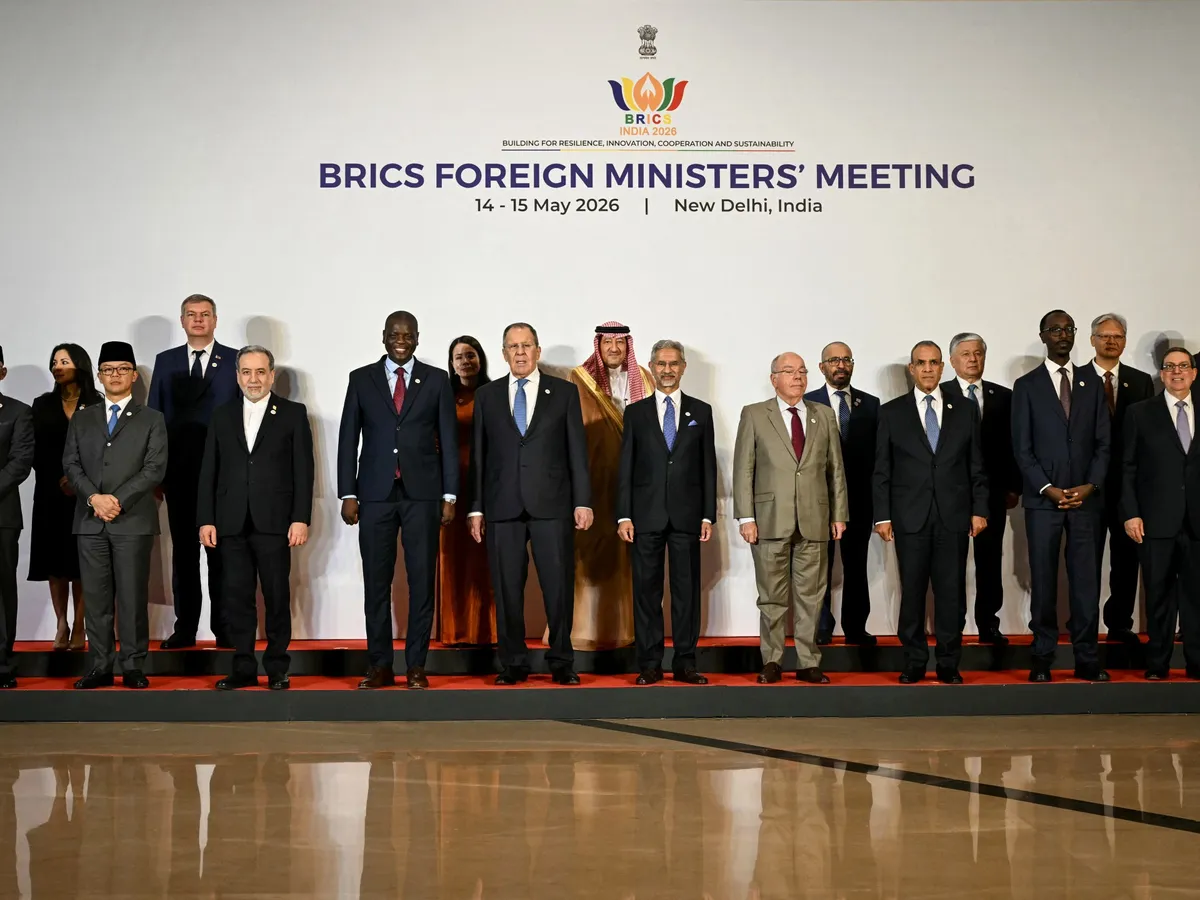
Al JazeeraFIG 01
Reading time
6min
Word count
1 257words
Sources cited
3cited
Entities identified
12entities
Quality score
100%
§ 01
Briefing Summary
AI-generatedNEWSAR · AI
A BRICS foreign ministers' meeting in New Delhi, India, concluded without a joint position on the US-Israeli war on Iran. This marks the second consecutive BRICS gathering to fail to reach consensus on the conflict, which has been ongoing for 77 days. The bloc, comprising ten emerging economies, aims to increase the Global South's influence but is facing internal divisions over the Iran conflict. The meeting, held under India's 2026 BRICS presidency, saw differing views acknowledged in the outcome document. The war has led to the closure of the Strait of Hormuz, surging energy prices, and stalled diplomatic efforts.
Confidence 0.90Sources 3Claims 5Entities 12
§ 02
Article analysis
Model · rule-basedFraming
Diplomatic
Conflict
Tone
Mixed Tone
AI-assessed
CalmNeutralAlarmist
Factuality
0.70 / 1.00
Factual
LowHigh
Sources cited
3
Well sourced
FewMany
§ 03
Key claims
5 extracted01
The BRICS meeting outcome document acknowledged "differing views" among members regarding the conflict.
factual
Confidence
0.95
02
Iranian Foreign Minister Araghchi urged BRICS members to condemn the "US-Israeli war aggression".
quoteIranian Foreign Minister Abbas Araghchi
Confidence
0.90
03
Second BRICS meeting in a row collapses without joint position due to disagreements over the US-Israeli war on Iran.
factual
Confidence
0.90
04
Iran closed the Strait of Hormuz to commercial shipping, global energy prices surged, and diplomatic efforts have stalled since the conflict began.
factual
Confidence
0.85
05
The US-Israel war on Iran began on February 28 with US and Israeli strikes on Iranian military sites, nuclear facilities and infrastructure.
factual
Confidence
0.85
§ 04
Full report
6 min read · 1 257 words§ 05
Entities
12 identifiedKey playerOppositionContextPositiveNeutralNegative
People4
Organizations1
§ 06
Keywords & salience
10 termsiran conflict
1.00
us-israeli war on iran
1.00
brics
1.00
brics foreign ministers meeting
0.90
global south
0.70
strait of hormuz
0.60
naval blockade
0.50
diplomatic efforts
0.50
emerging economies
0.40
india's brics presidency
0.40
§ 07
Topic connections
Interactive graph Network visualization showing 27 related topics
View Full Graph Person Organization Location Event|Click node to navigate|Edge numbers = shared articles