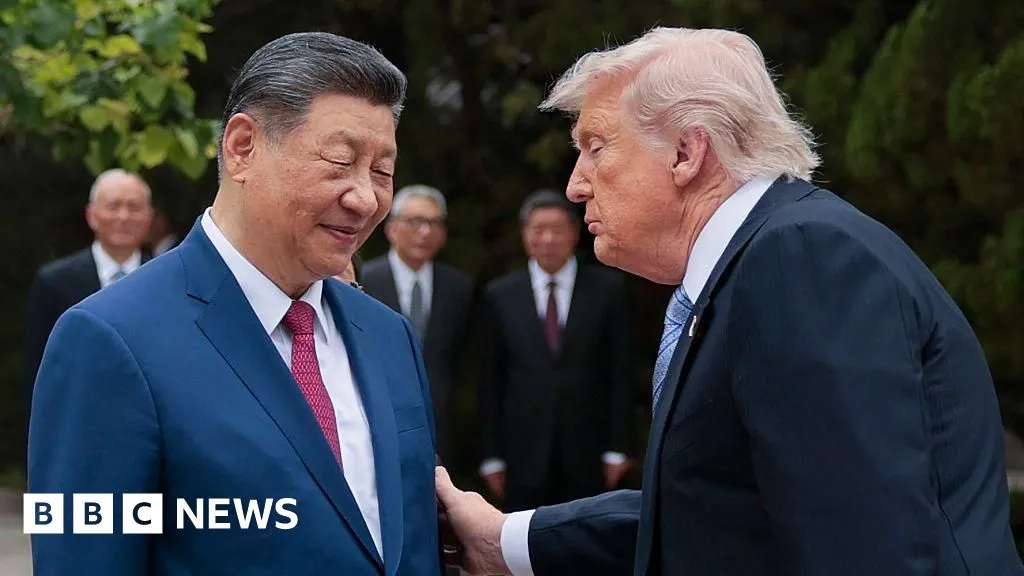
The man who once said China was raping America was now calling its leader his friend.Trump soon hailed "fantastic trade deals", although details have been modest so far. Chipmaker Nvidia was reportedly given a go-ahead to sell semiconductors to 10 Chinese companies and Boeing secured an order for 200 aircraft. Citi was granted an approval to operate a securities business in China.But amid the pleasantries and softened positions, hardline positions against China reflect the traditionally more hawkish stance of Trump's Republican Party.Less than a week before the summit, the US state department sanctioned three Chinese firms for providing satellite imagery to Iran to help strike US forces in the Middle East.And outstanding issues remain - chiefly Taiwan, the self-ruled island viewed by Beijing as a renegade province. Trump delivered few details on the fate of a delayed $14bn arms sale viewed as essential by Democrats and Republican China "hawks" alike.Ahead of the visit, a bipartisan group of senators sent a letter urging Trump to move ahead with the sale and "formally" notify his Chinese counterpart."On Taiwan, he [Xi] feels very strongly. I made no commitment either way," Trump told reporters on Air Force One, adding that he would make a "determination over the next fairly short period" about the arms sale.Notably, the Chinese read-out of the meeting made Taiwan its central point, arguing that a failure to address the issue could lead to "clashes and even conflicts, putting the entire relationship in great jeopardy". The White House read-out made no mention of Taiwan.The Chinese statement was seen as a threat by some within the broader Make America Great Again movement."I am shocked, given how much people wanted to make this into a positive spirit, he [Xi] started with a threat," former Trump strategist Steve Bannon told Politico. "It was so brazen and so blatant, that they made this at the very top."However, even the most ardent China hawks on Capitol Hill and among Trump's allies stayed largely silent after the trip, offering little reaction to Trump's friendly tone and non-committal statements on Taiwan.For China experts in the US, the lack of reaction came as no surprise."If you had 50 presidential summits in one month or one year, it still wouldn't change the fact that there are some issues on which the US and China are simply never going to agree," David Firestein, president and CEO of the George HW Bush Foundation for US-China Relations, told the BBC."That doesn't mean it's not going to be a successful summit," he added.Trump's softening rhetoric and tone, Firestein added, could reflect an acknowledgement that the tactics used in the years after his last visit in 2017 have not worked."We still have the same problems today with market access, intellectual property rights, subsidies…the list goes on," he said. "None of those problems have been solved after eight years of having these tariffs on the books."David Sacks, a fellow for Asia studies at the Council on Foreign Relations, said that the softening of Trump's tone will likely trickle down to other officials, Republican lawmakers and Trump's wider base."Unlike the first Trump administration, and frankly, any other US administration in recent memory, this is much more top down," he said. "I think those in the administration are, mostly, in the role of implementation."Sacks' comments were echoed by Stephen Orlins, president at the National Committee on US-China Relations."When Trump opines, people follow," he said. "And the base follows."Trump, however, still faces a dilemma with Taiwan.Pressure will remain - from both sides of the political spectrum - for Trump to formalise the pending $14bn weapons sale ahead of President Xi's planned visit to the White House in September.
SRCBBC News - World
LANGEN
LEANCenter
WORDS609
ENT12
FRI · 2026-05-15 · 19:52 GMTBRIEF NSR-2026-0515-76644
NSR-2026-0515-76644Analysis·EN·Political Strategy
What China critics in Maga movement make of Trump's Beijing trip
During a recent trip to Beijing, Donald Trump adopted a softer tone towards China, calling its leader his friend and announcing some trade deals, including a chipmaker's semiconductor sales and an aircraft order. Despite these pleasantries, outstanding issues like Taiwan remain, with Trump making no firm commitment on a delayed $14 billion arms sale, a point China emphasized as crucial.
BBC News - WorldFiled 2026-05-15 · 19:52 GMTLean · CenterRead · 3 min
BBC News - WorldFIG 01
Reading time
3min
Word count
609words
Sources cited
3cited
Entities identified
12entities
Quality score
100%
§ 01
Briefing Summary
AI-generatedNEWSAR · AI
During a recent trip to Beijing, Donald Trump adopted a softer tone towards China, calling its leader his friend and announcing some trade deals, including a chipmaker's semiconductor sales and an aircraft order. Despite these pleasantries, outstanding issues like Taiwan remain, with Trump making no firm commitment on a delayed $14 billion arms sale, a point China emphasized as crucial. Experts suggest Trump's softened approach may signal a shift in strategy, acknowledging past tactics haven't resolved ongoing trade and intellectual property issues. This top-down shift in rhetoric is expected to influence the wider MAGA base and Republican lawmakers.
Confidence 0.90Sources 3Claims 5Entities 12
§ 02
Article analysis
Model · rule-basedFraming
Political Strategy
Diplomatic
Tone
Measured
AI-assessed
CalmNeutralAlarmist
Factuality
0.60 / 1.00
Mixed
LowHigh
Sources cited
3
Well sourced
FewMany
§ 03
Key claims
5 extracted01
Steve Bannon expressed shock at China's 'brazen' statement on Taiwan, viewing it as a threat.
quoteSteve Bannon
Confidence
1.00
02
Trump stated he made no commitment either way on Taiwan and would make a determination on an arms sale soon.
quoteDonald Trump
Confidence
1.00
03
The US State Department sanctioned three Chinese firms for providing satellite imagery to Iran.
factualarticle
Confidence
1.00
04
The Chinese read-out of the meeting made Taiwan its central point, arguing failure to address it could lead to 'clashes and even conflicts'.
factualarticle
Confidence
0.90
05
Trump hailed 'fantastic trade deals' with China, though details were modest.
factualarticle
Confidence
0.90
§ 04
Full report
3 min read · 609 words§ 05
Entities
12 identifiedKey playerOppositionContextPositiveNeutralNegative
People3
Organizations4
Locations4
§ 06
Keywords & salience
10 termsus-china relations
1.00
taiwan
0.90
trump
0.90
china hawks
0.80
maga movement
0.70
arms sale
0.60
trade deals
0.60
semiconductors
0.50
sanctions
0.40
xi jinping
0.40
§ 07
Topic connections
Interactive graph Network visualization showing 51 related topics
View Full Graph Person Organization Location Event|Click node to navigate|Edge numbers = shared articles