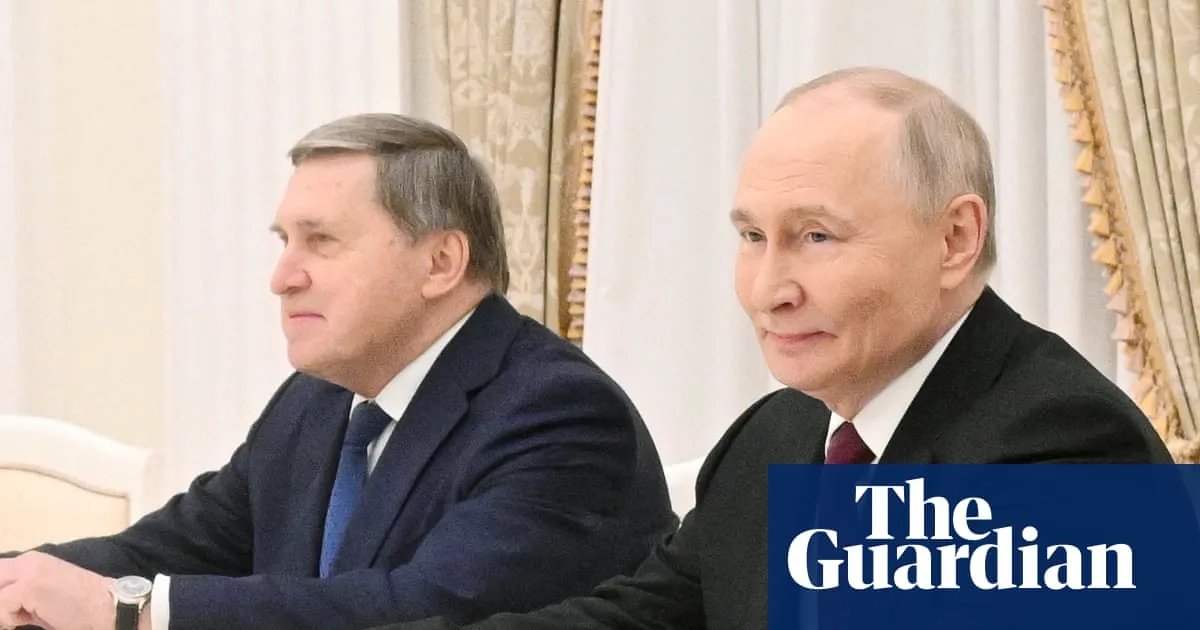
For days, officials across Europe scrambled to hastily planned meetings, hashing out details on frantic calls and hours-long negotiations. But after a tumultuous few weeks, capped off by the Russian president warning that his country was ready for war with Europe, peace in Ukraine appears to be no closer.Instead, what has seemingly been laid bare is the glaring clash of views underpinning the peace process.Since Russia launched its full-scale invasion of Ukraine nearly four years ago, leaders across Europe have become increasingly vocal about what they see as the imperialist intentions of Russia’s Vladimir Putin. In France and Germany, leaders have described Russia as a destabilising power whose sights are also set on the EU and Nato and argued that any Ukraine peace plan needs to take this into account. “Rewarding aggression will only invite more of it,” Kaja Kallas, the European Union’s top diplomat, recently told reporters.This view, however, sharply contrasts with that of leaders across the Atlantic – who have treated Putin as though he were any other world leader – rather than one with the seemingly endless appetite and ambition for expansion that he seems to have. Earlier this year, Donald Trump’s special envoy, Steve Witkoff, brushed off the suggestion that Russia would take further territory in Europe, saying in a US interview: “I take him at his word in this sense.”Similarly friendly positions have been voiced by Trump and his vice-president, JD Vance, leaving Europe in a depressing routine of trying to “push the Trump pendulum away from Russia,” only to watch it revert back to its “natural position of sympathy for Putin,” as our diplomatic editor, Patrick Wintour recently put it.The result is a sequence of events that is becoming routine: Washington unleashes a “diplomatic cavalry charge” against Ukraine that Kyiv, alongside other European capitals, manages to fend off, as Dmytro Kuleba, the former foreign minister of Ukraine recently pointed out in an opinion piece. But the gains are short-lived: “They stabilise the situation but never actually win the battle. This pattern will, no doubt, persist.”The recent flurry of diplomatic activity echoed that of August, when Trump rolled out the red carpet for Putin in Alaska. European leaders frantically cleared their schedules to join Ukraine’s president, Volodymyr Zelenskyy, in Washington, coming together in a show of solidarity that was later dubbed the “Great European Charm Offensive”.Throughout all of this frenzied activity, missiles and drones have continued to rain down nightly on Ukraine, making one thing clear. “By night, Putin brutally reminds the world that, for him, war remains the primary tool for achieving ‘peace’,” wrote Kuleba.This week is shaping up to be a prime example. On Tuesday, days after leaders in Ukraine appeared to have staved off the imposition of a US plan that was heavily tilted in Russia’s favour, Witkoff, accompanied by Trump’s son-in-law Jared Kushner, arrived in Moscow.As European leaders expressed concerns that the Moscow talks would pile pressure on Ukraine to make concessions, Putin claimed Russian forces had taken control of the strategic city of Pokrovsk in Ukraine – a claim swiftly denied by Ukraine’s military and Zelenskyy. Soon after Putin made hawkish remarks accusing European governments of being on the “side of war” by seeking to sabotage the peace process. He added: “Russia does not intend to fight Europe, but if Europe starts, we are ready right now.”skip past newsletter promotionafter newsletter promotionThe remarks appeared to be an attempt to drive a wedge between Washington and Europe, said the Guardian’s Russian affairs reporter, Pjotr Sauer. Russia has seemingly been happy to capitalise on this clash of views, pushing for a peace deal as long as it is only on Russia’s terms.“The Russians see this as a win-win situation,” said Pjotr. Either the peace plan goes ahead, with Russia’s maximalist demands in effect requiring Ukraine’s capitulation, or they’ll “just keep on fighting”.To receive the complete version of This Is Europe in your inbox every Wednesday, please subscribe here.
SRCThe Guardian - World News
LANGEN
LEANCenter-Left
WORDS656
ENT9
WED · 2025-12-03 · 16:08 GMTBRIEF NSR-2025-1203-773
NSR-2025-1203-773Analysis·EN·Political Strategy
Amid missiles and diplomacy, Russia is exploiting western divisions over Ukraine
Amidst ongoing conflict and diplomatic efforts regarding Ukraine, Russia is reportedly exploiting divisions between Western nations. European leaders increasingly view Russia as an aggressive, destabilizing force with broader ambitions beyond Ukraine, advocating for a firm stance.
Ashifa KassamThe Guardian - World NewsFiled 2025-12-03 · 16:08 GMTLean · Center-LeftRead · 3 min
The Guardian - World NewsFIG 01
Reading time
3min
Word count
656words
Sources cited
6cited
Entities identified
9entities
Quality score
100%
§ 01
Briefing Summary
AI-generatedNEWSAR · AI
Amidst ongoing conflict and diplomatic efforts regarding Ukraine, Russia is reportedly exploiting divisions between Western nations. European leaders increasingly view Russia as an aggressive, destabilizing force with broader ambitions beyond Ukraine, advocating for a firm stance. This contrasts with some American leaders, particularly within the Republican party, who express a more lenient view towards Putin and downplay the threat of further Russian expansion. This divergence leads to repeated cycles where European and Ukrainian efforts to counter Russian influence are undermined by shifts in U.S. policy, creating instability in the region. The situation highlights a fundamental disagreement on how to approach Russia's actions and intentions in Eastern Europe.
Confidence 0.90Sources 6Claims 5Entities 9
§ 02
Article analysis
Model · rule-basedFraming
Political Strategy
Conflict
Tone
Mixed Tone
AI-assessed
CalmNeutralAlarmist
Factuality
0.60 / 1.00
Mixed
LowHigh
Sources cited
6
Well sourced
FewMany
§ 03
Key claims
5 extracted01
By night, Putin brutally reminds the world that, for him, war remains the primary tool for achieving ‘peace’
quoteDmytro Kuleba
Confidence
1.00
02
Rewarding aggression will only invite more of it.
quoteKaja Kallas
Confidence
1.00
03
Donald Trump's special envoy brushed off suggestions that Russia would take further territory in Europe.
factualnull
Confidence
0.90
04
Leaders in France and Germany view Russia as a destabilising power.
factualnull
Confidence
0.90
05
Russia is exploiting western divisions over Ukraine.
factualnull
Confidence
0.80
§ 04
Full report
3 min read · 656 words§ 05
Entities
9 identifiedKey playerOppositionContextPositiveNeutralNegative
People5
§ 06
Keywords & salience
10 termsukraine
1.00
russia
0.90
western divisions
0.80
diplomacy
0.70
vladimir putin
0.60
peace process
0.60
donald trump
0.50
nato
0.50
european union
0.50
imperialist intentions
0.40
§ 07
Topic connections
Interactive graph Network visualization showing 51 related topics
View Full Graph Person Organization Location Event|Click node to navigate|Edge numbers = shared articles