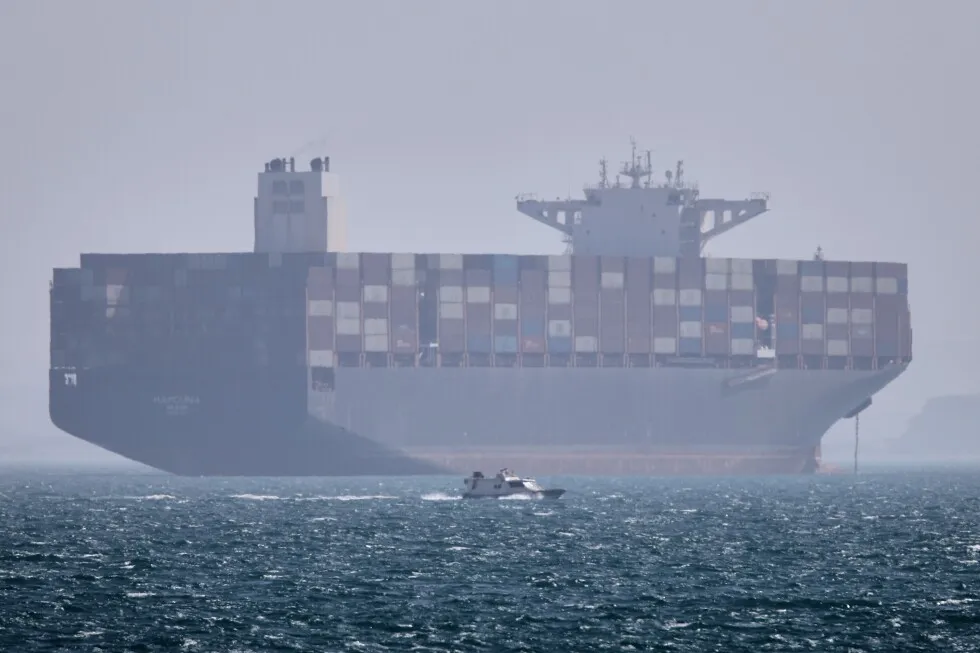
Trump meeting with aides to make ‘final determination’ on moving forward with Iran deal 1 of 5 | The Trump administration said from the start of the war with Iran that they undertook it to ensure that the country could never have a nuclear weapon. But Vance told reporters that the U.S. “could substantially set back their nuclear program -- over the long term.” 2 of 5 | A container ship sits at anchor as a small motorboat passes in the foreground in the Strait of Hormuz off Bandar Abbas, Iran, Saturday, May 2, 2026. (Amirhosein Khorgooi/ISNA via AP) 3 of 5 | People cross an intersection in front of a billboard showing a portrait of the late Iranian President Ebrahim Raisi, who was killed in a helicopter crash in 2024, in downtown Tehran, Iran, Thursday, May 28, 2026. (AP Photo/Vahid Salemi) 4 of 5 | Men ride on their motorbike at the historic neighborhood of Oudlajan in Tehran, Iran, Thursday, May 28, 2026. (AP Photo/Vahid Salemi) 5 of 5 | This is a locator map for the Gulf Cooperation Council member states: Saudi Arabia, Bahrain, Qatar, Oman, Kuwait and United Arab Emirates. (AP Photo) 1 of 5 The Trump administration said from the start of the war with Iran that they undertook it to ensure that the country could never have a nuclear weapon. But Vance told reporters that the U.S. “could substantially set back their nuclear program -- over the long term.” Add AP News on Google Add AP News as your preferred source to see more of our stories on Google. Share 2 of 5 | A container ship sits at anchor as a small motorboat passes in the foreground in the Strait of Hormuz off Bandar Abbas, Iran, Saturday, May 2, 2026. (Amirhosein Khorgooi/ISNA via AP) 2 of 5 A container ship sits at anchor as a small motorboat passes in the foreground in the Strait of Hormuz off Bandar Abbas, Iran, Saturday, May 2, 2026. (Amirhosein Khorgooi/ISNA via AP) Add AP News on Google Add AP News as your preferred source to see more of our stories on Google. Share 3 of 5 | People cross an intersection in front of a billboard showing a portrait of the late Iranian President Ebrahim Raisi, who was killed in a helicopter crash in 2024, in downtown Tehran, Iran, Thursday, May 28, 2026. (AP Photo/Vahid Salemi) 3 of 5 People cross an intersection in front of a billboard showing a portrait of the late Iranian President Ebrahim Raisi, who was killed in a helicopter crash in 2024, in downtown Tehran, Iran, Thursday, May 28, 2026. (AP Photo/Vahid Salemi) Add AP News on Google Add AP News as your preferred source to see more of our stories on Google. Share 4 of 5 | Men ride on their motorbike at the historic neighborhood of Oudlajan in Tehran, Iran, Thursday, May 28, 2026. (AP Photo/Vahid Salemi) 4 of 5 Men ride on their motorbike at the historic neighborhood of Oudlajan in Tehran, Iran, Thursday, May 28, 2026. (AP Photo/Vahid Salemi) Add AP News on Google Add AP News as your preferred source to see more of our stories on Google. Share 5 of 5 | This is a locator map for the Gulf Cooperation Council member states: Saudi Arabia, Bahrain, Qatar, Oman, Kuwait and United Arab Emirates. (AP Photo) 5 of 5 This is a locator map for the Gulf Cooperation Council member states: Saudi Arabia, Bahrain, Qatar, Oman, Kuwait and United Arab Emirates. (AP Photo) Add AP News on Google Add AP News as your preferred source to see more of our stories on Google. Share Updated [hour]:[minute] [AMPM] [timezone], [monthFull] [day], [year] WASHINGTON (AP) — U.S. President Donald Trump said Friday he’s holding a White House Situation Room meeting with his advisors as he looks to make a “final determination” on moving forward with a deal to extend the Iran ceasefire and reopen the Strait of Hormuz.Trump confirmed the high-level White House talks the day after The Associated Press and other news outlets reported that U.S. and Iranian negotiators had come to terms on a tentative agreement. The deal would extend the fragile ceasefire by 60 days as new talks are held on Iran’s disputed nuclear program.Trump in a social media posting said that “Iran must agree that they will never have a nuclear weapon or Bomb,” the Strait of Hormuz must be reopened for international navigation and all sea mines dropped in the waterway must be destroyed as part of the agreement.Iran’s main negotiator said Friday that it has “no trust in guarantees or words,” only actions, underscoring lingering distrust after the U.S. and Israel have twice attacked Iran over the past year while it was engaged in nuclear negotiations.“No step will be taken before the other side acts,” Mohammad Bagher Qalibaf, who attended talks in Qatar this week, wrote on X. “We do not gain concessions through talks, but through missiles.” Vance says discussions continue on nuclear issuesOn Thursday, U.S. Vice President JD Vance suggested negotiators were trying to strike general terms on Iran’s nuclear program in the tentative agreement, with the specifics to be hammered out in the ensuing talks.Vance said the sides were going back and forth on “a couple of issues on the nuclear stuff, the highly enriched stockpile, and also the question of enrichment.” The Islamic Republic has 440.9 kilograms (972 pounds) of uranium that is enriched up to 60% purity, a short, technical step from weapons-grade levels of 90%, according to the International Atomic Energy Agency. 2 MIN READ 3 MIN READ 6 MIN READ Trump and his team said from the start of the conflict that a prime objective was to ensure that Iran can never have a nuclear weapon. Vance framed the war’s accomplishments more modestly. “We’re in a position where we could substantially set back their nuclear program, not just during the term of this president but over the long term,” Vance said, saying that would be “very, very good” for Americans.Iran has long maintained its nuclear program is peaceful and has not publicly committed to giving up the stockpile, believed to be buried under a trio of nuclear sites that were badly damaged by U.S. strikes last year.Deal would reopen the Strait of Hormuz The proposed memorandum makes clear that Iran would not be able to impose tolls on the Strait of Hormuz and that it would have to remove all mines from the vital waterway within 30 days, according to a U.S. official who was not authorized to comment publicly and spoke on condition of anonymity.The U.S. would gradually lift its blockade on Iranian ports and would also agree to relax sanctions, allowing Iran to sell more of its oil. Iran has effectively closed the strait since the U.S. and Israel launched a surprise attack on Feb. 28 that killed Iran’s supreme leader and other top officials. Before then, the waterway was open to international traffic, and around a fifth of the world’s oil and gas passed through it. The closure of the strait, which runs between Iran and Oman, has caused the price of fuel and other goods to soar, with the effects felt far beyond the Middle East.Iran has said it lets some commercial vessels pass — about two dozen daily in recent days, compared with more than 100 a day before the war. But the Islamic Republic also has charged tolls for at least some ships and established a formal gatekeeper agency earlier this month, spurring a new round of U.S. sanctions this week. Iran and Oman discuss strait after Trump threatIranian Foreign Minister Abbas Araghchi said Friday that he discussed the strait’s future management with his Omani counterpart. Araghchi wrote on X that he expressed expressed solidarity “in the face of any threat.”On Wednesday, Trump had warned Oman — a U.S. ally — not to enter into any agreement with Iran to share control of the strait or the U.S. will “have to blow them up.”Meanwhile, U.S. Secretary of State Marco Rubio met with Pakistan’s top diplomat, Ishaq Dar, whose country has been mediating the Iran talks. Neither Rubio nor Dar spoke as they posed for photographs at the State Department in Washington.Even as word of the potential deal emerged, the U.S. Treasury Department imposed additional sanctions on the Iranian military’s oil sales arm. The new penalties, first reported by The Associated Press, extend the Trump administration’s economic pressure campaign. Since the ceasefire began about seven weeks ago, the U.S. and Iran have traded strikes and accusations of ceasefire violations. But they have not returned to full-scale hostilities and have kept negotiating.___Associated Press writers Jennifer Peltz and Farnoush Amiri in New York and Matthew Lee in Washington contributed to this report. Madhani covers the White House for The Associated Press. He is based in Washington. Price covers the White House. She previously covered the 2024 presidential campaign and politics, government and other news in New York, Nevada, Utah and Arizona. She is based in Washington.
SRCAssociated Press (AP)
LANGEN
LEANCenter
WORDS1 503
ENT12
FRI · 2026-05-29 · 14:23 GMTBRIEF NSR-2026-0529-80226
NSR-2026-0529-80226News Report·EN·Conflict
Questions dog tentative US-Iran deal as Iranian official says concessions come ‘through missiles’
The U.S. and Iran have reached a tentative agreement to extend their ceasefire for 60 days, with further talks planned on Iran's nuclear program.
By
AAMER MADHANI and MICHELLE L. PRICEAssociated Press (AP)Filed 2026-05-29 · 14:23 GMTLean · CenterRead · 7 min
Associated Press (AP)FIG 01
Reading time
7min
Word count
1 503words
Sources cited
2cited
Entities identified
12entities
Quality score
100%
§ 01
Briefing Summary
AI-generatedNEWSAR · AI
The U.S. and Iran have reached a tentative agreement to extend their ceasefire for 60 days, with further talks planned on Iran's nuclear program. U.S. Vice President JD Vance stated that the deal would address Iran's highly enriched uranium stockpile, though specific details are still being negotiated. However, Iranian Parliament Speaker Mohammad Bagher Qalibaf expressed distrust in negotiations, asserting that concessions are gained through military strength rather than talks. President Trump is meeting with advisors to finalize a decision on the deal, which he stated must include Iran's commitment to never possess nuclear weapons, the reopening of the Strait of Hormuz, and the removal of sea mines. The tentative agreement also reportedly includes the gradual lifting of U.S. naval blockades on Iranian ports and relaxation of sanctions.
Confidence 0.90Sources 2Claims 4Entities 12
§ 02
Article analysis
Model · rule-basedFraming
Conflict
National Security
Tone
Mixed Tone
AI-assessed
CalmNeutralAlarmist
Factuality
0.60 / 1.00
Mixed
LowHigh
Sources cited
2
Limited
FewMany
§ 03
Key claims
4 extracted01
President Ebrahim Raisi was killed in a helicopter crash in 2024.
factualAP Photo/Vahid Salemi
Confidence
1.00
02
An Iranian official stated that concessions to the US come 'through missiles'.
quoteIranian official
Confidence
1.00
03
The Trump administration's stated goal in its war with Iran was to prevent the country from obtaining a nuclear weapon.
factualTrump administration
Confidence
0.90
04
The US could substantially set back Iran's nuclear program over the long term.
quoteVance
Confidence
0.80
§ 04
Full report
7 min read · 1 503 words§ 05
Entities
12 identifiedKey playerOppositionContextPositiveNeutralNegative
Organizations1
Locations8
§ 06
Keywords & salience
9 termsus-iran deal
1.00
nuclear weapon
0.90
nuclear program
0.80
strait of hormuz
0.70
trump administration
0.60
missiles
0.50
concessions
0.40
iran
0.40
united states
0.40
§ 07
Topic connections
Interactive graph Network visualization showing 51 related topics
View Full Graph Person Organization Location Event|Click node to navigate|Edge numbers = shared articles