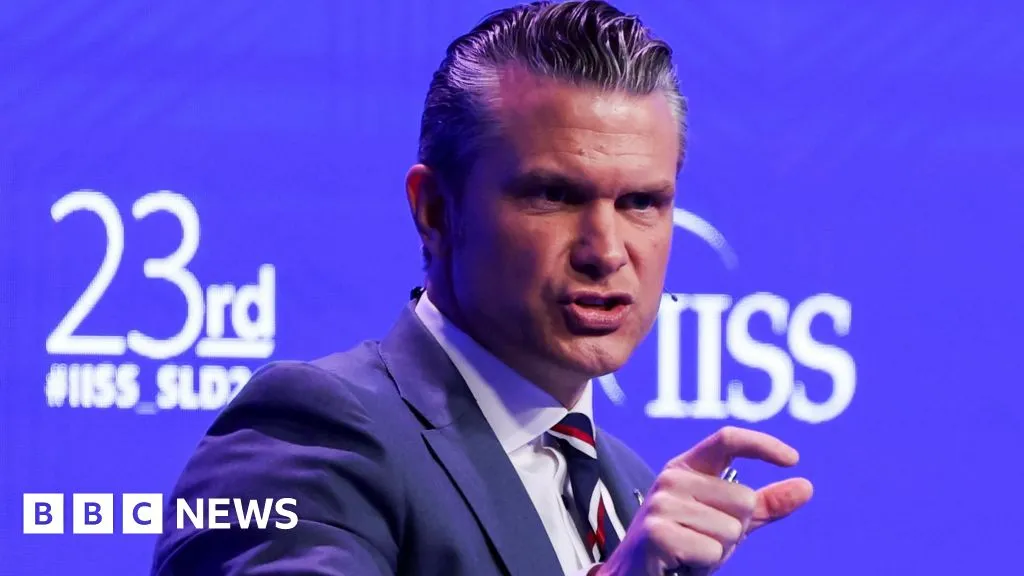
Separately, a dialogue participant raised the question of the US's ability to fulfil arms deals with its partners after suspending a $14bn (£10bn) package to Taiwan in order to conserve munitions for the war in Iran.Hegseth said he would "very much decouple the two" issues, insisting the US was in a "very good place... very strong position" in terms of its overall munitions stockpile and ability to produce more if needed.In his speech, Hegseth emphasised the US's "strong, quiet and clear" approach to the region - its capacity to wield a "big stick" but "speak softly".Central to this approach was more weapons, he insisted, instead of "empty globalist rhetoric about the rules-based international order"."Rules are great, but if you can't back them up with hard power, the rules are not worth the paper they are written on," he said. "We don't need more conferences, we need more combat power… less Shangri-La Dialogue, more ships and more subs."His comments came hours after Vietnam's President To Lam called for more dialogue to resolve tensions in the region, in the defence summit's keynote speech.Reiterating a demand which he made in last year's speech, Hegseth called on Asian allies to spend more on defence, setting 3.5% of their GDP as a target.He heaped praise on countries who have in recent months increased military spending and co-operation with the US, namechecking allies such as South Korea, Japan, Australia, and Philippines among others.
SRCBBC News - World
LANGEN
LeanCenter
WORDS237
ENT12
SAT · 2026-05-30 · 05:57 GMTBRIEF NSR-2026-0530-80374
NSR-2026-0530-80374News Report·EN·National Security
US not 'turning back' on Asia allies, but expects them to boost defence - Hegseth
At an Asian security summit in Singapore, US Defense Secretary Hegseth reassured allies that the US remains committed to the region, emphasizing a "strong, quiet and clear" approach backed by hard power. He stated the US is not "turning back" on its Asian partners but expects them to increase their defense spending, suggesting a target of 3.5% of GDP.
BBC News - WorldFiled 2026-05-30 · 05:57 GMTLean · CenterRead · 1 min
BBC News - WorldFIG 01
Reading time
1min
Word count
237words
Sources cited
2cited
Entities identified
12entities
NEWSAR · AI
At an Asian security summit in Singapore, US Defense Secretary Hegseth reassured allies that the US remains committed to the region, emphasizing a "strong, quiet and clear" approach backed by hard power. He stated the US is not "turning back" on its Asian partners but expects them to increase their defense spending, suggesting a target of 3.5% of GDP. Hegseth downplayed concerns about the US's ability to fulfill arms deals, asserting a strong munitions stockpile and production capacity, despite a recent suspension of a package to Taiwan. He argued for increased combat power over "empty globalist rhetoric," calling for more ships and submarines rather than additional conferences. This comes as Vietnam's President called for more dialogue to resolve regional tensions.
Confidence 0.90Sources 2Claims 5Entities 12
Framing
National Security
Diplomatic
Tone
Measured
AI-assessed
CalmNeutralAlarmist
Factuality
0.60 / 1.00
Mixed
LowHigh
Sources cited
2
Limited
FewMany
01
Rules are not worth the paper they are written on if they cannot be backed up with hard power.
quoteHegseth
Confidence
1.00
02
Asian allies should spend 3.5% of their GDP on defence.
statisticHegseth
Confidence
1.00
03
The US is in a 'very good place' regarding its overall munitions stockpile and production capacity.
quoteHegseth
Confidence
1.00
04
The US is not 'turning back' on Asia allies but expects them to boost defence spending.
quoteHegseth
Confidence
1.00
05
The US suspended a $14bn arms package to Taiwan to conserve munitions for the war in Iran.
factualdialogue participant
Confidence
0.80
§ 04
Full report
1 min read · 237 wordsKey playerOppositionContextPositiveNeutralNegative
Locations8
defence spending
1.00
asia allies
1.00
us defence policy
0.90
munitions stockpile
0.80
hard power
0.70
combat power
0.60
rules-based international order
0.60
shangri-la dialogue
0.50
taiwan
0.40
vietnam
0.40
§ 07
Connections
Who appears together in the newsIn this articleWider coverageLine weight = articles in common
Laying out network…
Strongest ties articles in common
- 12,267
- 866
- 667
- 663
- 632
- 486
Recurring context not named in this article
- PDonald Trumplinks 12
- PXi Jinpinglinks 11
- LSingaporelinks 11
- LBeijinglinks 11
- LIndialinks 11
- LChinalinks 11
- LWashingtonlinks 10
- LRussialinks 10