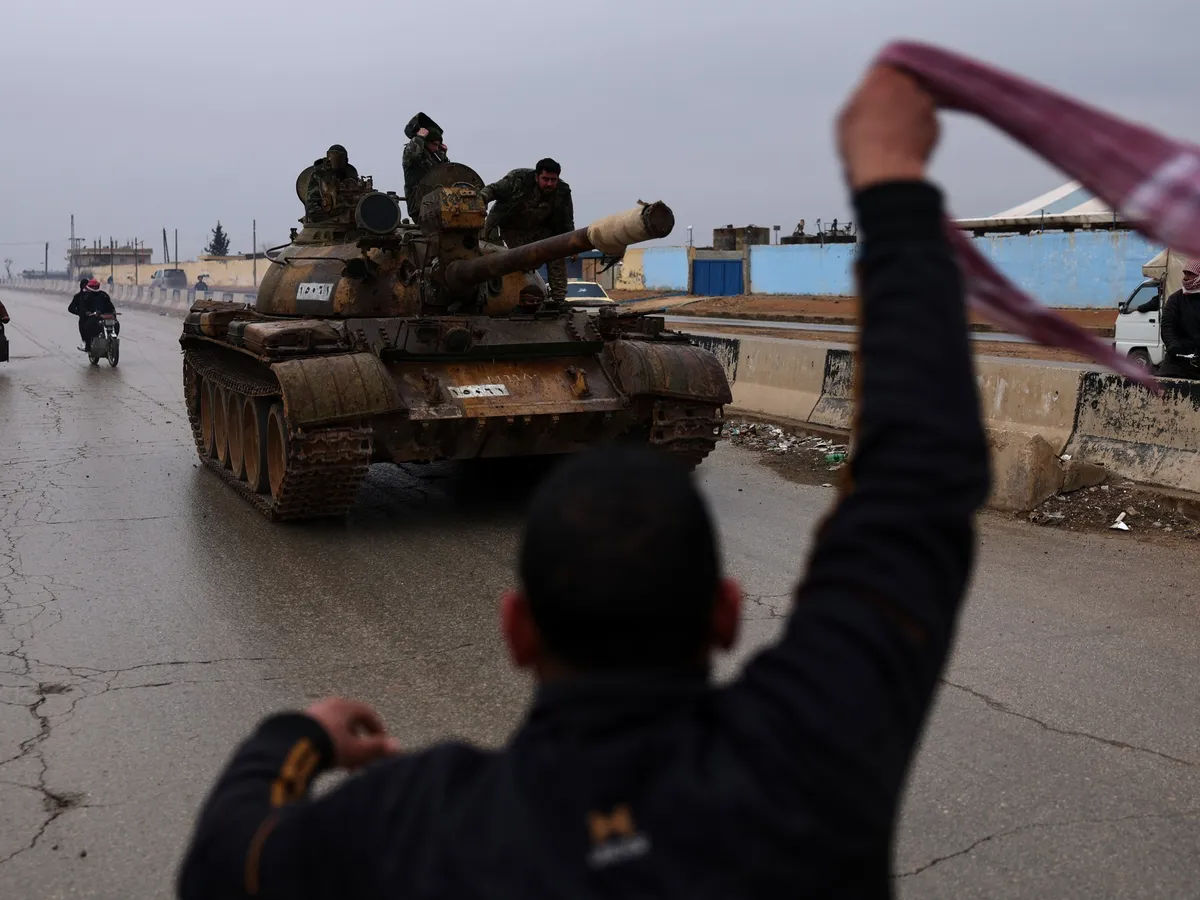
Military says it seized 34 villages and towns in the region as it keeps taking over territories from Kurdish fighters.People welcome Syrian government forces as they enter the town of Deir Hafer [Ghaith Alsayed/AP]Published On 17 Jan 2026Syria’s army says its forces have taken control of dozens of towns in the east of Aleppo governorate after the Kurdish-led Syrian Democratic Forces (SDF) withdrew from the areas.After driving out Kurdish forces from Aleppo city last week following deadly clashes, Syria’s army deployed reinforcements near Deir Hafer and other towns, and told the SDF to evacuate the area between the town and the Euphrates River, about 30km (18 miles) further east, amid a power struggle over the disarmament of the Kurdish-led group.Recommended Stories list of 4 itemslist 1 of 4Syrian army announces full control of Deir Hafer after SDF withdrawallist 2 of 4Photos: Syrian Army enters Deir Hafer after SDF withdrawallist 3 of 4Syria decree grants Kurds new rights, formally recognising Kurdish languagelist 4 of 4Syrian army tells civilians to evacuate new front with SDF east of Aleppoend of listIn statements to state television, Syria’s army said it had taken control of “34 villages and towns” east of Aleppo since it started entering the areas on Saturday morning, including the key towns of Deir Hafer and Maskana, as well as a military airport.However, it accused the SDF of violating the agreement and targeting an army patrol near Maskana, “killing two soldiers”.It also said it had secured the exit of “more than 200 SDF organisation fighters and their weapons”.The SDF, meanwhile, accused Damascus of violating the agreement, saying the army entered the towns of Deir Hafer and Maskana “before our fighters had fully withdrawn, creating a highly dangerous situation”, reporting clashes.CelebrationsAl Jazeera’s Zein Basravi, reporting from Deir Hafer, said civilians are on their way back to the town, trying to enter it.“We have seen families travelling in the backs of pick-up trucks, braving cold, rainy weather. They are arriving at mud walls set up by the SDF as roadblocks and checkpoints as part of their positions,” he said,“We are now seeing bulldozers moving in to clear the area, as the Syrian military attempts to establish control and carry out checks on those returning.”Basravi also said people were elated at the fact that the city was under the control of the Syrian military. “Things here are celebratory,” he said.Syria’s government is seeking to extend its authority across the country following the removal of longtime leader Bashar al-Assad in December 2024.The SDF controls swaths of Syria’s oil-rich north and northeast, much of which it captured during the country’s civil war and the fight against the ISIL (ISIS) group over the past decade – a war the SDF fought as the main regional ally of the United States.Progress on implementing a March deal to integrate the political and armed bodies of the Kurdish de facto autonomous administration and forces into the state has stalled amid differences between the two sides, including the Kurds’ demand for decentralised rule.On Friday evening, the Syrian Army struck what it said were Kurdish positions in Deir Hafer. The SDF announced during the attack that the town was “currently under heavy artillery bombardment”.Kurdish leader Mazloum Abdi, also known as Mazloum Kobani, committed to withdrawing the SDF on Saturday morning “towards redeployment in areas east of the Euphrates”, based on “calls from friendly countries and mediators”.The Syrian defence ministry welcomed Abdi’s announcement, saying its troops would deploy after the SDF withdrew.The Syrian Army had urged civilians to flee Deir Hafer in recent days, with at least 4,000 people leaving, according to Syrian authorities.Millions of Kurds live across Syria, Iraq, Iran and Turkiye, with about one to 1.5 million estimated to live in northeastern Syria, controlled by the SDF.Kurdish rights recognisedThe latest advance of the Syrian Army came a day after President Ahmed al-Sharaa issued a decree, declaring Kurdish a “national language” and granting the minority official recognition in an apparent goodwill gesture, though the Kurds said it fell short of their aspirations.Al-Sharaa’s announcement was the first formal recognition of Kurdish rights since Syria’s independence in 1946.The decree stated that Kurds are “an essential and integral part” of Syria, where they have suffered decades of marginalisation and oppression under former rulers.It made Kurdish a “national language” that can be taught in public schools in areas where the community is heavily present, and granted nationality to all Kurds, 20 percent of whom had been stripped of it under a controversial 1962 census.The Kurdish administration in Syria’s north and northeast said the decree was “a first step, however, it does not satisfy the aspirations and hopes of the Syrian people”.“Rights are not protected by temporary decrees, but … through permanent constitutions that express the will of the people and all components” of society, it said in a statement.
SRCAl Jazeera
LANGEN
LEANCenter
WORDS802
ENT8
SAT · 2026-01-17 · 12:42 GMTBRIEF NSR-2026-0117-8203
NSR-2026-0117-8203News Report·EN·Conflict
Syrian army takes control of east Aleppo towns as Kurdish fighters withdraw
In January 2026, the Syrian army announced it had taken control of 34 towns and villages east of Aleppo, including Deir Hafer and Maskana, after the Kurdish-led Syrian Democratic Forces (SDF) withdrew from the area. The Syrian army's advance followed deadly clashes in Aleppo city and a demand for the SDF to disarm and evacuate the area between Deir Hafer and the Euphrates River.
Al JazeeraFiled 2026-01-17 · 12:42 GMTLean · CenterRead · 4 min
Al JazeeraFIG 01
Reading time
4min
Word count
802words
Sources cited
2cited
Entities identified
8entities
Quality score
100%
§ 01
Briefing Summary
AI-generatedNEWSAR · AI
In January 2026, the Syrian army announced it had taken control of 34 towns and villages east of Aleppo, including Deir Hafer and Maskana, after the Kurdish-led Syrian Democratic Forces (SDF) withdrew from the area. The Syrian army's advance followed deadly clashes in Aleppo city and a demand for the SDF to disarm and evacuate the area between Deir Hafer and the Euphrates River. While the Syrian army claimed the SDF violated the agreement by attacking an army patrol, the SDF accused the army of entering towns before their full withdrawal, leading to clashes. Civilians are reportedly returning to the area, and the Syrian military is working to establish control. The Syrian government is seeking to exert its authority in the region.
Confidence 0.90Sources 2Claims 5Entities 8
§ 02
Article analysis
Model · rule-basedFraming
Conflict
Political Strategy
Tone
Measured
AI-assessed
CalmNeutralAlarmist
Factuality
0.80 / 1.00
Factual
LowHigh
Sources cited
2
Limited
FewMany
§ 03
Key claims
5 extracted01
Syria’s army accused the SDF of violating the agreement and targeting an army patrol near Maskana, “killing two soldiers”.
factualSyria's army
Confidence
1.00
02
Syria’s army said it had taken control of “34 villages and towns” east of Aleppo.
factualSyria’s army
Confidence
1.00
03
The SDF accused Damascus of violating the agreement, reporting clashes.
factualSDF
Confidence
1.00
04
Syria’s army says its forces have taken control of dozens of towns in the east of Aleppo governorate.
factualSyria’s army
Confidence
1.00
05
Syria’s government is seeking to extend its authority across the country.
factual
Confidence
0.90
§ 04
Full report
4 min read · 802 words§ 05
Entities
8 identifiedKey playerOppositionContextPositiveNeutralNegative
People1
Organizations2
§ 06
Keywords & salience
10 termssyrian army
1.00
kurdish fighters
0.90
aleppo
0.80
syrian democratic forces
0.80
territorial control
0.70
deir hafer
0.70
maskana
0.60
military operation
0.50
power struggle
0.50
syria
0.40
§ 07
Topic connections
Interactive graph No topic relationship data available yet. This graph will appear once topic relationships have been computed.