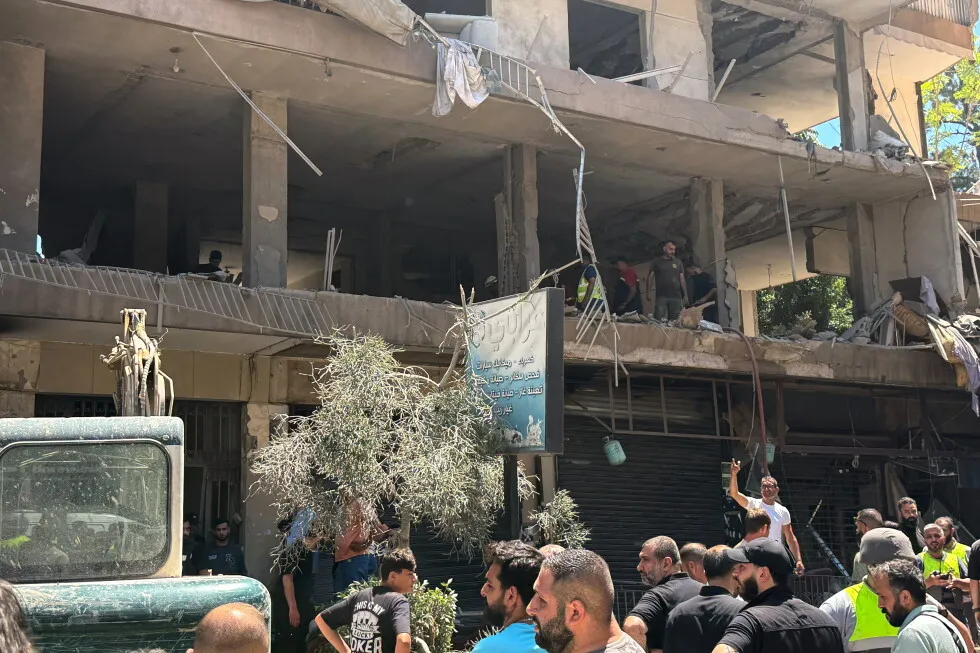
Israeli military strikes Beirut suburbs in the lead-up to anticipated US-Iran deal 1 of 4 | People gather at the site of an Israeli airstrike that struck an apartment in Dahiyeh, Beirut’s southern suburbs, Lebanon, Sunday, June 14, 2026. (AP Photo/Bilal Hussein) 2 of 4 | People gather at the site of an Israeli airstrike that struck an apartment in Dahiyeh, Beirut’s southern suburbs, Lebanon, Sunday, June 14, 2026. (AP Photo/Bilal Hussein) 3 of 4 | A man checks an apartment that was hit in an Israeli airstrike in Dahiyeh, Beirut’s southern suburbs, Lebanon, Sunday, June 14, 2026. (AP Photo/Bilal Hussein) 4 of 4 | People gather at the site where an Israeli airstrike struck an apartment in Dahiyeh, Beirut’s southern suburbs, Lebanon, Sunday, June 14, 2026. (AP Photo/Bilal Hussein) By JULIA FRANKEL, ABBY SEWELL, MUNIR AHMED and SAMY MAGDY Updated 1:50 PM MESZ, June 14, 2026 Leer en español Add AP News on Google Add AP News as your preferred source to see more of our stories on Google. Share Share Facebook Copy Link copied Print Email X LinkedIn Bluesky Flipboard Pinterest Reddit JERUSALEM (AP) — The Israeli military said it launched strikes on Beirut on Sunday targeting Hezbollah infrastructure, despite ongoing efforts to negotiate an end to the U.S.-Iran war. Smoke could be seen rising over the Lebanese capital. The strikes threatened to hamper negotiations over a deal, which in its current form is a deep disappointment to Israel’s government. The last time Israel struck the Beirut suburbs a week ago, it set off the most serious escalation of fighting between Iran and Israel since the tenuous ceasefire took hold April 7. The office of Israeli Prime Minister Benjamin Netanyahu said the strikes were in response to Hezbollah attacks on the north of the country. Israel’s military said earlier in the day that Hezbollah had launched three projectiles into northern Israel, releasing footage where an audible boom was followed by a column of smoke rising above the tree line. An Associated Press photographer at the scene in Beirut said the building struck was a five-story apartment building with shops on the bottom floor. The two lower floors were the most heavily damaged by the strikes. Residents of the southern suburbs, many of whom had returned to their homes after a period of relative calm in recent weeks, could be seen fleeing the area. Hezbollah fired missiles into Israel on March 2, two days after the U.S. and Israel attacked Iran, sparking war in the Middle East. Israeli troops have pushed their invasion of Lebanon deeper than at any point in over a quarter century. Slovenia’s new government lifts entry ban on Netanyahu and other measures against Israel 2 MIN READ 17 Trump calls off latest threats to strike Iran, citing a breakthrough in talks to end the war 5 MIN READ 1021 Netanyahu and Trump are at odds over the war they started together 5 MIN READ 571 Strike comes as mediators push Iran and the US closer to a deal Iran wants a ceasefire deal to include the fighting in Lebanon and seeks the release of billions of dollars in frozen funds. But as talks continued, Israel has been sidelined in negotiations led by Pakistan and others. “Israel will not tolerate firing into its territory,” a statement from Netanyahu and Defense Minister Israel Katz said Sunday. Qatari mediators traveled to Tehran on Sunday to finalize the agreement, according to two regional officials. The officials, who spoke on the condition of anonymity because they were not authorized to speak to the media, expressed cautious optimism that the U.S. and Iran were finally approaching an agreement that could halt hostilities that have killed thousands of people and reopen the Strait of Hormuz, whose closure has thrown world markets into disarray. U.S. President Donald Trump and Pakistani Prime Minister Shehbaz Sharif said Saturday that the deal would be signed on Sunday, while Iran’s foreign ministry spokesperson Esmail Baghaei said it could happen in the coming days. Trump said that the Strait of Hormuz would open immediately after the signing. The deal is expected to be signed electronically, without an in-person ceremony, though it’s unclear when or how the signing will take place. The deal does not solve the thorniest issues between the U.S. and Iran, including Iran’s nuclear program or its frozen assets, but offers a 60-day framework for technical discussions on those issues, according to Pakistani and regional officials familiar with the ongoing negotiations who spoke on the condition of anonymity because they were not authorized to speak publicly. The officials described Pakistan’s monthslong effort leading the negotiations, struggling to keep both sides from walking out of the room and a total collapse of the negotiations on multiple occasions. Under the current deal being discussed, U.S. and Israel appear to have fallen short of their original goals of destroying Iran’s missile and nuclear programs and ending its support for proxies. It is not clear how the deal will address these issues, or if they will be part of the final agreement. Critics in Trump’s own Republican Party, struggling with an unpopular war ahead of the midterm elections, criticized the deal. Some said it did not improve on the terms of the 2015 Iran nuclear deal that Trump withdrew the U.S. from during his first term and which he still describes as “bad.” Meanwhile, Trump was expected to discuss demining the Strait of Hormuz during the Group of Seven summit that starts Monday. The waterway is crucial to significant shipments of oil, natural gas and related products like fertilizer, and its effective closure rocked the global economy. Iran’s nuclear program and highly enriched uranium have long been at the center of tensions with the U.S. and Israel and an international source of concern. Trump on social media asserted that “when all is calm,” the U.S. would go in and “downblend and destroy” the enriched uranium in Iran or in the U.S. Iran has 440.9 kilograms (972 pounds) of uranium that is enriched up to 60% purity, a short, technical step from weapons-grade levels of 90%, according to the International Atomic Energy Agency. Iran has long maintained its nuclear program is peaceful and has not publicly committed to giving up the enriched uranium, which is believed to be buried under three nuclear sites that were badly damaged by U.S. strikes last year. Frankel from Jerusalem, Ahmed from Islamabad, Magdy from Cairo and Sewell from Beirut. Associated Press writer Melanie Lidman in Tel Aviv, Israel, contributed to this report. JULIA FRANKEL Frankel, based in Jerusalem, has reported from across Israel and the Israeli-occupied West Bank. Her reporting focuses on war, human rights, displacement and criminal justice. twitter mailto ABBY SEWELL Sewell is the Associated Press news director for Lebanon, Syria and Iraq. She joined the AP in 2022 but has been based in the region since 2016, reporting and guiding coverage on some of its most significant news stories. twitter mailto SAMY MAGDY Magdy is a Middle East reporter for The Associated Press, based in Cairo. He focuses on conflict, migration and human rights abuses. twitter facebook mailto
SRCAssociated Press (AP)
LANGEN
LEANCenter
WORDS1 186
ENT12
SUN · 2026-06-14 · 10:23 GMTBRIEF NSR-2026-0614-84320
NSR-2026-0614-84320News Report·EN·Conflict
Qatari mediators travel to Tehran for final touches on a possible deal to end war
Qatari mediators traveled to Tehran on Sunday to finalize a potential deal aimed at ending the Iran war. This agreement, cautiously optimistic according to regional officials, seeks to halt hostilities that have caused thousands of deaths and reopen the Strait of Hormuz, which has disrupted global markets.
Associated Press (AP)Filed 2026-06-14 · 10:23 GMTLean · CenterRead · 5 min
Associated Press (AP)FIG 01
Reading time
5min
Word count
1 186words
Sources cited
3cited
Entities identified
12entities
Quality score
100%
§ 01
Briefing Summary
AI-generatedNEWSAR · AI
Qatari mediators traveled to Tehran on Sunday to finalize a potential deal aimed at ending the Iran war. This agreement, cautiously optimistic according to regional officials, seeks to halt hostilities that have caused thousands of deaths and reopen the Strait of Hormuz, which has disrupted global markets. U.S. President Donald Trump and Pakistani Prime Minister Shehbaz Sharif indicated the deal might be signed on Sunday, with Trump stating the Strait would open immediately after. The agreement does not resolve core issues like Iran's nuclear program or frozen assets but establishes a 60-day framework for technical discussions. Meanwhile, Israeli military strikes on Beirut targeting Hezbollah infrastructure occurred on Sunday, despite ongoing negotiation efforts, threatening to complicate the peace process.
Confidence 0.90Sources 3Claims 5Entities 12
§ 02
Article analysis
Model · rule-basedFraming
Conflict
Diplomatic
Tone
Measured
AI-assessed
CalmNeutralAlarmist
Factuality
0.80 / 1.00
Factual
LowHigh
Sources cited
3
Well sourced
FewMany
§ 03
Key claims
5 extracted01
The office of Israeli Prime Minister Benjamin Netanyahu stated the strikes were in response to Hezbollah attacks on northern Israel.
factualOffice of Israeli Prime Minister Benjamin Netanyahu
Confidence
1.00
02
The Israeli military launched strikes on Beirut targeting Hezbollah infrastructure.
factualIsraeli military
Confidence
1.00
03
Qatari mediators are traveling to Tehran for final touches on a possible deal to end the war.
factual
Confidence
0.90
04
Hezbollah fired missiles into Israel on March 2, two days after the U.S. and Israel attacked Iran, sparking war in the Middle East.
factual
Confidence
0.90
05
The strikes threatened to hamper negotiations over a deal to end the U.S.-Iran war.
factual
Confidence
0.90
§ 04
Full report
5 min read · 1 186 words§ 05
Entities
12 identifiedKey playerOppositionContextPositiveNeutralNegative
Organizations2
Locations7
§ 06
Keywords & salience
8 termsus-iran war
1.00
israeli military strikes
0.90
qatari mediators
0.80
negotiations
0.70
hezbollah infrastructure
0.60
beirut suburbs
0.50
ceasefire
0.50
escalation of fighting
0.40
§ 07
Topic connections
Interactive graph Network visualization showing 51 related topics
View Full Graph Person Organization Location Event|Click node to navigate|Edge numbers = shared articles