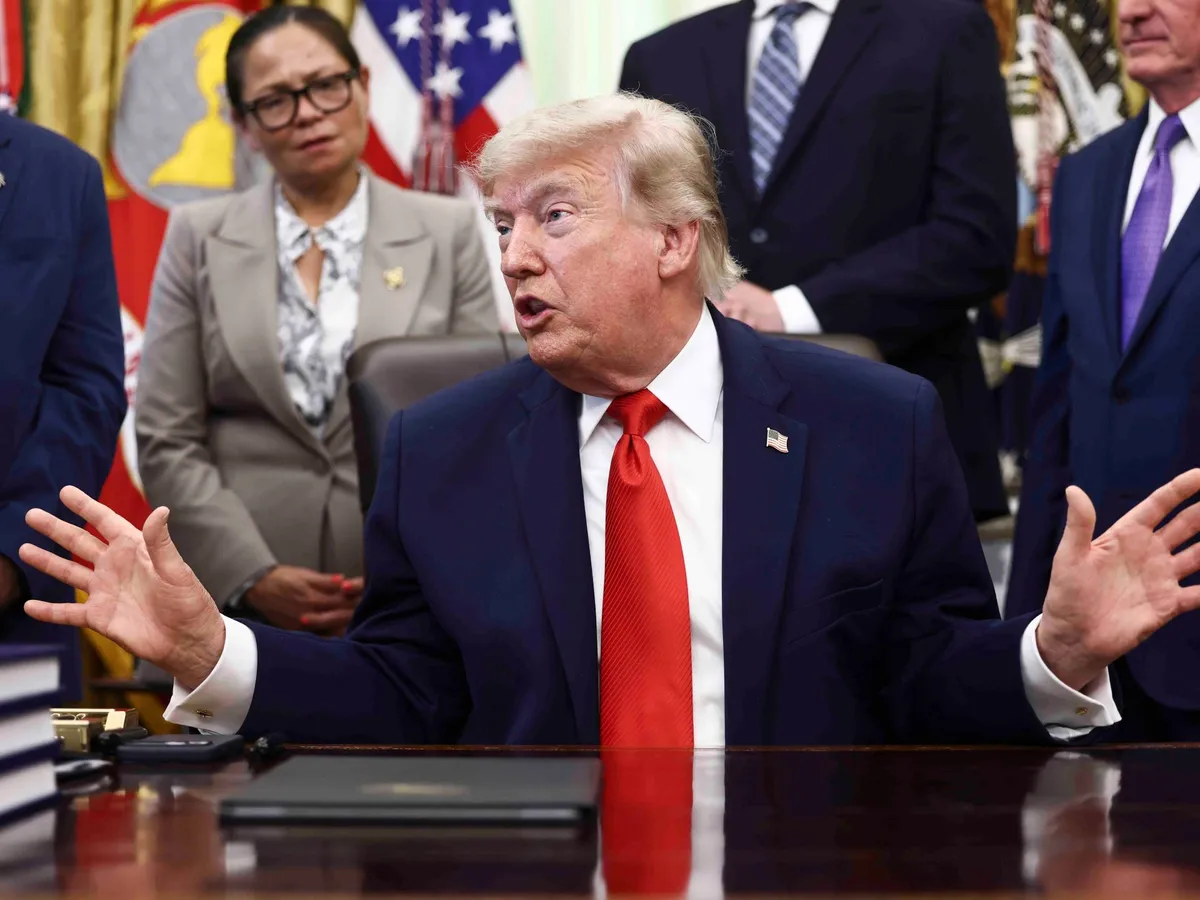
Trump says there should be ‘no more attacks’ by Israel or Hezbollah on ‘special day’ when deal could be signed.US President Donald Trump is seen in the Oval Office of the White House in Washington, DC, the United States [EPA]Published On 14 Jun 2026United States President Donald Trump has criticised Israel for launching an attack on Lebanon’s capital, Beirut, on the day he has said a deal to end the Israel-war" class="entity-link entity-event" data-entity-id="38759" data-entity-type="event">US-Israel war with Iran could be signed.In a post on Truth Social on Sunday, Trump said the Israeli attack on Beirut “should not have happened, particularly on a special day when we are so close to a Iran" class="entity-link entity-topic" data-entity-id="146234" data-entity-type="topic">Peace Deal with Iran”.Recommended Stories list of 3 itemslist 1 of 3Iran war day 107: Washington, Tehran close to signing first stage of deallist 2 of 3Signing of US-Iran deal not on Trump’s public schedulelist 3 of 3Trump says US-Iran deal to be signed on Sunday: Will it be?end of list“We are very close to a Deal that will bring peace to the region, including to Lebanon, and all sides should stand down,” he said.“There should be no more attacks by Israel anywhere in Lebanon, but there should also be no more attacks by any other party, including Hezbollah, against Israel,” he said.“This could be the beginning of a long and beautiful peace — Let’s not blow it!”The statement came shortly after Iran’s top negotiator and parliament speaker, Mohammad Bagher Ghalibaf, said Israel’s attacks had again drawn US trust into question.The US and Israel twice launched attacks against Iran – sparking the 12-day war in 2025 and the current war on February 28 – amid ongoing indirect talks over Iran’s nuclear programme.In a post on X, Ghalibaf said the US “either lacks the will to fulfil its commitments or the ability to do so”.“If you lack the will and ability to fulfil your commitments, speaking of continuing the path is not possible,” he added.Authorities have said at least three people have been killed in the Israeli strikes on the Dahiyeh area of Beirut.Israeli Prime Minister Benjamin Netanyahu had said the military launched the strikes in response to Hezbollah firing projectiles towards northern Israel.In his post on Truth Social, Trump questioned the justification.“Israel has the right to defend itself against threats, but the attack it was responding to was very small and meaningless, nobody was hurt, injured, or killed, and should not disrupt this important process,” he said.US says signing closeTrump on Saturday said that a deal with Iran was “scheduled” to be signed on Sunday, with top mediator Pakistan indicating the signing would be digital.But Iranian officials have offered a slightly different timeline, with Esmaeil Baghaei, a spokesperson for Iran’s Ministry of Foreign Affairs, saying on Saturday that the signing could take days.Still, both sides have broadly indicated that a signing of a memorandum of understanding to end fighting on all fronts, including in Lebanon, was closer than ever.While no official terms of that initial agreement have been released, both sides have indicated that the Strait of Hormuz would be open, the US naval blockade lifted, and fighting would be immediately halted.Questions over the deeply entrenched issues of the future of Iran’s nuclear programme, frozen Iranian assets and sanctions relief were expected to be addressed in a 60-day period following the initial signing.Speaking to Al Jazeera, Sami Nader, the director of the Levant Institute for Strategic Affairs, called Israel’s attacks on Sunday a “strategic test” for both sides.Israel has repeatedly pushed for Lebanon to be decoupled from any deal with Iran, he explained.“There is also a domestic intention, given the current upcoming election in Israel. Netanyahu has been criticised that he is not doing enough against Hezbollah, that he is very deferential, lenient to Trump,” Nader said during a television interview.US officials have publicly said that US and Israeli objectives for the war diverge.Obama weighs inWhile fighting between the US and Iran has been largely paused since April 8, barring a handful of flare-ups, efforts to reach a more lasting ceasefire have remained elusive.Trump has repeatedly vowed to reach a deal more stringent than the Joint Comprehensive Plan of Action (JCPOA) signed in 2015.Under the deal, reached between Iran, the US, the United Kingdom, Russia, Germany, France, China and the European Union, Tehran agreed to limit its nuclear programme and allow for unprecedented inspections in exchange for sanctions relief.Critics said the timelines of the agreement were not strict enough, with Trump unilaterally withdrawing in 2018. Iran has for years denied seeking a nuclear weapon.Speaking during an interview on the ABC News programme “This Week” released on Sunday, former US President Barack Obama said it was unlikely a better deal on Iran’s nuclear programme could be negotiated than the one his administration negotiated.“It is doubtful that any agreement that arises is going to be significantly different or a significant improvement from the deal that we had in the first place,” he said.Obama added that the US can not “just bully our way or bomb our way to solutions”.“You’d think we would have learned that lesson by now,” he said.
SRCAl Jazeera
LANGEN
LEANCenter
WORDS845
ENT12
SUN · 2026-06-14 · 15:22 GMTBRIEF NSR-2026-0614-84342
NSR-2026-0614-84342News Report·EN·Diplomatic
Trump condemns Israel attack on Beirut, says Iran deal still close
US President Donald Trump condemned Israel's attack on Beirut, stating it should not have occurred on a day when a peace deal with Iran was close to being signed. Trump urged both Israel and Hezbollah to cease attacks, emphasizing the potential for a "long and beautiful peace." The strikes, which killed at least three people, were Israel's response to Hezbollah projectiles.
Joseph StepanskyAl JazeeraFiled 2026-06-14 · 15:22 GMTLean · CenterRead · 4 min
Al JazeeraFIG 01
Reading time
4min
Word count
845words
Sources cited
4cited
Entities identified
12entities
Quality score
100%
§ 01
Briefing Summary
AI-generatedNEWSAR · AI
US President Donald Trump condemned Israel's attack on Beirut, stating it should not have occurred on a day when a peace deal with Iran was close to being signed. Trump urged both Israel and Hezbollah to cease attacks, emphasizing the potential for a "long and beautiful peace." The strikes, which killed at least three people, were Israel's response to Hezbollah projectiles. Trump questioned the justification for the Israeli attack, calling the Hezbollah response "very small and meaningless." This comes as the US and Iran are reportedly nearing an agreement to end their war, with a signing potentially scheduled for Sunday. Iran's top negotiator expressed doubt about US commitment following the Beirut attack.
Confidence 0.90Sources 4Claims 5Entities 12
§ 02
Article analysis
Model · rule-basedFraming
Diplomatic
Conflict
Tone
Measured
AI-assessed
CalmNeutralAlarmist
Factuality
0.60 / 1.00
Mixed
LowHigh
Sources cited
4
Well sourced
FewMany
§ 03
Key claims
5 extracted01
Iran's top negotiator stated the US either lacks the will or ability to fulfill its commitments.
quoteMohammad Bagher Ghalibaf
Confidence
1.00
02
Israeli Prime Minister Benjamin Netanyahu stated the strikes were in response to Hezbollah firing projectiles.
quoteBenjamin Netanyahu
Confidence
1.00
03
US President Donald Trump criticized Israel for an attack on Beirut on a day a peace deal with Iran could be signed.
quoteDonald Trump
Confidence
1.00
04
At least three people were killed in Israeli strikes on the Dahiyeh area of Beirut.
factualAuthorities
Confidence
0.90
05
A deal to end the US-Israel war with Iran is reportedly close to being signed.
prediction
Confidence
0.80
§ 04
Full report
4 min read · 845 words§ 05
Entities
12 identifiedKey playerOppositionContextPositiveNeutralNegative
People3
Organizations1
Locations6
§ 06
Keywords & salience
9 termspeace deal
1.00
us-iran war
1.00
donald trump
0.90
israel attack
0.80
hezbollah
0.70
iran nuclear programme
0.60
beirut
0.50
middle east peace
0.50
diplomacy
0.40
§ 07
Topic connections
Interactive graph Network visualization showing 51 related topics
View Full Graph Person Organization Location Event|Click node to navigate|Edge numbers = shared articles