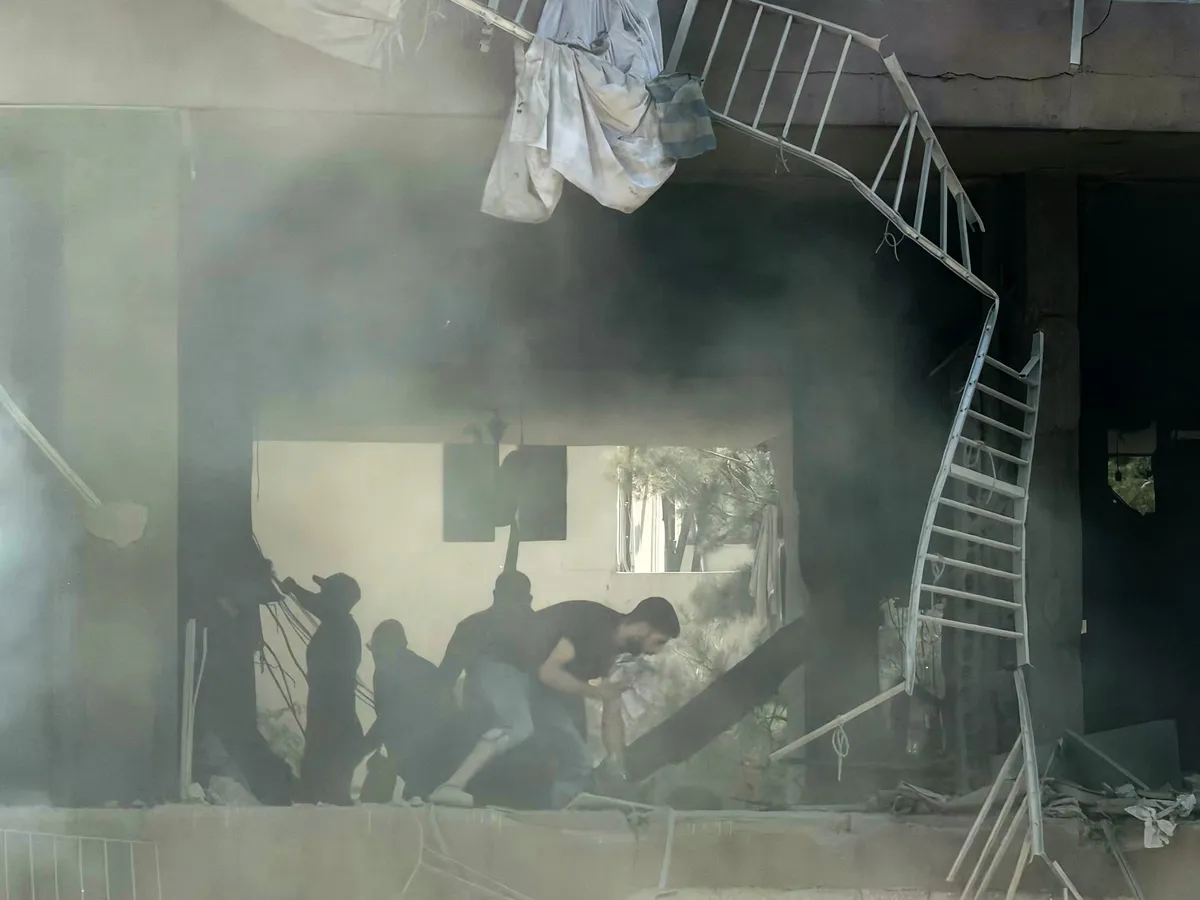
The escalation has raised concerns that peace negotiations between the United States and Iran could be derailed.People gather at the site of an Israeli airstrike that targeted a building in Beirut's southern suburbs on June 14, 2026. The office of Israeli Prime Minister Benjamin Netanyahu said on June 14 the military had carried out strikes in Beirut's southern suburbs, known as Dahiyeh, while Lebanese state media said a strike hit the Ghobeiry neighbourhood. [IbrahimAmro/AFP]Published On 14 Jun 2026The Israeli military has attacked targets in Beirut’s southern suburbs in what Prime Minister Benjamin Netanyahu said was a response to Hezbollah firing into northern Israel, raising concerns over the impact on delicate peace negotiations between the United States and Iran.Netanyahu’s office said in a statement on Sunday that the military had “just carried out strikes in the Dahiyeh district of Beirut against terrorist targets belonging to the Hezbollah terrorist organisation, in response to Hezbollah’s firing toward Israeli territory”.Recommended Stories list of 4 itemslist 1 of 4Lebanon war victims among 117M people displaced worldwidelist 2 of 4Israel attacks Lebanon despite being included in potential peace deallist 3 of 4Israel attacks Lebanon as US says Iran deal to be signed on Sundaylist 4 of 4Iran war day 107: Washington, Tehran close to signing first stage of dealend of listLebanon’s National News Agency said at least two people were killed and four wounded.The Israeli military said Hezbollah had launched three projectiles towards northern Israel in what it described as a blatant ceasefire violation.The latest escalation in Lebanon risks derailing negotiations on a memorandum of understanding between the United States and Iran.President Donald Trump said the deal would be agreed on Sunday, and Pakistani Prime Minister Shehbaz Sharif also said it would be completed within 24 hours and signed electronically. Pakistan has been acting as a key mediator in the talks.Iranian Ministry of Foreign Affairs spokesman Esmaeil Baghaei, meanwhile, had said a deal was close but would not be signed on Sunday.During the negotiations, Iran has made clear that attacks on southern Beirut were a red line. When Israel last struck the Beirut suburbs a week ago, Iran responded by firing missiles at Israel, and Trump demanded restraint from Netanyahu in an angry phone call.“We’re waiting for an official response from Iran, but from what we understand, this is a serious development as far as Iran’s view is concerned. We’ve seen that the situation in Lebanon, what’s going on there, is an integral and central part of the peace deal,” said Al Jazeera’s Almigdad Alruhaid, reporting from Tehran.“The latest broader ceasefire, on April 8th, was linked to the situation in Lebanon, and Iranian officials have repeatedly said that the situation in Lebanon will not be separated from this deal. So it could be a huge setback for Iran,” he said.“We know that right now there’s a Qatari delegation in Tehran working to resolve disputes, helping to move things forward, progressing or narrowing the gap between both sides and this could be changing the picture for this latest memorandum of understanding.”After Trump told Netanyahu a week ago to stop attacking southern Beirut, the Israeli prime minister posted on X: “I spoke this evening with President Trump and told him that if Hezbollah does not stop firing at our cities and citizens – Israel will strike terrorist targets in Beirut.”On Friday, Iranian Foreign Minister Abbas Araghchi said that while a deal has “never been closer”, Iran would not leave Lebanon alone or accept a deal that allows Israel to continue military strikes.Forced displacement ordersEarlier on Sunday, Israel issued forced displacement orders covering 29 locations in southern Lebanon – 25 in Nabatieh district and four in Sidon district – with people in those communities told to flee north of the Zahrani River immediately.An Israeli military spokesperson said the forced displacement orders on Sunday included the towns of Jbaa, Houmin al-Tahta, Ansar and Kfar Sir.“Once again, the focus is on that southern city of Nabatieh,” said Al Jazeera’s Heidi Pett, reporting from Beirut. “It used to be a large, thriving city. It’s now home to one of the only hospitals still functioning in the south, and it has been pounded by Israeli air strikes over the last couple of weeks, leading to widespread destruction.”Meanwhile, there is anxiety in Lebanon at the prospect of an Iran-US deal, she said. After the US and Iran announced a temporary ceasefire in April, Lebanon suffered its deadliest day of the war with more than 350 killed.“The last time that the US and Iran agreed to a ceasefire deal, Israel said that Lebanon wasn’t part of that agreement and sought to make that extremely clear by striking more than 100 locations in Lebanon in the span of 10 minutes,” Pett said. “And the concern is that that is their stance once again, that they’re not party to this deal, that they will not be withdrawing.”
SRCAl Jazeera
LANGEN
LEANCenter
WORDS810
ENT12
SUN · 2026-06-14 · 10:25 GMTBRIEF NSR-2026-0614-84300
NSR-2026-0614-84300News Report·EN·Conflict
Israel attacks southern Beirut after alleged Hezbollah drone fire
Israel conducted airstrikes in Beirut's southern suburbs on June 14, 2026, in response to Hezbollah firing projectiles into northern Israel. The Israeli military stated these strikes targeted Hezbollah "terrorist targets" in the Dahiyeh district.
Al Jazeera StaffAl JazeeraFiled 2026-06-14 · 10:25 GMTLean · CenterRead · 4 min
Al JazeeraFIG 01
Reading time
4min
Word count
810words
Sources cited
5cited
Entities identified
12entities
Quality score
100%
§ 01
Briefing Summary
AI-generatedNEWSAR · AI
Israel conducted airstrikes in Beirut's southern suburbs on June 14, 2026, in response to Hezbollah firing projectiles into northern Israel. The Israeli military stated these strikes targeted Hezbollah "terrorist targets" in the Dahiyeh district. Lebanese state media reported a strike hit the Ghobeiry neighborhood, resulting in at least two deaths and four injuries. This escalation raises concerns about derailing ongoing peace negotiations between the United States and Iran, as Iran has indicated that attacks on southern Beirut are a "red line" and that Lebanon must be included in any peace deal. Earlier, Israel had issued forced displacement orders for 29 locations in southern Lebanon.
Confidence 0.90Sources 5Claims 5Entities 12
§ 02
Article analysis
Model · rule-basedFraming
Conflict
Diplomatic
Tone
Mixed Tone
AI-assessed
CalmNeutralAlarmist
Factuality
0.70 / 1.00
Factual
LowHigh
Sources cited
5
Well sourced
FewMany
§ 03
Key claims
5 extracted01
Attacks on southern Beirut are a red line for Iran in the peace negotiations.
factualIranian Ministry of Foreign Affairs
Confidence
0.90
02
Hezbollah launched three projectiles towards northern Israel, violating a ceasefire.
factualIsraeli military
Confidence
0.90
03
The Israeli military attacked targets in Beirut's southern suburbs in response to Hezbollah firing into northern Israel.
factualIsraeli Prime Minister Benjamin Netanyahu
Confidence
0.90
04
The escalation risks derailing peace negotiations between the United States and Iran.
predictionAl Jazeera's Almigdad Alruhaid
Confidence
0.80
05
At least two people were killed and four wounded in an Israeli airstrike in Beirut's southern suburbs.
factualLebanon’s National News Agency
Confidence
0.80
§ 04
Full report
4 min read · 810 words§ 05
Entities
12 identifiedKey playerOppositionContextPositiveNeutralNegative
People4
Organizations1
§ 06
Keywords & salience
8 termsisrael hezbollah conflict
1.00
us iran negotiations
0.90
beirut airstrike
0.80
ceasefire violation
0.70
middle east escalation
0.60
benjamin netanyahu
0.50
donald trump
0.40
pakistan mediation
0.40
§ 07
Topic connections
Interactive graph Network visualization showing 51 related topics
View Full Graph Person Organization Location Event|Click node to navigate|Edge numbers = shared articles