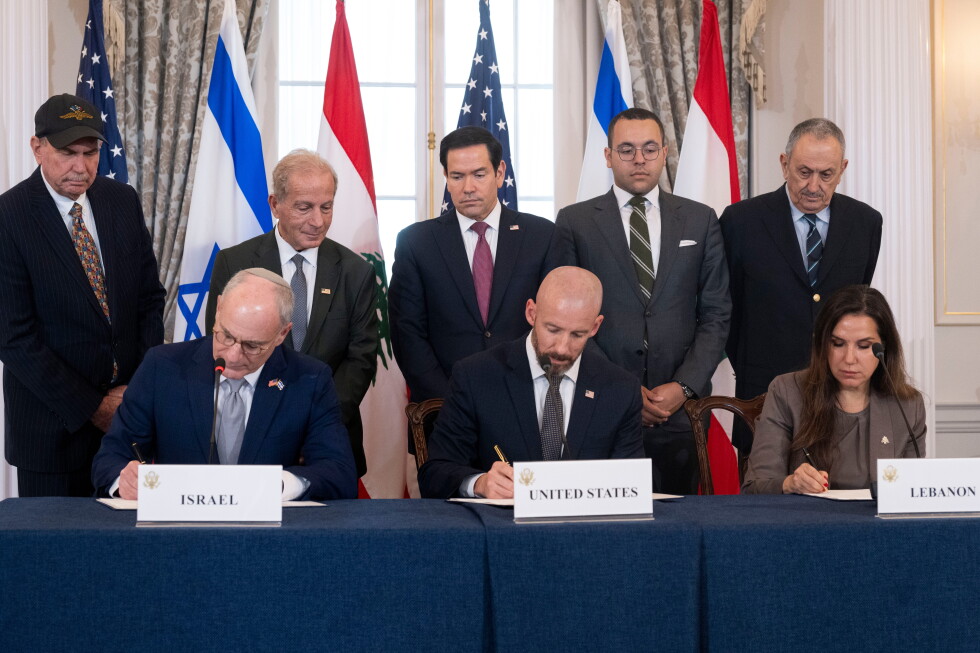
Israel and Lebanon sign Framework Agreement with US in ‘first step’ toward Peace, Rubio says 1 of 3 | The officials did not share details on the agreement that was signed by Yechiel Leiter, the Israeli ambassador to the U.S., and Nada Hamadeh, ambassador of Lebanon to the U.S. 2 of 3 | Secretary of State Marco Rubio and others watch, seated from left, Israel’s Ambassador to the U.S. Yechiel Leiter, counselor Dan Holler, and Lebanon’s Ambassador to the U.S. Nada Hamadeh, sign a Framework Agreement, described as a first step toward Peace following months of Conflict between Israel and the Lebanese militant group Hezbollah, at the State Department, Friday, June 26, 2026, in Washington. (AP Photo/Kevin Wolf) 3 of 3 | Secretary of State Marco Rubio shakes hands with Lebanon’s Ambassador to the U.S. Nada Hamadeh, left, following a signing of a Framework Agreement, described as a first step toward Peace following months of Conflict between Israel and the Lebanese militant group Hezbollah, at the State Department, Friday, June 26, 2026, in Washington. At left, is Counselor Dan Holler. (AP Photo/Kevin Wolf) 1 of 3 The officials did not share details on the agreement that was signed by Yechiel Leiter, the Israeli ambassador to the U.S., and Nada Hamadeh, ambassador of Lebanon to the U.S. Add AP News on Google Add AP News as your preferred source to see more of our stories on Google. Share 2 of 3 | Secretary of State Marco Rubio and others watch, seated from left, Israel’s Ambassador to the U.S. Yechiel Leiter, counselor Dan Holler, and Lebanon’s Ambassador to the U.S. Nada Hamadeh, sign a Framework Agreement, described as a first step toward Peace following months of Conflict between Israel and the Lebanese militant group Hezbollah, at the State Department, Friday, June 26, 2026, in Washington. (AP Photo/Kevin Wolf) 2 of 3 Secretary of State Marco Rubio and others watch, seated from left, Israel’s Ambassador to the U.S. Yechiel Leiter, counselor Dan Holler, and Lebanon’s Ambassador to the U.S. Nada Hamadeh, sign a Framework Agreement, described as a first step toward Peace following months of Conflict between Israel and the Lebanese militant group Hezbollah, at the State Department, Friday, June 26, 2026, in Washington. (AP Photo/Kevin Wolf) Add AP News on Google Add AP News as your preferred source to see more of our stories on Google. Share 3 of 3 | Secretary of State Marco Rubio shakes hands with Lebanon’s Ambassador to the U.S. Nada Hamadeh, left, following a signing of a Framework Agreement, described as a first step toward Peace following months of Conflict between Israel and the Lebanese militant group Hezbollah, at the State Department, Friday, June 26, 2026, in Washington. At left, is Counselor Dan Holler. (AP Photo/Kevin Wolf) 3 of 3 Secretary of State Marco Rubio shakes hands with Lebanon’s Ambassador to the U.S. Nada Hamadeh, left, following a signing of a Framework Agreement, described as a first step toward Peace following months of Conflict between Israel and the Lebanese militant group Hezbollah, at the State Department, Friday, June 26, 2026, in Washington. At left, is Counselor Dan Holler. (AP Photo/Kevin Wolf) Add AP News on Google Add AP News as your preferred source to see more of our stories on Google. Share Updated [hour]:[minute] [AMPM] [timezone], [monthFull] [day], [year] WASHINGTON (AP) — Secretary of State Marco Rubio joined Israel and Lebanon’s ambassadors to the U.S. Friday to announce a Framework Agreement that was described as a first step toward Peace following months of Conflict between Israel and the Lebanese militant group Hezbollah.The officials did not share details on the agreement, which does not include Hezbollah and prompted one of the group’s officials in Lebanon to warn of civil war. Israeli Prime Minister Benjamin Netanyahu later said that the framework would allow Lebanese forces to eventually take control of territory from Israel’s military. The agreement was signed in front of Rubio in Washington by Yechiel Leiter, the Israeli ambassador to the United States, and Nada Hamadeh, the Lebanese ambassador to the United States.Hamadeh said the framework “is a first step on the road to restoring Lebanese sovereignty and territorial integrity, securing a permanent and final cessation of hostilities, enabling our people to go back to their land and allowing all Lebanese to live in Peace, security and prosperity.” Leiter said the final destination of the framework is Peace between the two countries. 1 MIN READ 2 MIN READ 5 MIN READ “Real Peace, where both countries will live in security, where Israel’s and Lebanon’s sovereignty will be respected, honored and protected,” Leiter said. “In this performance-based trilateral Framework Agreement, Iran is out. Hezbollah is out. And the road to Peace between Israel and Lebanon is in.” The latest Conflict began when Hezbollah fired rockets into Israel days after Israel and the U.S. launched their war on Iran on Feb. 28. Israel invaded Lebanon and has expanded its control.The talks between Israel and Lebanon were separate from the interim deal that was signed last week by the leaders of the U.S. and Iran to end the fighting in the Islamic Republic. That agreement set a 60-day period for negotiations on key issues, including the future of Tehran’s nuclear program amid concerns that Iran wants to use it for military purposes, a claim the country denies. The Lebanese government had been wary of having Iran negotiate on its behalf, and Lebanon launched its own direct negotiations with Israel after the outbreak of the latest Israel-Hezbollah war. Hezbollah was not part of the talks, which resulted in several ceasefire agreements that were never implemented on the ground. Iran, meanwhile, insisted that its own agreement with the U.S. explicitly include a ceasefire in Lebanon. The first halt in fighting in Lebanon since March coincided with the beginning of U.S.-Iran talks in Switzerland.Hassan Fadlallah, a member of Hezbollah’s parliamentary bloc, reiterated the group’s stance on Beirut-based pan-Arab Al-Mayadeen TV that it rejects Lebanon’s direct negotiations with Israel and that it will not give up its weapons. Fadlallah said Lebanese authorities “will not be able to enforce the agreement signed in Washington unless they go, with American support, to civil war.” He also called the agreement in Washington “an attempt to derail the Islamabad process,” referring to the U.S.-Iran negotiations. In a statement, Lebanese President Joseph Aoun thanked the Trump administration and the Lebanese negotiating team and said Friday’s agreement will be a “first step” toward allowing the Lebanese displaced by the war “to return to their fully liberated land and to their homes” and to live “with their heads held high, under the sovereignty of a Lebanese state that has no partner in its sovereignty over its land and people.”He did not share details of the pact.More than 4,000 people in Lebanon have been killed in Israeli strikes since March. At least 37 Israeli soldiers have been killed in Lebanon or northern Israel during the fighting.A lull earlier this week in fire between Israeli and Hezbollah forces began to show cracks after Israel said it targeted Hezbollah militants in several strikes across southern Lebanon.Lebanese officials have said that securing a withdrawal of Israeli forces from southern Lebanon is a top priority for them in the negotiations, while Israeli officials have prioritized the disarmament of the Iran-backed Hezbollah. Aoun had told a visiting British parliamentary delegation on Wednesday that a proposal for “pilot zones” where the Lebanese army is supposed to take exclusive control of the territory as Israeli troops will withdraw was “under discussion pending approval from the Israeli side.” He reiterated that the Israel-Lebanon negotiations in Washington are separate from what emerged from from the Iran-U.S. talks in Switzerland.An Israeli official who spoke on the condition of anonymity because they were not authorized to speak to the media said Israel’s direct negotiations with Lebanon include discussions about the redeployment of Israeli forces after southern Lebanon is cleared of Hezbollah infrastructure and Hezbollah has disarmed. Hezbollah is unlikely to agree to any plan that would include its disarmament throughout the country. The group has maintained that it is only required by previous agreements and U.N. resolutions to disarm in the area south of the Litani River, near Lebanon’s border with Israel.Netanyahu, the Israeli leader, said in a video on Friday that the framework is a “great achievement” for Israel. “The most important thing, first and foremost, is that Israel will remain in the security zone in southern Lebanon,” he said. “This is a major achievement, and we will maintain it as long as Hezbollah has not been disarmed and as long as it continues to pose a threat to the State of Israel.”Netanyahu also said that Israel is allowing the Lebanese army to begin preparing to take control of territory. “We are establishing two pilot zones, both based on the recommendation of the IDF,” he said. “The first is entirely outside the security zone and south of the Litani River. The second is north of the Litani.” On Wednesday, Lebanon’s President Joseph Aoun told a visiting British parliamentary delegation that a proposal for “pilot zones” where the Lebanese army is supposed to take exclusive control of the territory as Israeli troops will withdraw was “under discussion pending approval from the Israeli side.” ___Sewell reported from Beirut. Lidman reported from Tel Aviv. Associated Press writers Koral Saeed in Herzliya, Israel, and John Seewer in Toledo, Ohio, contributed to this report. Sewell is the Associated Press news director for Lebanon, Syria and Iraq. She joined the AP in 2022 but has been based in the region since 2016, reporting and guiding coverage on some of its most significant news stories. Lidman is an Associated Press reporter based in Tel Aviv, Israel.
SRCAssociated Press (AP)
LANGEN
LEANCenter
WORDS1 616
ENT12
FRI · 2026-06-26 · 18:23 GMTBRIEF NSR-2026-0626-87736
NSR-2026-0626-87736News Report·EN·Diplomatic
Israel and Lebanon sign framework agreement with US in ‘first step’ toward peace, Rubio says
U.S. Secretary of State Marco Rubio, along with the ambassadors of Israel and Lebanon, announced a framework agreement on Friday, June 26, 2026, in Washington D.C.
By
BEN FINLEY, ABBY SEWELL and MELANIE LIDMANAssociated Press (AP)Filed 2026-06-26 · 18:23 GMTLean · CenterRead · 7 min
Associated Press (AP)FIG 01
Reading time
7min
Word count
1 616words
Sources cited
1cited
Entities identified
12entities
Quality score
100%
§ 01
Briefing Summary
AI-generatedNEWSAR · AI
U.S. Secretary of State Marco Rubio, along with the ambassadors of Israel and Lebanon, announced a framework agreement on Friday, June 26, 2026, in Washington D.C. Described as a first step toward peace, the agreement follows months of conflict between Israel and the Lebanese militant group Hezbollah. While details were not disclosed, both ambassadors expressed optimism. Lebanon's ambassador stated it aims to restore sovereignty, secure a cessation of hostilities, and enable peace and prosperity. Israel's ambassador emphasized the goal of real peace, mutual security, and respect for sovereignty, explicitly stating that Iran and Hezbollah are excluded from this framework. The agreement was signed by Israeli Ambassador Yechiel Leiter and Lebanese Ambassador Nada Hamadeh.
Confidence 0.90Sources 1Claims 4Entities 12
§ 02
Article analysis
Model · rule-basedFraming
Diplomatic
Conflict
Tone
Measured
AI-assessed
CalmNeutralAlarmist
Factuality
0.80 / 1.00
Factual
LowHigh
Sources cited
1
Limited
FewMany
§ 03
Key claims
4 extracted01
Yechiel Leiter, Israeli ambassador to the U.S., and Nada Hamadeh, ambassador of Lebanon to the U.S., signed the agreement.
factual
Confidence
1.00
02
The signing followed months of conflict between Israel and Hezbollah.
factual
Confidence
1.00
03
The agreement is described as a 'first step' toward peace.
quoteSecretary of State Marco Rubio
Confidence
1.00
04
Israel and Lebanon signed a framework agreement with the US.
factual
Confidence
1.00
§ 04
Full report
7 min read · 1 616 words§ 05
Entities
12 identifiedKey playerOppositionContextPositiveNeutralNegative
People4
Topics1
§ 06
Keywords & salience
8 termsframework agreement
1.00
peace
0.90
israel
0.80
lebanon
0.80
us
0.70
hezbollah
0.60
conflict
0.50
diplomacy
0.40
§ 07
Topic connections
Interactive graph Network visualization showing 51 related topics
View Full Graph Person Organization Location Event|Click node to navigate|Edge numbers = shared articles