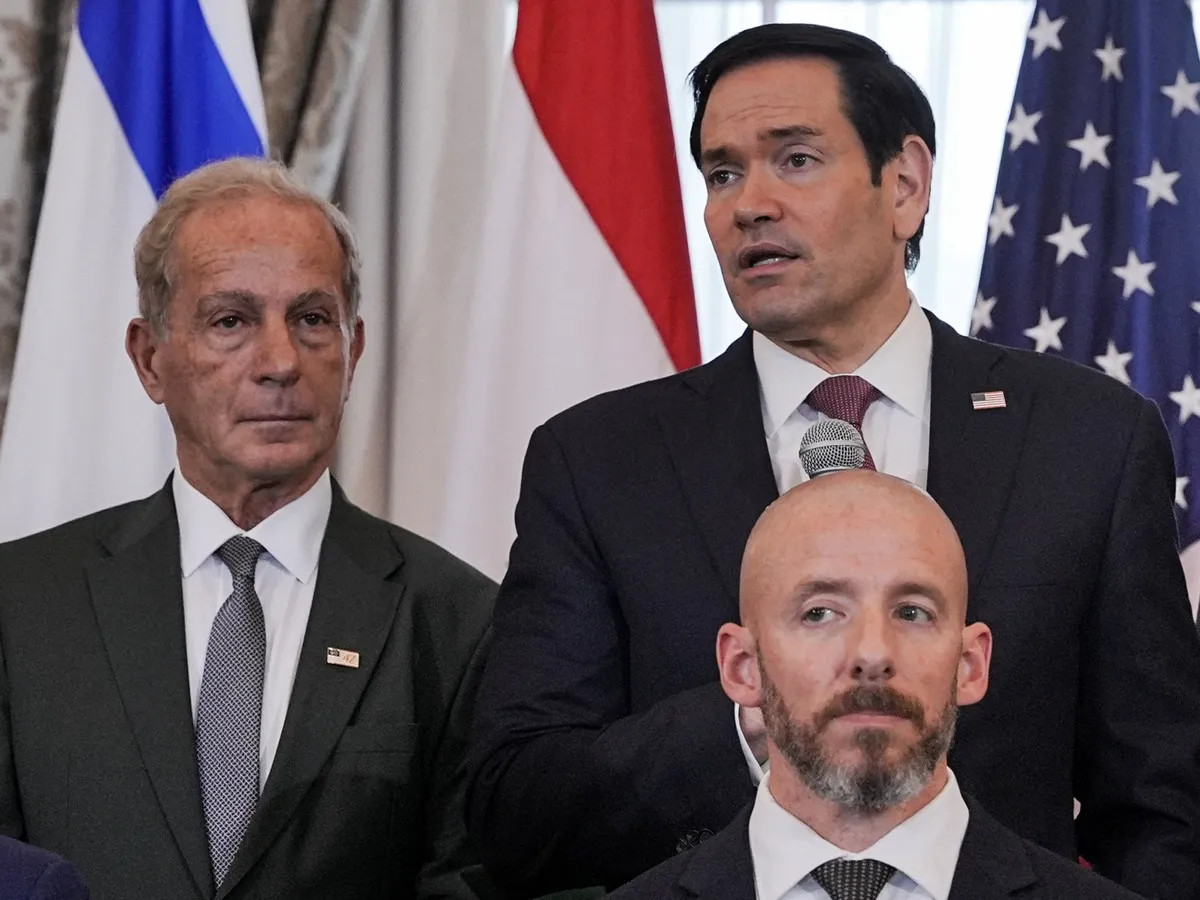
US Secretary of State Marco Rubio has announced the deal after trilateral talks in Washington, DC, calling it a ‘first step’.US Secretary of State Marco Rubio speaks during a meeting with Lebanese and Israeli representatives [Ken Cedeno/Reuters]Published On 26 Jun 2026United States Secretary of State Marco Rubio has announced a deal framework between Lebanon and Israel after negotiations in Washington, DC.Details about the agreement remain scarce. But in his remarks on Friday, Rubio made clear that the deal was only the “first step” in further negotiations.Recommended Stories list of 3 itemslist 1 of 3Why has the UN paused plans to evacuate sailors from the Strait of Hormuz?list 2 of 3Hezbollah: Israel must ‘unconditionally’ leave Lebanonlist 3 of 3Israeli prosecutors charge six settlers after West Bank mosque attackend of list“It’s the beginning of the beginning,” Rubio said, surrounded by representatives from both Lebanon and Israel.“There’s a lot of work ahead. We don’t in any way underestimate the difficulty of the task ahead, but we understand the importance of it, how vital it is.”The two sides had gathered in Washington, DC, for four days of US-mediated talks this week, starting on Tuesday. The Lebanese group Hezbollah has not been party to the talks.Ongoing fighting in Lebanon, however, has threatened to disrupt efforts to forge a ceasefire between Iran and the US.On June 17, the US and Iran signed a memorandum of understanding (MOU) to bring to a halt the Iran" class="entity-link entity-event" data-entity-id="119503" data-entity-type="event">US-Israeli war against Iran. That 14-point document required “the immediate and permanent termination of military operations on all fronts, including in Lebanon”.But Israel has occupied nearly a fifth of Lebanon, and it continued to bombard the country after the memorandum was signed.Last Friday, the two sides agreed to a ceasefire, but Israeli troops remain stationed in southern Lebanon, and while its attacks have lessened, they have not stopped.Three people, for instance, were killed in strike in southern Lebanon on Thursday, and more houses were burned as Israel continues its campaign, allegedly against Hezbollah.The leadership of Hezbollah, meanwhile, has called on Israel to withdraw from the country as a necessary condition for peace. “Israel must leave unconditionally,” Hezbollah leader Naim Qassem said in a separate statement on Friday.But shortly after the framework deal was announced, Israeli Prime Minister Benjamin Netanyahu dashed that prospect.“The most important thing is, first of all, that Israel remains in the security zone in southern Lebanon. This is a major achievement, and we will maintain it as long as Hezbollah has not disarmed,” Netanyahu said in a statement.Hezbollah, meanwhile, continued to reject the talks as weakening Lebanon’s sovereignty.“The course being pursued by Lebanese authorities amounts to unilateral, gratuitous concessions that will only undermine the country and serve the interests of the Israeli enemy,” said Hezbollah MP Hassan Fadlallah.US Secretary of State Marco Rubio (top centre), Israeli ambassador Yechiel Leiter (lower left) and Lebanese ambassador Nada Hamadeh (lower right) attend a signing ceremony on June 26 [Ken Cedeno/Reuters]The continued fighting in Lebanon has become a growing source of tension between Netanyahu and US President Donald Trump, who is facing domestic backlash over the war against Iran.Earlier this month, Trump confirmed he called Netanyahu “crazy”, though he has insisted the Israeli leader is a “very good man” with whom he has an “amazing partnership”. “We have a little dispute over Lebanon,” Trump said at the Group of 7 (G7) summit in France last week. “You don’t have to knock down a building every time somebody walks into it that’s from Hezbollah.”He then encouraged Netanyahu to adopt a “softer touch” in approaching Lebanon.“They could do a much better job with Hezbollah on that. I don’t think they’re doing well. And I feel very bad for Lebanon,” Trump added.In Friday’s news conference, Rubio echoed that message of concern for Lebanon.“The people of Lebanon have suffered tremendously now for decades as a result of outside interference in their affairs, of countries trying to use the country as a launchpad for attacks,” he said. “This is not what the people of Lebanon want, and that’s not what they deserve.”This is not the first time the US has hosted talks between Israel and Lebanon in recent months. This week’s meeting marked the fifth round of mediated talks between the two sides.In April, for instance, Rubio hosted talks between the two sides after ongoing fighting in Lebanon threatened to derail another US-Iran ceasefire agreement, signed on April 7.It was touted as the first high-level engagement between the two sides since 1993, but that meeting ultimately concluded with little more than an agreement “to launch direct negotiations” in future.That was followed by a two days of negotiations in May, which concluded with “a framework for negotiations to advance lasting peace”, similar to what was announced on Friday.Nada Hamadeh, the Lebanese ambassador to the US, called the latest meeting “long and difficult”. But she expressed optimism that the latest framework might advance peace talks.“The trilateral framework we sign today is a first step on the road to restoring Lebanese sovereignty and territorial integrity, securing a permanent and final cessation of hostilities, enabling our people to go back to their land and allowing all Lebanese to live in peace, security, and prosperity,” she said.Her Israeli counterpart, Yechiel Leiter, praised Hamadeh as a “tough negotiator” who fights “like a lioness” for her country. He also claimed the latest round of talks “ put the train back on the tracks”.“It’s running in the right direction. Final destination? Peace between our two countries. Real peace, where both countries will live in security, where Israel’s and Lebanon’s sovereignty will be respected, honored and protected,” Leiter said.“In this performance-based trilateral framework agreement, Iran is out, Hezbollah is out, and the road to peace between Israel and Lebanon is in.”Leiter also described the talks as advancing Trump’s vision of “peace through strength”.One of the proposals reportedly considered during this week’s talks was the establishment of “pilot zones” that would allow the Lebanese military to regain control over certain Israeli-occupied land.Rubio, meanwhile, suggested Friday’s framework would pave the way for the disarmament of Hezbollah and the dismantling of its infrastructure.But experts questioned how substantial Friday’s framework might be. Rami Khouri, a fellow at the American University of Beirut, said a framework alone is “not something very significant”.“It’s a public relations idea that they’d like to see an eventual agreement between Lebanon and Israel, where they’re not shooting, Hezbollah and Israel are not shooting,” Khouri said.But he pointed out that Hezbollah has not been part of the talks, which could hamper any deal from being cemented. “The Lebanese army by itself cannot disarm Hezbollah,” he said.Still, that is not the biggest hurdle in the negotiations ahead, according to Khouri.“If the Lebanese armed forces can protect all of Lebanon, and if the Israelis stop attacking Lebanon, if Lebanon’s sovereignty and security are guaranteed, Hezbollah shouldn’t be a big problem in the long run,” he explained.“The biggest problem is that this whole process — and the symbolism of it being in the State Department kind of confirms this — is predicated on the fact that Israel’s safety has to be guaranteed before the Lebanese get their rights.”Khouri said the conflict is “resolvable”, so long as both sides treat each other as equals. But he added that he has not seen that so far.
SRCAl Jazeera
LANGEN
LEANCenter
WORDS1 212
ENT10
FRI · 2026-06-26 · 17:53 GMTBRIEF NSR-2026-0626-87746
NSR-2026-0626-87746News Report·EN·Diplomatic
US announces framework agreement between Israel and Lebanon
US Secretary of State Marco Rubio announced a framework agreement between Lebanon and Israel following four days of US-mediated talks in Washington, DC. Rubio described the deal as a "first step" in ongoing negotiations, acknowledging significant work remains.
Al Jazeera StaffAl JazeeraFiled 2026-06-26 · 17:53 GMTLean · CenterRead · 5 min
Al JazeeraFIG 01
Reading time
5min
Word count
1 212words
Sources cited
4cited
Entities identified
10entities
Quality score
100%
§ 01
Briefing Summary
AI-generatedNEWSAR · AI
US Secretary of State Marco Rubio announced a framework agreement between Lebanon and Israel following four days of US-mediated talks in Washington, DC. Rubio described the deal as a "first step" in ongoing negotiations, acknowledging significant work remains. Details of the agreement are scarce, but it follows a recent US-Iran memorandum of understanding for a ceasefire on all fronts, including Lebanon. Despite this, Israeli troops remain in southern Lebanon, and fighting has continued, with Hezbollah calling for an unconditional Israeli withdrawal. Israeli Prime Minister Benjamin Netanyahu stated Israel would maintain its presence in southern Lebanon until Hezbollah disarms, a stance rejected by Hezbollah. This marks the fifth round of US-hosted talks between the two nations.
Confidence 0.90Sources 4Claims 5Entities 10
§ 02
Article analysis
Model · rule-basedFraming
Diplomatic
Conflict
Tone
Measured
AI-assessed
CalmNeutralAlarmist
Factuality
0.70 / 1.00
Factual
LowHigh
Sources cited
4
Well sourced
FewMany
§ 03
Key claims
5 extracted01
Israeli Prime Minister Benjamin Netanyahu stated Israel will remain in the security zone in southern Lebanon as long as Hezbollah has not disarmed.
quoteBenjamin Netanyahu
Confidence
1.00
02
Hezbollah leader Naim Qassem stated that Israel must leave Lebanon unconditionally for peace.
quoteNaim Qassem
Confidence
1.00
03
US Secretary of State Marco Rubio announced a framework agreement between Lebanon and Israel after trilateral talks in Washington, DC.
quoteMarco Rubio
Confidence
1.00
04
The US and Iran signed a memorandum of understanding (MOU) on June 17 to halt the US-Israeli war against Iran, requiring termination of military operations on all fronts, including in Lebanon.
factualarticle
Confidence
0.90
05
Israel has occupied nearly a fifth of Lebanon and continued to bombard the country after the MOU was signed.
factualarticle
Confidence
0.80
§ 04
Full report
5 min read · 1 212 words§ 05
Entities
10 identifiedKey playerOppositionContextPositiveNeutralNegative
People3
Organizations1
Locations5
§ 06
Keywords & salience
8 termsisrael lebanon
1.00
framework agreement
1.00
us-mediated talks
0.90
ceasefire
0.80
hezbollah
0.70
us secretary of state
0.60
military operations
0.50
occupied territory
0.40
§ 07
Topic connections
Interactive graph Network visualization showing 51 related topics
View Full Graph Person Organization Location Event|Click node to navigate|Edge numbers = shared articles