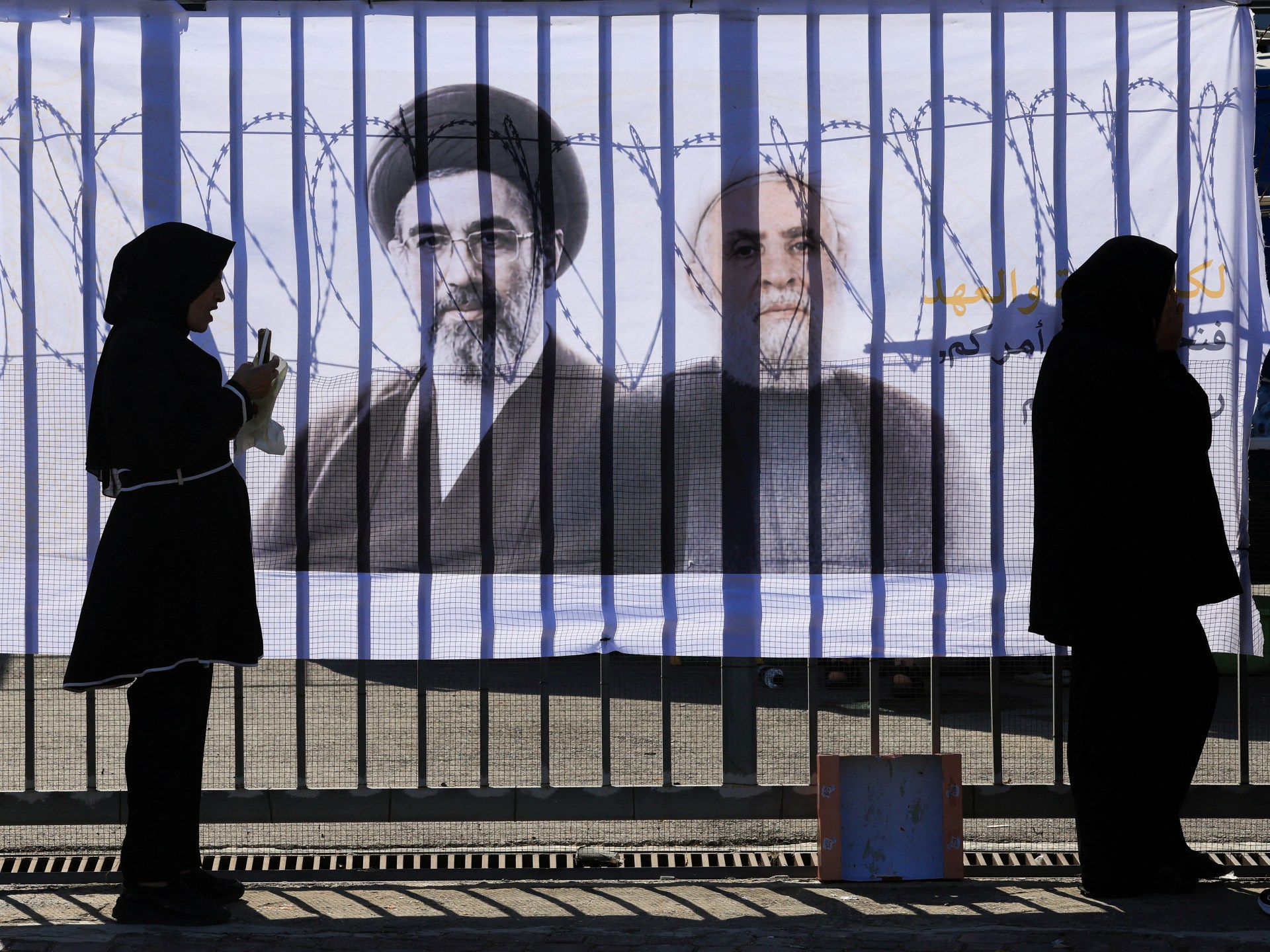
EXPLAINERHezbollah chief calls the deal ‘null and void’, raising questions if the latest agreement can lead to peace in Lebanon.Shia mourners stand in front of a banner with pictures of Hezbollah chief Naim Qassem and Iran's new Supreme Leader Mojtaba Khamenei, as they mark Ashura,, in the southern suburbs of Beirut, Lebanon, June 26, 2026 [Mohamed Azakir/Reuters]Published On 27 Jun 2026Israel and Lebanon have agreed on a new framework agreement after four days of marathon talks in Washington, DC, brokered by the United States, trying to end the months-long conflict.Israel has been occupying almost 20 percent of Lebanese territory in the south and has killed more than 4,000 people since fighting erupted on March 2. A previous bout of fighting ended in a ceasefire in November 2024, but Israel carried out almost daily attacks and refused to end its occupation in breach of the deal.The new deal, however, does not specifically call for the withdrawal of the Israeli forces and instead ties it to the disarmament of Hezbollah – a condition repeatedly rejected by the Iran-backed armed group.Hezbollah chief Naim Qassem on Saturday rejected the framework agreement, calling it “null and void”. Hezbollah has demanded that Israel first end its occupation.Hezbollah supporters flooded the streets of the capital, Beirut, on Friday evening to oppose the deal.So, what is the new agreement, which does not include Hezbollah, and can it lead to peace in Lebanon?US Secretary of State Marco Rubio looks on as State Department Counsellor Daniel Holler, Israel’s ambassador to the US, Yechiel Leiter, and Lebanon’s ambassador to the US, Nada Hamadeh, sign a framework agreement between Israel and Lebanon, at the State Department in Washington, DC, June 26, 2026 [Ken Cedeno/Reuters]What’s in the Israel-Lebanon agreement?After the trilateral signing in Washington, the US Department of State released the text of the agreement, which talks of a “sequenced process” that will see the Lebanese army restore “effective sovereign authority over all Lebanese territory, pending the verified disarmament of non-state armed groups” – a clear reference to Hezbollah.The deal does not mandate Israeli withdrawal from the fifth of Lebanese land it occupies. Instead, the framework notes that Israel shall “progressively redeploy” out of Lebanon, offering two “pilot zones” where the Lebanese military “will gradually assume full and effective security responsibility”.“One [pilot zone] is south of the Litani River and outside the security zone altogether, and the other is north of the Litani – a small area in the expanded security zone that we conquered in the last two weeks, and which the [Israeli military] says it does not need,” Israeli Prime Minister Benjamin Netanyahu later said in a statement.Once these conditions are met, “Lebanese civilians will be able to safely return to these areas under the exclusive control of Lebanese state authorities,” the framework says. More than 1.2 million people have been forcefully displaced.Israel says that successfully returning southern Lebanon to Lebanese government control would “eliminate any future need for [Israeli military] action or presence in Lebanon” and “[declared] that it has not territorial ambitions in Lebanon”.The Lebanese government has signed that it rejects “the claims of any state or non-state actor to use force on its behalf without its explicit authorization,” deeming such attacks “illegal” and “contrary to Lebanese national interests”.Hezbollah supporters block the old airport road in the southern suburbs of Beirut, with burning tyres to protest against the trilateral agreement that was signed between the US, Israel and Lebanon on June 27, 2026 [Ibrahim Amro/AFP]How have parties to the conflict reacted to the agreement?IsraelNetanyahu issued a video statement shortly after the agreement was announced, stressing that the framework would allow the Israeli military to remain in the occupied Lebanese land.“We will maintain [the buffer zone] until Hezbollah disarms and as long as there is a threat to the State of Israel,” Netanyahu said.It is also a partial, momentary win for Netanyahu, who faced intense domestic criticism after the US and Iran sidelined Israel to sign the Islamabad Memorandum of Understanding, which mandates an end to hostilities in Lebanon as well.LebanonPresident Joseph Aoun expressed gratitude to Trump and other regional mediators after the signing of the trilateral agreement, which he hailed as “the first step on the path to restoring Lebanon’s sovereignty”.In a statement from the Lebanese presidency, Aoun noted that the framework also “marks the beginning of the road to fructify [Lebanese citizens’] sacrifices, so that they may return to their fully liberated land”.His statement has done little to tamp down the tensions in the capital, where supporters of Hezbollah took to the streets, burning tyres and blocking a road leading to the airport.People react, as they watch Hezbollah chief Naim Qassem deliver a televised speech on a giant screen at the burial site of former Hezbollah leader Hassan Nasrallah, on the outskirts of Beirut, Lebanon, June 17, 2026 [Mohamed Azakir/Reuters]HezbollahThough the armed group is not a party to the agreement, and was not present at the negotiating table, its posture and actions will dictate where the conflict heads in the future.The Hezbollah leader on Saturday condemned proposals to tie the Israeli withdrawal to the group’s disarmament. “Linking the Israeli withdrawal to the disarmament of the resistance throughout Lebanon is a very dangerous proposition that crosses all red lines,” he said.“The framework agreement in Washington is humiliating, shameful, and a surrender of sovereignty,” he said.He added that the framework agreement should be replaced by the Iran-US Memorandum of Understanding (MoU) signed on June 15.Earlier, Hassan Fadlallah, a Hezbollah representative in the parliament, said Lebanese authorities would not be able to enforce the framework agreement unless, with US support, “they go to civil war”.In a televised speech before the agreement was signed, Qassem said that Hezbollah would hold its weapons closer, ready to fight Israel for Lebanon, if the Lebanese state fails to do so.The Iran-US MOU called for the “territorial integrity and sovereignty of Lebanon” – a similar wording has been used in the framework agreement.United StatesUS Secretary of State Marco Rubio, Washington’s point person in Israel and Lebanon talks, announced an “immediate” $100m donation by the US towards humanitarian assistance in coordination with the UN.At the signing ceremony at the State Department in Washington, Rubio appeared to acknowledge the limited scope of the agreement, calling it “the beginning of the beginning.”“There’s a lot of work ahead. We don’t in any way underestimate the difficulty of the task ahead, but we understand the importance of it, how vital it is, and we are honored to have played a part in bringing this together,” he said.Two previous ceasefire agreements brokered by Washington failed to stop the fighting in Lebanon, as well as the Islamabad MOU, signed by President Trump and his Iranian counterpart Masoud Pezeshkian, earlier this month.IranThough Tehran is yet to officially react to the agreement, its state media has been pressing against the deal.Fars news agency noted that the agreement is essentially the US permitting Israel to violate the first clause of the Islamabad MOU, which mandated the cessation of hostilities on all fronts, including Lebanon.Does the Israel-Lebanon agreement contradict the Islamabad MOU?Analysts point towards two direct contradictions between the preliminary deal signed by the US and Iran, and the latest agreement between Israel and Lebanon.
SRCAl Jazeera
LANGEN
LEANCenter
WORDS1 198
ENT12
SAT · 2026-06-27 · 13:54 GMTBRIEF NSR-2026-0627-87935
NSR-2026-0627-87935Analysis·EN·Conflict
Israel-Lebanon deal ties ceasefire to Hezbollah disarmament: Will it work?
The United States brokered a new framework agreement between Israel and Lebanon on June 26, 2026, following months of conflict. The deal, signed in Washington D.C., aims to end hostilities but ties Israeli redeployment to the disarmament of Hezbollah.
Yashraj SharmaAl JazeeraFiled 2026-06-27 · 13:54 GMTLean · CenterRead · 5 min
Al JazeeraFIG 01
Reading time
5min
Word count
1 198words
Sources cited
3cited
Entities identified
12entities
Quality score
100%
§ 01
Briefing Summary
AI-generatedNEWSAR · AI
The United States brokered a new framework agreement between Israel and Lebanon on June 26, 2026, following months of conflict. The deal, signed in Washington D.C., aims to end hostilities but ties Israeli redeployment to the disarmament of Hezbollah. Hezbollah's chief, Naim Qassem, has rejected the agreement, calling it "null and void," and supporters protested in Beirut. The framework outlines a "sequenced process" where the Lebanese army would restore sovereign authority pending Hezbollah's disarmament, with Israel progressively redeploying from occupied territory into designated "pilot zones." While the Lebanese President welcomed the deal as a step towards sovereignty, Israel's Prime Minister stated Israeli forces would remain until Hezbollah disarms.
Confidence 0.90Sources 3Claims 5Entities 12
§ 02
Article analysis
Model · rule-basedFraming
Conflict
Diplomatic
Tone
Measured
AI-assessed
CalmNeutralAlarmist
Factuality
0.70 / 1.00
Factual
LowHigh
Sources cited
3
Well sourced
FewMany
§ 03
Key claims
5 extracted01
The agreement requires the Lebanese army to restore sovereign authority pending the verified disarmament of non-state armed groups.
factual
Confidence
1.00
02
Hezbollah chief Naim Qassem rejected the framework agreement, calling it 'null and void'.
quoteNaim Qassem
Confidence
1.00
03
The new deal ties Israeli withdrawal to the disarmament of Hezbollah, a condition rejected by the group.
factual
Confidence
1.00
04
Israel and Lebanon have agreed on a new framework agreement brokered by the United States to end the months-long conflict.
factual
Confidence
1.00
05
Israel has been occupying almost 20 percent of Lebanese territory in the south and has killed more than 4,000 people since fighting erupted on March 2.
statistic
Confidence
0.90
§ 04
Full report
5 min read · 1 198 words§ 05
Entities
12 identifiedKey playerOppositionContextPositiveNeutralNegative
People5
Organizations1
§ 06
Keywords & salience
8 termshezbollah disarmament
1.00
israel-lebanon conflict
1.00
framework agreement
0.90
us mediation
0.80
israeli occupation
0.70
sovereign authority
0.60
non-state armed groups
0.50
ceasefire
0.40
§ 07
Topic connections
Interactive graph Network visualization showing 51 related topics
View Full Graph Person Organization Location Event|Click node to navigate|Edge numbers = shared articles