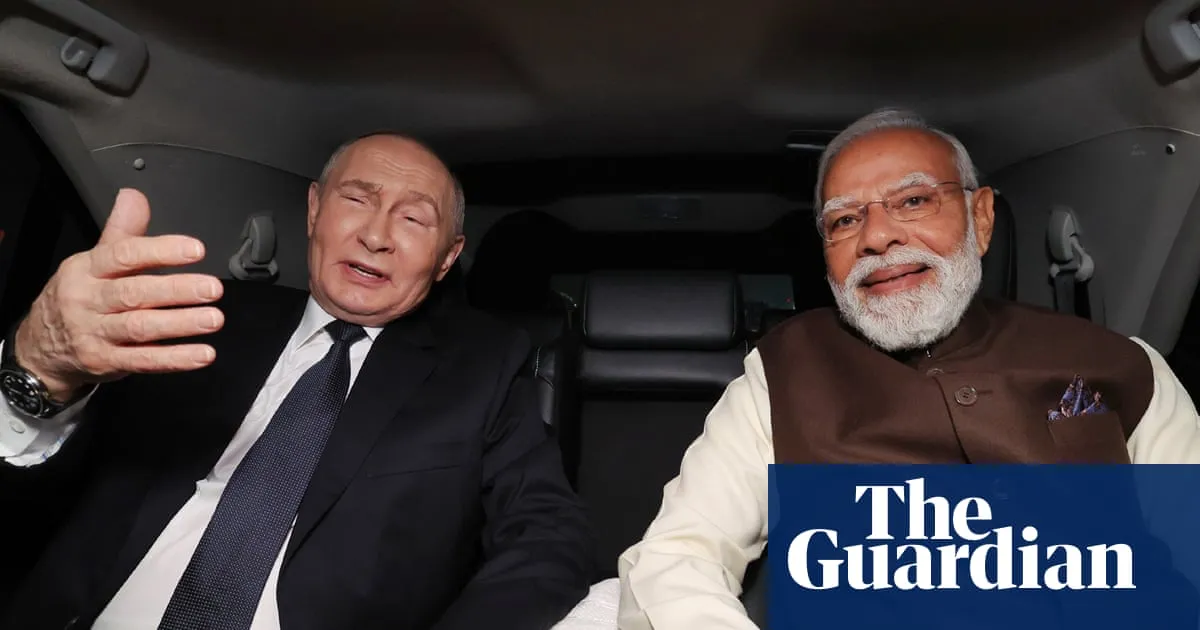
When Vladimir Putin last set foot in India almost exactly four years ago, the world order looked materially different. That visit – lasting just five hours due to the covid pandemic – saw Putin and Indian prime minister Narendra Modi discuss economic and military cooperation and reaffirm their special relationship.Three months later, Russia’s full-scale invasion of Ukraine would turn him into a global pariah, isolating Russia from the world and restricting Putin’s international travel.The last visit was also several years before Donald Trump was re-elected and upended years of closely nurtured US-India relations with inflammatory rhetoric and some of the world’s most punishing import tariffs, throwing Delhi into a tailspin.Against this turbulent geopolitical backdrop, analysts emphasised the significance of Putin travelling to India on Thursday to meet Modi, both as a symbol of the enduring relationship between the countries and as a message that neither would be cowed by US pressure.The summit comes at a critical juncture for both countries. Putin arrives in Delhi after rejecting the latest Ukraine peace proposal proposed by the US, confident that recent advances by Russian forces on the battlefield have strengthened his hand.Petr Topychkanov, Moscow-based senior researcher at the Stockholm International Peace Research Institute, said that for Russia, “the importance of this visit lies primarily in the fact that it is happening at all”.“It will signal that Russia is returning to something resembling normal international relations,” said Topychkanov. “Russia is no longer anxious about the risks of political isolation.”Russian President Vladimir Putin and Indian prime minister Narendra Modi greet each other in New Delhi on 6 December 2021. Photograph: Manish Swarup/APFor India, there are even greater stakes at play. As Aparna Pande, director of the India and south Asia initiative at the Hudson Institute, put it, Delhi is currently grappling with its most unfavourable geopolitical climate in years, thanks to “a semi-isolationist America, a weaker Russia and a very powerful China”.In a notable sign of the tightrope India has to walk, on the eve of Putin’s arrival a joint opinion piece by the French ambassador, German high commissioner and UK high commissioner to India was published in the Times of India, titled “Russia doesn’t seem serious about peace”.It prompted a stinging response from India’s foreign ministry, which said it was “not an acceptable diplomatic practice to give public advice on India’s relations with a third country”.‘China remains the greatest threat to India’India’s relationship with Russia goes back to the cold war and has remained deeply entrenched since then, with Russia remaining India’s biggest defence supplier. It is an alliance that was long-tolerated by western governments, even after Putin’s actions in Ukraine, but Trump’s return to the White House has signalled a markedly different approach.Over the past three years, the US and Europe turned a blind eye as India became one of the largest buyers of cheap Russian oil, despite sanctions in the west. But after the US president’s peacemaking efforts in Ukraine failed earlier this year, Trump began to accuse India of bankrolling Russia’s invasion. He publicly put pressure on Delhi to halt its Russian oil purchases, which culminated in a punishing additional 25% punitive US tariff on Indian imports.In Delhi, which has pursued a multi-alignment foreign policy since independence and reacts poorly to any outside interference, the perceived attempts by Trump to meddle and coerce was met with outrage, resulting in the worst decline in US-India relations in years.In response, Pande said, India has returned to its default mode of “hedging” in its unorthodox alliances, “signalling to the US it has multiple options and waiting to see where everything will fall”. The last meeting between Putin and Modi was just three months ago, alongside Chinese premier Xi Jinping, where the three leaders were pictured holding hands and sharing jokes – optics that prompted fury from Trump.Yet India has other pressing priorities in its engagement with Russia, namely the vast superpower that sits along its febrile north and north-eastern border. “From the Indian side – for all the talk of Russian being a great and loyal friend – the real reason that relationship is important is geography,” said Pande. “China remains the greatest threat to India for the foreseeable future and since the Soviet Union, India has always relied on Russia as a continental balancer against China.”The increasingly close, “no-limits partnership” between Moscow and Beijing has rattled India, said Pande, and left them hoping to find a way to “prevent Russia from ever getting too close to China and ensure it can count on Moscow to put some pressure on the Chinese”.It has also prompted India to try to move away from its dependence on Russia, particularly on defence. For decades, about 70% of Indian defence purchases came from Russia but in the past four years, this has reduced to less than 40%.While the sale of weapons and planes – in particular Russian S-400 air defence systems and the Sukhoi Su-57 fighter aircraft – will probably be a key component of Modi and Putin’s talks on Friday, Pande said: “India will try to strike a balance; keep purchasing enough Russia weapons to retain the alliance, but not be so dependent that if Russia suddenly cut off supplies under China’s pressure, India would be left hanging.”For all the bear hugs and golf buggy rides that Modi and Putin have publicly enjoyed together in recent years, “this is a relationship based on pure realpolitik,” she added.The question of oilGrowing economic cooperation and bilateral trade between the two countries is also likely to be on the table at the summit. At an event on Tuesday with leading Russian economists, Putin emphasised Russia’s plan to take its cooperation with China and India “to a qualitatively new level”, flying in the face of western sanctions.The question of oil also looms large. While Modi has insisted that India would continue to buy Russian oil, newly imposed sanctions by the US and EU which threatens companies that buy from Russia has led to a notable slowdown in purchases by the Indian private sector. Meanwhile, in a move seen as a bid to appease Trump, India has agreed to import more US oil and gas.In a briefing this week, Dmitry Peskov, Putin’s press secretary, acknowledged “obstacles” in economic and energy cooperation between the two countries but said they would continue uninterrupted. Western sanctions would cause only “insignificant drops and decreases” in how much oil Russia exports to India, and only “for a very brief time”, said Peskov, adding that Moscow possessed the technology to circumvent sanctions in the long run.As Modi and Putin sit down, mention of Ukraine will probably be limited to India’s repeated calls for peace, said analysts, emphasising that the Indian prime minister was unlikely to be able to move the needle in the global push for a halt to the war. “Yes Modi can speak to both Putin and Zelenskyy, but aside from asking both countries to talk to each other, India doesn’t have the leverage to make a difference on either side,” said Pande.
SRCThe Guardian - World News
LANGEN
LeanCenter-Left
WORDS1,167
ENT5
THU · 2025-12-04 · 07:31 GMTBRIEF NSR-2025-1204-892
NSR-2025-1204-892News Report·EN·Political Strategy
Putin and Modi to meet amid politically treacherous times for Russia and India
Vladimir Putin is scheduled to meet with Narendra Modi in India, marking Putin's first visit in four years amidst a complex geopolitical landscape. The meeting is significant for Russia as it aims to demonstrate a return to normal international relations despite Western isolation following the Ukraine invasion.
Hannah Ellis-Petersen and Pjotr SauerThe Guardian - World NewsFiled 2025-12-04 · 07:31 GMTLean · Center-LeftRead · 5 min
The Guardian - World NewsFIG 01
Reading time
5min
Word count
1,167words
Sources cited
3cited
Entities identified
5entities
NEWSAR · AI
Vladimir Putin is scheduled to meet with Narendra Modi in India, marking Putin's first visit in four years amidst a complex geopolitical landscape. The meeting is significant for Russia as it aims to demonstrate a return to normal international relations despite Western isolation following the Ukraine invasion. For India, the summit occurs during a period of strained relations with the US and a rising China, highlighting India's delicate balancing act. The meeting underscores the enduring relationship between Russia and India, signaling that both countries will resist US pressure. The timing is critical as Putin rejects US peace proposals for Ukraine, and India navigates a challenging international environment.
Confidence 0.90Sources 3Claims 5Entities 5
Framing
Political Strategy
Diplomatic
Tone
Measured
AI-assessed
CalmNeutralAlarmist
Factuality
0.70 / 1.00
Factual
LowHigh
Sources cited
3
Well sourced
FewMany
01
Russia remains India’s biggest defence supplier.
factual
Confidence
1.00
02
Russia's full-scale invasion of Ukraine would turn him into a global pariah.
factual
Confidence
1.00
03
For Russia, the importance of this visit lies primarily in the fact that it is happening at all.
quotePetr Topychkanov, Stockholm International Peace Research Institute
Confidence
0.90
04
Putin and Modi are meeting amid politically treacherous times for Russia and India.
factual
Confidence
0.90
05
Delhi is currently grappling with its most unfavourable geopolitical climate in years.
quoteAparna Pande, Hudson Institute
Confidence
0.80
§ 04
Full report
5 min read · 1,167 wordsKey playerOppositionContextPositiveNeutralNegative
putin modi meeting
1.00
russia india relations
0.90
geopolitical landscape
0.80
us pressure
0.70
ukraine peace proposal
0.60
international relations
0.50
political isolation
0.50
economic cooperation
0.40
military cooperation
0.40
§ 07
Connections
Who appears together in the newsIn this articleWider coverageLine weight = articles in common
Laying out network…
Strongest ties articles in common
- 3,926
- 1,299
- 1,089
- 452
- 208
- 104
Recurring context not named in this article
- PVolodymyr Zelenskyylinks 5
- LIranlinks 5
- PDonald Trumplinks 5
- LMoscowlinks 5
- LIsraellinks 5
- LChinalinks 5
- LUnited Stateslinks 5
- OEuropean Unionlinks 5