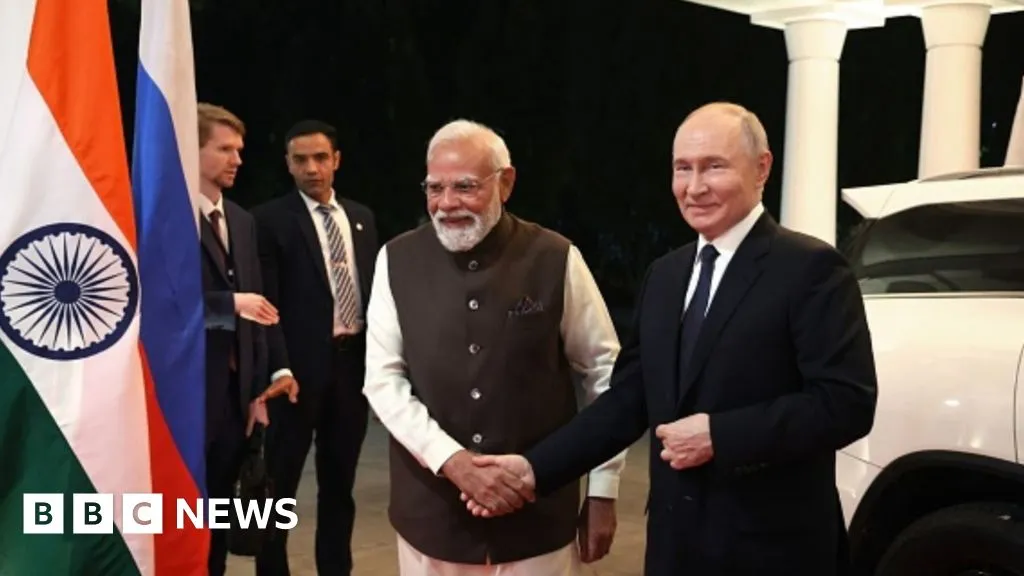
Oil, defence and geopolitics: Why Putin is visiting Modi in Delhi11 hours agoSteve Rosenberg,Russia editor, in DelhiandVikas Pandey,India editorAFP via Getty ImagesModi and Putin share a warm relationshipRussian President Vladimir Putin is starting a two-day visit to India, where he will meet Prime Minister Narendra Modi and attend an annual summit held by both countries.Delhi and Moscow are expected to sign a number of deals during the visit, which comes months after the US increased pressure on India to stop buying Russian oil.It also comes as US President Donald Trump's administration holds a series of talks with Russia and Ukraine in an attempt to end the war.India and Russia have been close allies for decades and Putin and Modi share a warm relationship. Here's a look at why they both need each other - and what to watch for as they meet.A special friendship, trade deals and geopoliticsBy Steve RosenbergWhy are relations with India key for the Kremlin?Well, for a start, look at the numbers:a population of nearly a billion and a half.economic growth exceeding 8%. India is the world's fastest growing major economy.That makes it a hugely attractive market for Russian goods and resources - especially oil.India is the world's third largest consumer of crude oil and has been buying large volumes from Russia. That wasn't always the case. Before the Kremlin's full-scale invasion of Ukraine, only 2.5% of India's oil imports were Russian.That figure jumped to 35% as India took advantage of Russian price discounts prompted by sanctions against Moscow and Russia's restricted access to the European market.India was happy. Washington less so.Earlier this year, the Trump administration slapped an additional 25% tariff on Indian goods, arguing that by purchasing oil from Russia, India was helping to fund the Kremlin's war chest. Orders from India for Russian oil have since dropped. President Putin will be keen for India to keep buying.For Moscow, weapons sales to India are another priority and have been since Soviet times. Ahead of Putin's visit, there were reports that India plans to purchase state-of-the-art Russian fighter jets and air defence systems.Russia, hit by a labour shortage, also sees India as a valuable source of skilled workers.But there's geopolitics at play, too.The Kremlin enjoys demonstrating that Western efforts to isolate it over the war in Ukraine have failed.Flying to India and meeting Prime Minister Modi is one way of doing that.So is travelling to China and holding talks with Xi Jinping, as Putin did three months ago. He met Modi on the same trip. The image of the three leaders smiling and chatting together sent a clear message that, despite the war in Ukraine, Moscow has powerful allies who support the concept of a "multi-polar world".Russia lauds its "no limits partnership" with China.It is just as vocal about its "special and privileged strategic partnership" with India.That is a stark contrast to Moscow's strained relationship with the European Union."I think the Kremlin is sure that the West, including Europe, totally failed," believes Novaya Gazeta columnist Andrei Kolesnikov."We are not isolated, because we have connections to Asia and the Global South. Economically, this is the future. In that sense Russia returned as the main actor in these parts of the globe, like the Soviet Union. But even the Soviet Union had special channels and connections to the US, West Germany and France. It had a multi-vector policy."But now we are totally isolated from Europe. This is unprecedented. Our philosophers always said that Russia was a part of Europe. Now we're not. This is a big failure and a big loss. I'm sure that part of Russia's political and entrepreneurial class is dreaming of returning to Europe and of doing business not only with China and India."This week, though, expect to hear about Russia-India friendship, trade deals and increased economic cooperation between Moscow and Delhi.Getty ImagesWeapon sales to India are a priority for RussiaTest of Modi's strategic autonomyBy Vikas PandeyPutin's visit to Delhi is coming at a crucial time for Modi and India's global ambitions.India-Russia ties go back to the Soviet era and have endured irrespective of the changing geopolitical landscape.Putin has arguably put more time and energy into this relationship than other Russian leaders before him.As for Modi, despite coming under intense pressure from Western governments to criticise Russia over its war in Ukraine, he maintained that dialogue was the only way to resolve the conflict.This was India's "strategic autonomy" at play – with Modi occupying a particular place in the geopolitical order where he held close ties with Moscow while maintaining his relationship with the West at the same time.That worked - until Trump returned to the White House. India-US ties have hit an all-time low in recent months as the two countries have failed to resolve the tariff deadlock.In this context, Putin's visit assumes more significance for Modi than ever before because it will test India's geopolitical autonomy. He will be walking the proverbial diplomatic tightrope here.Modi would want to show Indians at home and in the wider world that he still counts Putin as his ally and hasn't given into pressure from Trump, whom he has earlier called his "true friend".But he has also faced pressure from his allies in Europe - just this week, the German, French and UK ambassadors in India wrote a rare joint article in a major newspaper criticising Russia's stance on Ukraine.And so, Modi will have to ensure that the strengthening of India-Russia ties does not overshadow ongoing trade talks with the US and his partnership with Europe."For India, the challenge is strategic balance - protecting autonomy while navigating pressure from Washington and dependence on Moscow," said the Global Trade Research Initiative (GTRI), a Delhi-based think-tank.Getty ImagesPresident Trump has imposed an additional 25% tariff on India as penalty for buying Russian oilModi's other priority will be to unlock the potential of bilateral trade between India and Russia.Analysts have often said that the economic relationship between the two strong allies has underperformed for decades.Their bilateral trade rose to $68.72bn at the end of March 2025, up from just $8.1bn in 2020. This was largely due to India sharply increasing discounted Russian oil purchases. This has skewed the balance heavily in favour of Russia and that is something Modi would want to correct.With Indian firms already reducing oil purchases from Russia to avoid sanctions from Washington, the two countries will look at other areas to boost trade.Defence is the easiest pick. India's defence imports from Russia reduced to 36% between 2020 and 2024, from the peaks of 72% in 2010-2015 and 55% between 2015 and 2019, according to Stockholm International Peace Research Institute.This was largely due to India's attempt to diversify its defence portfolio and boost domestic manufacturing.But a closer look at these numbers tells a different story. Several Indian defence platforms still rely heavily on Russia. Many of its 29 air force squadrons use Russian Sukhoi-30 jets.India's limited armed conflict with Pakistan in May this year proved the indispensable role of Russian platforms like the S-400 air defence systems in its armed forces but it also showed the vulnerabilities that the country urgently needs to fix.Reports suggest that India wants to buy the upgraded S-500 systems and the Su-57 fifth-generation fighter jet. Pakistan's purchase of the China-made J-35 fifth-generation stealth fighter has not gone unnoticed in Delhi, and it would want to secure a comparable jet as soon as possible.But Russia is already facing a shortage of critical components due to sanctions and the war in Ukraine. The deadline to deliver some units of the S-400 have reportedly been delayed to 2026. Modi will seek some guarantees on timelines with Putin.Modi would also want Russia's economy to open space for Indian products to fix the massive trade imbalance."Consumer-oriented and high-visibility categories remain marginal: smartphones ($75.9m), shrimp ($75.7m), meat ($63m) and garments at just $20.94m underscore India's limited penetration in Russia's retail markets and electronics value chains despite geopolitical churn," GTRI said.Modi aims to position Indian goods in Russia's market, especially once the war ends and Moscow is reintegrated into the global economy.He would seek to lessen trade dependence on oil and defence, aiming for a deal that strengthens ties with Russia while leaving room to deepen relations with the West."Putin's visit is not a nostalgic return to Cold War diplomacy. It is a negotiation over risk, supply chains and economic insulation. A modest outcome will secure oil and defence; an ambitious one will reshape regional economics," GTRI said.Follow BBC News India on Instagram, YouTube, Twitter and Facebook.
SRCBBC News - World
LANGEN
LeanCenter
WORDS1,417
ENT5
THU · 2025-12-04 · 00:07 GMTBRIEF NSR-2025-1204-909
NSR-2025-1204-909Analysis·EN·Political Strategy
Oil, defence and geopolitics: Why Putin is visiting Modi in Delhi
Russian President Vladimir Putin is visiting Delhi for a two-day summit with Indian Prime Minister Narendra Modi. The meeting aims to strengthen the long-standing alliance between India and Russia through trade deals, particularly in oil and defense.
BBC News - WorldFiled 2025-12-04 · 00:07 GMTLean · CenterRead · 6 min
BBC News - WorldFIG 01
Reading time
6min
Word count
1,417words
Sources cited
2cited
Entities identified
5entities
NEWSAR · AI
Russian President Vladimir Putin is visiting Delhi for a two-day summit with Indian Prime Minister Narendra Modi. The meeting aims to strengthen the long-standing alliance between India and Russia through trade deals, particularly in oil and defense. Russia seeks to maintain India as a major buyer of its oil, despite pressure from the US and Western sanctions related to the war in Ukraine. India benefits from discounted Russian oil and potential access to skilled workers. The summit also serves Russia's geopolitical interests by demonstrating its ability to maintain international relationships despite Western efforts to isolate it. Discussions are expected on weapons sales and other areas of cooperation.
Confidence 0.90Sources 2Claims 5Entities 5
Framing
Political Strategy
Economic Impact
Tone
Measured
AI-assessed
CalmNeutralAlarmist
Factuality
0.70 / 1.00
Factual
LowHigh
Sources cited
2
Limited
FewMany
01
The Trump administration slapped an additional 25% tariff on Indian goods.
factualSteve Rosenberg
Confidence
1.00
02
That figure jumped to 35% as India took advantage of Russian price discounts.
statisticSteve Rosenberg
Confidence
1.00
03
Before the Kremlin's full-scale invasion of Ukraine, only 2.5% of India's oil imports were Russian.
statisticSteve Rosenberg
Confidence
1.00
04
India is the world's fastest growing major economy.
factualSteve Rosenberg
Confidence
1.00
05
India plans to purchase state-of-the-art Russian fighter jets and air defence systems.
factualreports
Confidence
0.80
§ 04
Full report
6 min read · 1,417 wordsKey playerOppositionContextPositiveNeutralNegative
india-russia relations
0.90
oil imports
0.80
geopolitics
0.70
defence
0.70
narendra modi
0.60
vladimir putin
0.60
us sanctions
0.50
trade deals
0.50
weapons sales
0.40
§ 07
Connections
Who appears together in the newsIn this articleWider coverageLine weight = articles in common
Laying out network…
Strongest ties articles in common
- 2,491
- 1,299
- 727
- 703
- 452
- 208
Recurring context not named in this article
- PVolodymyr Zelenskyylinks 5
- LIranlinks 5
- PDonald Trumplinks 5
- LIsraellinks 5
- LStrait of Hormuzlinks 5
- LChinalinks 5
- OEuropean Unionlinks 5
- LUkrainelinks 5