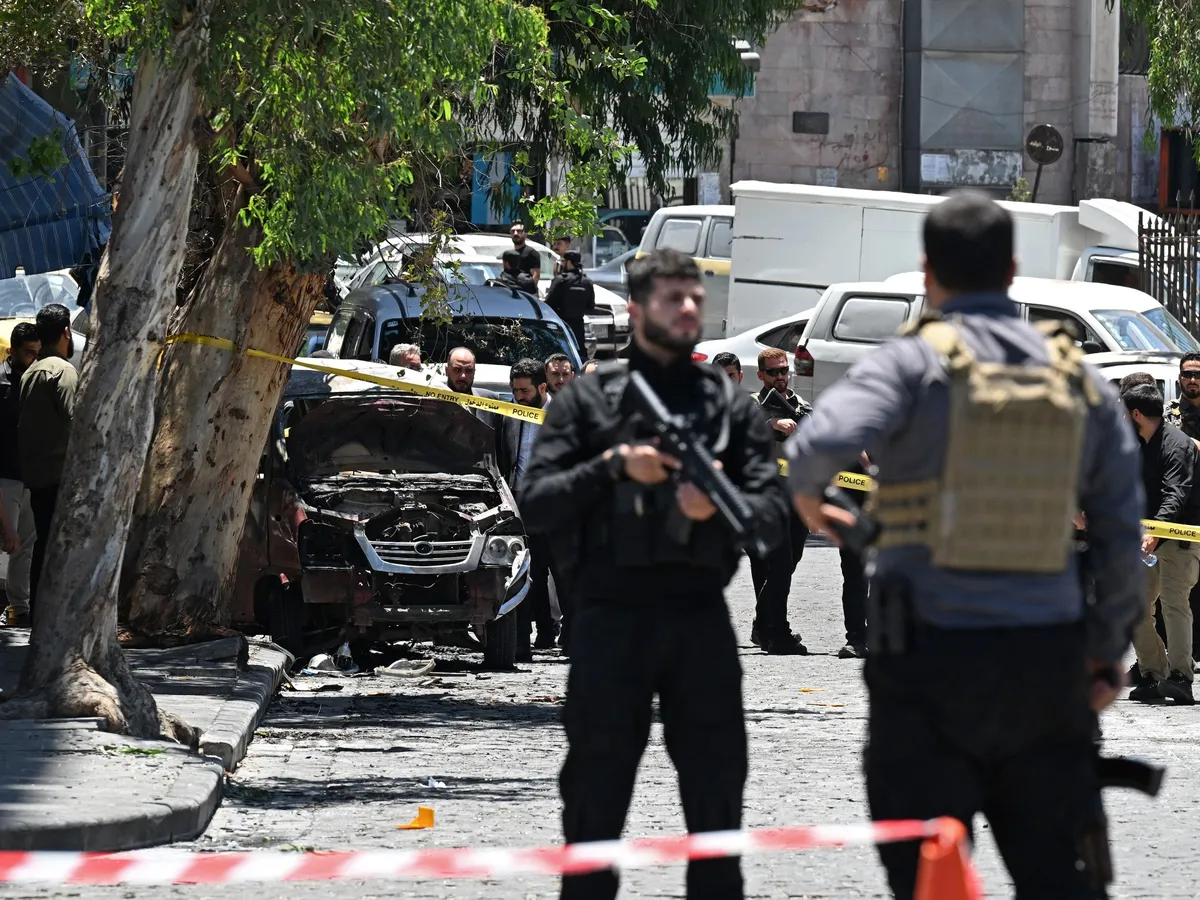
Damascus shaken by twin blasts during Macron’s visit, marking heightened threats to Syria’s fragile stabilitySecurity personnel stand guard near the Four Seasons Hotel following two blasts nearby in Damascus on July 7, 2026 [Louai Beshara/AFP]Published On 8 Jul 2026Damascus was rocked on Tuesday by explosions during a visit by French President Emmanuel Macron, the first European Union leader to visit the country since forces led by President Ahmed al-Sharaa deposed Bashar al-Assad in December 2024.A separate bomb explosion at a Damascus cafe last week killed at least nine people.Recommended Stories list of 4 itemslist 1 of 4Eighteen wounded as explosions rock Damascus during Macron’s visit to Syrialist 2 of 4Explosions in Damascus as French president visitslist 3 of 4Syria’s capital rocked by blasts during Macron visitlist 4 of 4Explosions in Damascus during Macron visit to Syria: What we knowend of listEighteen people were reported injured in the latest explosions on Tuesday, which occurred after an initial device that security forces were defusing near the French president’s hotel detonated, followed by a second explosion some minutes later, the state news agency, SANA, reported.Al-Sharaa’s government has faced innumerable challenges since al-Assad’s ouster two years ago. Having taken control of a bitterly divided country wracked by years of civil war, which served as a theatre for outside actors such as Russia, Iran, and its various allied Shia militias, joblessness remains high and the rule of law uncertain.While responsibility for the recent spate of bombings remains unknown, conjecture is centring upon the remnants of the ISIL (ISIS) group. Its former capital, Raqqa, in northeastern Syria became synonymous with its brutal excesses, and the group remains a tangible force on the ground. The United Nations estimates the group still boasts between 1,500 and 3,000 fighters across Syria and neighbouring Iraq.ISIL “is still around and still active”, Aron Lund, a fellow at Century International, a New York-headquartered think tank, told Al Jazeera, adding that, so far, speculation on responsibility for the recent bombing had largely centred upon the group.“It’s not really about numbers. You just need a couple of guys to make and plant a bomb to create an outsized impact,” he said, referring to the government’s efforts to project a sense of normalcy and attract tourism and much-needed foreign investment, which bombings such as Tuesday’s can easily derail. “From a political and psychological view, these things couldn’t come at a worse time,” Lund added.France’s President Emmanuel Macron, right, shakes hands with Syrian President Ahmed al-Charaa during a visit to the Umayyad Mosque in Damascus [Ludovic Marin/Pool/AFP]Presence of armed groups and factionsWhile al-Sharaa has defied expectations in regaining control of nearly all of Syria after years of fighting, in some areas the rule of law is at best maintained by local militias co-opted into the army, or is barely existent at all. Other fighting groups also remain active after years of conflict.In addition to those who remain loyal to the former al-Assad regime, a number of the Shia militias that originally allied with Iran to back the previous government remain active. All the while, mistrust and rivalries with neighbours Iran and Iraq, the Lebanese armed group Hezbollah, and Israel – which has proven eager to support minority groups, such as Syria’s Druze, against the government – threaten the state-building project al-Sharaa began in December 2024“Damascus controls most of Syria in formal terms, including the main cities and the northeast after the January integration deal,” Nanar Hawach, a senior analyst with the Crisis Group, said, adding that government control ranged from its strongest in western and central areas to its weakest along the southern border and in Druze-majority regions.Syrian security forces deploy amid clashes between tribal and Bedouin fighters on one side, and Druze gunmen on the other in July 2025 [Abdulaziz Ketaz/AFP]“Syria’s remaining opponents fall into three distinct challenges with different aims and methods,” Hawach continued. “ISIL cells seek to undermine the new order through attacks from within government-held areas, former regime remnants act as scattered spoiler networks through sabotage, and armed actors in Suwayda and the northeast retain the capacity to use force to contest how Damascus governs and integrates them.”Matters between the Druze and the local population reached a head in July 2025 when fighting between Druze and local Bedouins spilled over into open conflict, allowing Israel to intervene on what it claimed was the Druze’s behalf to shell Suwayda after Syrian government forces entered the Druze-majority city.Forces loyal to the former regime have also been active in recent weeks. Earlier this week, al-Assad’s billionaire cousin Rami Makhlouf, who Al Jazeera reported in January had been funnelling money from exile in Moscow to Alawite forces in Syria, issued a video appearing to threaten the government in Damascus. Calling for all Alawite prisoners to be released, Makhlouf warned, “When I say I’ll do something, I do it.”Internal threatAnalysts warned that some of al-Sharaa’s challenges might ironically be coming from quarters he once relied upon. In securing his rapid advance in December 2024, al-Sharaa drew heavily from forces from the conservative Hay’at Tahrir al-Sham (HTS) group, alongside a variety of rival and often equally religiously inspired groups.However, after the elation of al-Assad’s ousting has come the harsh reality of governing a country destroyed by 14 years of brutal war and an economy devastated by corruption and a vast array of sanctions.While foreign investment has yet to take hold, sanctions relief has been coming. In June 2025, US President Donald Trump startled many, not least among his critics within Syria, by waiving sanctions on “entities critical to Syria’s development, the operation of its government, and the rebuilding of the country’s social fabric”, the US Department of the Treasury said in a statement.However, while sanctions relief may prove crucial to securing future investment, it raises the prospect of undermining much of al-Sharaa’s backing among the now mostly unemployed conservative young men who were critical in helping him seize and sustain power.“I think the greatest threat to the new government comes from within,” Caroline Rose of the New Lines Institute said, adding that the risk was posed “not from a singular group or individual, but rather a pattern of division”.“I think elements within al-Sharaa’s core constituency and former HTS circle could feasibly mount a campaign against the new administration and al-Sharaa individually, if they continue to experience grievances over a more moderate governmental agenda that emphasises engagement with the West.”
SRCAl Jazeera
LANGEN
LEANCenter
WORDS1 061
ENT12
WED · 2026-07-08 · 05:10 GMTBRIEF NSR-2026-0708-91092
NSR-2026-0708-91092News Report·EN·Conflict
Syria grapples with unrest as government faces old and new threats
Damascus experienced twin explosions on July 7, 2026, during a visit by French President Emmanuel Macron, injuring eighteen people. These blasts occurred shortly after a separate cafe bombing killed nine.
Simon Speakman CordallAl JazeeraFiled 2026-07-08 · 05:10 GMTLean · CenterRead · 5 min
Al JazeeraFIG 01
Reading time
5min
Word count
1 061words
Sources cited
2cited
Entities identified
12entities
Quality score
100%
§ 01
Briefing Summary
AI-generatedNEWSAR · AI
Damascus experienced twin explosions on July 7, 2026, during a visit by French President Emmanuel Macron, injuring eighteen people. These blasts occurred shortly after a separate cafe bombing killed nine. The new Syrian government, led by President Ahmed al-Sharaa since deposing Bashar al-Assad in December 2024, faces significant challenges including high unemployment and uncertain rule of law. While responsibility for the bombings is unconfirmed, speculation centers on remnants of the ISIL group, estimated to have 1,500-3,000 fighters. The government also contends with former regime loyalists, Shia militias, and regional rivalries with Iran, Iraq, Hezbollah, and Israel, as well as internal conflicts in areas like Suwayda.
Confidence 0.90Sources 2Claims 5Entities 12
§ 02
Article analysis
Model · rule-basedFraming
Conflict
Diplomatic
Tone
Mixed Tone
AI-assessed
CalmNeutralAlarmist
Factuality
0.70 / 1.00
Factual
LowHigh
Sources cited
2
Limited
FewMany
§ 03
Key claims
5 extracted01
Bombings like Tuesday's can derail the government's efforts to project normalcy and attract investment.
quoteAron Lund
Confidence
0.90
02
The United Nations estimates ISIL still boasts between 1,500 and 3,000 fighters across Syria and Iraq.
statisticUnited Nations
Confidence
0.90
03
Damascus was rocked by explosions during a visit by French President Emmanuel Macron on July 8, 2026.
factualSANA
Confidence
0.90
04
Al-Sharaa's government has faced challenges including high joblessness and uncertain rule of law since deposing Bashar al-Assad.
factual
Confidence
0.80
05
Eighteen people were reported injured in the explosions.
factualSANA
Confidence
0.80
§ 04
Full report
5 min read · 1 061 words§ 05
Entities
12 identifiedKey playerOppositionContextPositiveNeutralNegative
People3
Organizations3
§ 06
Keywords & salience
9 termsdamascus explosions
1.00
syria unrest
1.00
ahmed al-sharaa government
0.90
bashar al-assad ouster
0.80
isil (isis) group
0.70
syrian civil war
0.60
emmanuel macron visit
0.50
fragile stability
0.50
foreign investment
0.40
§ 07
Topic connections
Interactive graph Network visualization showing 51 related topics
View Full Graph Person Organization Location Event|Click node to navigate|Edge numbers = shared articles