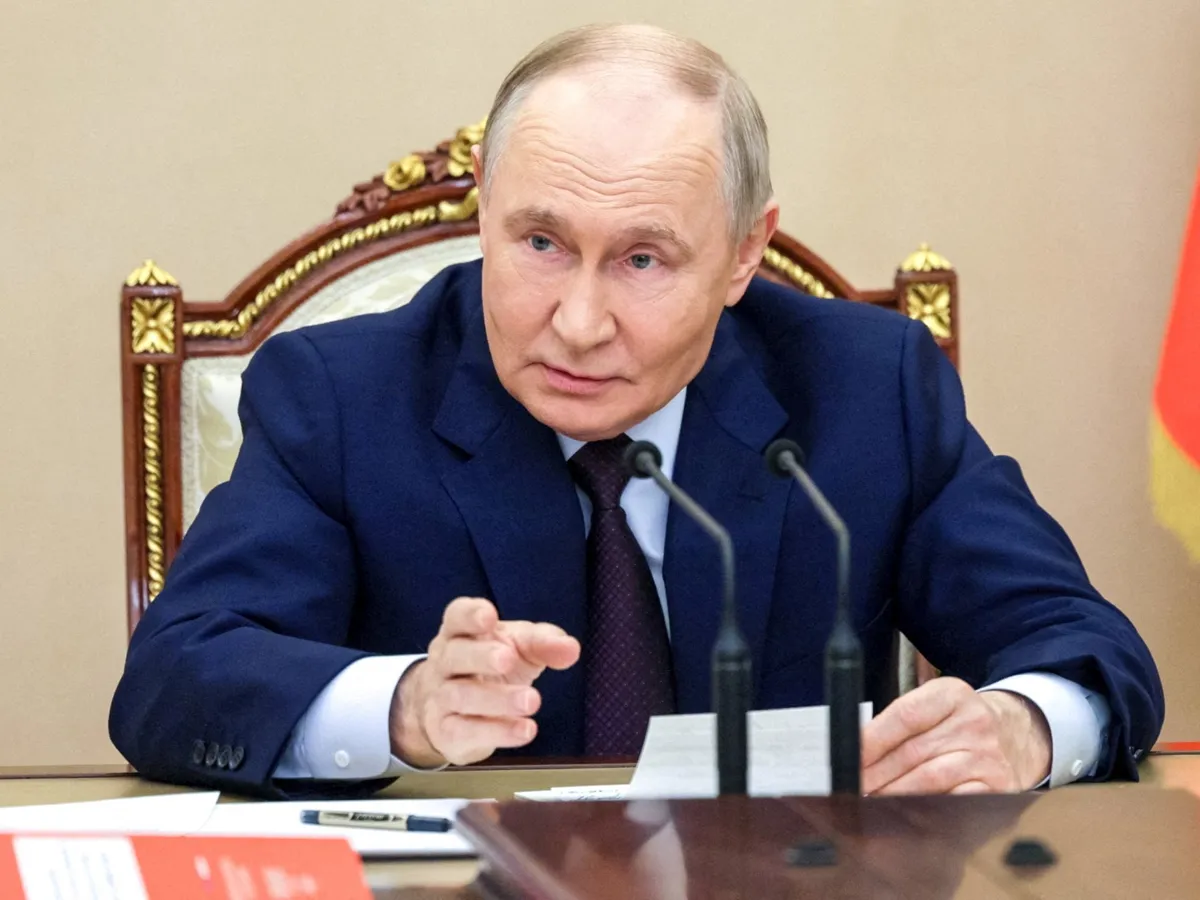
EXPLAINERBelgium is pushing back against a plan to use frozen Russian assets to support Ukraine’s economy and war effort.Russian President Vladimir Putin chairs a meeting with members of the Security Council in Moscow, Russia [File: Gavriil Grigorov/Reuters]Published On 4 Dec 2025The European Union has unveiled plans to use billions of euros in frozen Russian assets to help cover Ukraine’s war needs over the next two years. But Belgium is pushing back following the announcement on Wednesday, arguing that the plan carries legal and financial risks that it fears it could end up shouldering alone.European Commission President Ursula von der Leyen said that Brussels would supply 90 billion euros ($105bn) of Ukraine’s budget requirements for 2026-27, estimated by the International Monetary Fund to be 137 billion euros ($159bn). She said that other “international partners” would cover the rest.Recommended Stories list of 4 itemslist 1 of 4EU proposes using Russian assets, loans to fund $105bn package to Ukrainelist 2 of 4Putin says Russia ready to take Ukraine’s eastern Donbas region ‘by force’list 3 of 4Russia-Ukraine war: List of key events, day 1,379list 4 of 4Putin visits India amid Ukraine peace push: What’s on the agenda?end of list“Today, we are sending a very strong message to the Ukrainian people. We are with them for the long haul,” von der Leyen said.Frozen Russian funds held in Europe would be used as collateral for a “reparations loan” designed to sustain Ukraine’s war effort, and which Ukraine would ultimately pay back after it obtains compensation for the war from Russia.Aid could also be funded through common EU borrowing, but, despite Belgian objections, most European officials have expressed a preference for using frozen Russian assets. The EU’s controversial plan comes as the latest round of United States-led peace talks between Russia and Ukraine shows little sign of progress.Moscow has denounced the reparations loan plan as “theft”.How is the EU proposing to finance Ukraine?Since Russia’s full-scale invasion of Ukraine in February 2022, the European bloc has committed more than 170 billion euros ($197bn) to Ukraine, mainly in the form of military and humanitarian support. The European Commission is now pledging to provide more money for another two years in the form of loans.On Wednesday, long-awaited details of the EU plan for a “reparations loan” were published. Under it, some 90 billion euros ($104bn) of frozen Russian assets will be used as collateral for a loan to Ukraine.Under a loan arrangement, repayment to creditors – both government and private lenders – will be guaranteed by the present and future earnings of the frozen assets. Ukraine would then repay the loan once Moscow compensates Kyiv for the destruction caused by its invasion.“It’s quite a clever tactic,” Gregoire Roos, director of the Europe and Russia and Eurasia Programmes at Chatham House, told Al Jazeera. “They’re not seizing the assets. Rather, they are keeping them frozen and monetising them.”Roos added that “while assets have been frozen in previous conflicts … this is significant in Europe owing to the scale”.“There is no precedent for this,” he said.Von der Leyen said the funds would provide Ukraine with more leverage in peace talks and demonstrate to Moscow that “the prolongation of the war on their side comes with a high cost for them”. She added that Washington had been briefed on the plan.If von der Leyen’s reparations-loan plan fails to win unanimous EU member-state support, she hinted that the EU could fall back on market borrowing. However, this would require unanimous agreement from the bloc, giving Hungary another opportunity to veto Ukraine aid.Hungary has repeatedly vetoed EU assistance to Ukraine because Prime Minister Viktor Orban’s government argues that arming Kyiv will prolong the war and increase the EU’s collective debt. Orban has also maintained unusually warm ties with Vladimir Putin compared to other EU leaders.Why does Belgium object to this plan?Belgium worries that Euroclear – the Brussels-based financial clearing house that holds the bulk of the frozen Russian assets – could end up entangled in damaging litigation if Russia challenges the EU decision, or if the action harms Euroclear’s reputation and business model.In theory, Russia could challenge the asset-freeze decision in a court in Belgium, where Euroclear is incorporated.Addressing an audience at NATO’s headquarters in Brussels on Wednesday, Belgian Foreign Minister Maxime Prevot said: “We are not seeking to antagonise our partners or Ukraine. We are simply seeking to avoid potential disastrous consequences for a member state that is being asked to show solidarity without being offered the same solidarity in return.”Prevot said Belgium views “the option of the reparations loan the worst of all, as it is risky” and “has never been done before”. Instead, he wants the EU to pursue ordinary market borrowing to fund a loan to Ukraine. “It is a well-known, a robust and a well-established option with predictable parameters,” he said.He is strongly supported by Belgian officials who have doubled down on their opposition to the reparations loan in recent weeks, especially after a 28-point plan for a peace deal by the administration of US President Donald Trump was made public, and included plans to use the frozen assets.To address Belgium’s concerns, the European Commission’s blueprint does include measures to shield EU governments from “possible retaliation from Russia”, and to establish an EU-level borrowing mechanism to “underpin a loan to Ukraine”. However, Prevot emphasised that “the reparation loans scheme entails consequential economic, financial and legal risks”, and argued that the commission’s safeguards do not go far enough, leaving Belgium exposed.“It is not acceptable to use the money and leave us alone facing the risks,” he said.How much money is at stake?Some 290 billion euros ($337bn) of Russia’s sovereign wealth – principally in the form of foreign-exchange reserves held as cash and bonds – was frozen by Western powers following Moscow’s invasion of Ukraine nearly four years ago.A large portion of those assets is held in Belgium, where roughly 194 billion euros ($225bn) was held as of June this year. Euroclear alone holds about 183 billion euros ($212bn) of these assets. Smaller amounts of assets are also held in the US, United Kingdom, and Japan.Under a plan agreed by Group of Seven (G7) countries in 2024, Ukraine would be provided with loans to be repaid using the interest earned on Russia’s foreign frozen assets, effectively leaving the assets untouched but allowing Kyiv to benefit from the income they generate.Yesterday’s announcement goes one step further by collateralising the frozen funds.What do Belgium’s EU partners say?On Wednesday, von der Leyen said she was considering Belgium’s objections. “We have listened very carefully to Belgium’s concerns, and we have taken almost all of them into account in our proposal. We will share the burden in a fair way, as it is the European way,” she said.Other European officials echoed this. Johann Wadephul, Germany’s minister of foreign affairs, said: “We take Belgium’s concerns seriously. They are justified, but the issue can be resolved. It can be resolved if we are prepared to take responsibility together.”Elsewhere, David van Weel, the Netherlands’ minister of foreign affairs, highlighted the stakes of Belgium’s recalcitrance. “These funds are really, really important. We need to support the Ukrainian economy; otherwise, they will have a very tough time next year.”Van Weel emphasised that EU member states have listened to Belgium. “We understand the Belgian concerns, and we are willing to at least make sure that they are not alone in this,” he said.Other EU countries have already signalled readiness to backstop potential losses for Belgium.Belgium, meanwhile, has been collecting tax revenue from the immobilised Russian funds, and interest from the assets is already being directed into a G7-organised loan package for Ukraine.
SRCAl Jazeera
LANGEN
OutletState media · Qatar
WORDS1,269
ENT6
THU · 2025-12-04 · 15:39 GMTBRIEF NSR-2025-1204-926
NSR-2025-1204-926News Report·EN·Political Strategy
Why is Belgium opposed to using Russian assets to support Ukraine?
The European Union plans to use approximately 90 billion euros in frozen Russian assets to help fund Ukraine's budget requirements for 2026-27. This funding would come in the form of a "reparations loan" that Ukraine would eventually repay using compensation from Russia.
Alex Kozul-WrightAl JazeeraFiled 2025-12-04 · 15:39 GMTOutlet · State media · QatarRead · 6 min
Al JazeeraFIG 01
Reading time
6min
Word count
1,269words
Sources cited
2cited
Entities identified
6entities
NEWSAR · AI
The European Union plans to use approximately 90 billion euros in frozen Russian assets to help fund Ukraine's budget requirements for 2026-27. This funding would come in the form of a "reparations loan" that Ukraine would eventually repay using compensation from Russia. However, Belgium is resisting the EU plan, expressing concerns about potential legal and financial risks, fearing they might disproportionately bear the burden. The EU's proposal aims to provide long-term financial support to Ukraine amidst the ongoing conflict with Russia, but faces opposition from at least one member state. Moscow has condemned the plan as theft.
Confidence 0.90Sources 2Claims 5Entities 6
Framing
Political Strategy
Economic Impact
Tone
Measured
AI-assessed
CalmNeutralAlarmist
Factuality
0.80 / 1.00
Factual
LowHigh
Sources cited
2
Limited
FewMany
01
Moscow has denounced the reparations loan plan as “theft”.
quoteMoscow
Confidence
1.00
02
The International Monetary Fund estimates Ukraine's budget requirements for 2026-27 to be 137 billion euros.
statisticInternational Monetary Fund
Confidence
1.00
03
European Commission President Ursula von der Leyen said that Brussels would supply 90 billion euros of Ukraine’s budget requirements for 2026-27.
quoteUrsula von der Leyen
Confidence
1.00
04
The European Union has unveiled plans to use billions of euros in frozen Russian assets to help cover Ukraine’s war needs over the next two years.
factualnull
Confidence
1.00
05
Belgium is pushing back against a plan to use frozen Russian assets to support Ukraine’s economy and war effort.
factualnull
Confidence
1.00
§ 04
Full report
6 min read · 1,269 wordsKey playerOppositionContextPositiveNeutralNegative
Organizations1
ukraine
1.00
russian assets
1.00
reparations loan
0.90
european union
0.80
financial risks
0.70
belgium
0.60
war effort
0.60
frozen assets
0.50
eu borrowing
0.40
§ 07
Connections
Who appears together in the newsIn this articleWider coverageLine weight = articles in common
Laying out network…
Strongest ties articles in common
- 3,928
- 1,299
- 1,089
- 794
- 750
- 299
Recurring context not named in this article
- PVolodymyr Zelenskyylinks 6
- LIranlinks 6
- PDonald Trumplinks 6
- ONATOlinks 6
- LFrancelinks 6
- LGermanylinks 6
- LChinalinks 6
- LUnited Stateslinks 6